
By Charles A. Eastman (Ohiyesa)

Chief Joseph of the Nez Perce.
Let me be a free man, free to travel, free to stop, free to work, free to trade where I choose, free to choose my own teachers, free to follow the religion of my fathers, free to talk, think, and act for myself — and I will obey every law or submit to the penalty. Hin-mah-too-yah-lat-kekht has spoken for his people.
–– Chief Joseph
Like other tribes too large to be united under one chief, the Nez Perce tribe of Indians was composed of several bands, each distinct in sovereignty. It was a loose confederacy. Joseph and his people occupied the Imnaha or Grande Ronde Valley in Oregon, which was considered perhaps the finest land in that part of the country.
When the last treaty was entered into by some of the bands of the Nez Perce, Joseph’s band was at Lapwai, Idaho, and had nothing to do with the agreement. The elder chief, in dying, counseled his son, who was not more than twenty-two or twenty-three years of age, never to part with their home, assuring him that he had signed no papers. These peaceful, non-treaty Indians did not even know what land had been ceded until the agent read them the government order to leave. Of course, they refused. You and I would have done the same.
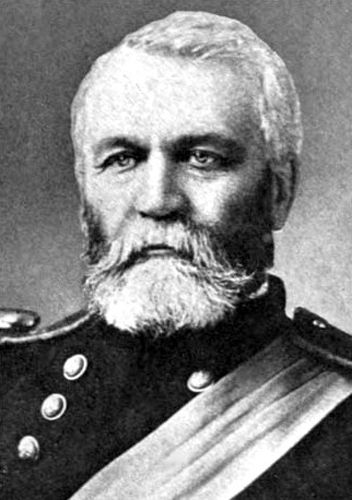
General O.O. Howard.
When the agent failed to move them, he and the would-be settlers called upon the army to force them to be good, namely, without a murmur, to leave their pleasant inheritance in the hands of a crowd of greedy grafters. General O. O. Howard, the Christian soldier, was sent to do the work.
He had a long council with Joseph and his leading men, telling them they must obey the order or be driven out by force. We may be sure that he reluctantly presented this hard alternative. Joseph was a mere youth without experience in war or public affairs. He had been well brought up in obedience to parental wisdom, and his brother Ollicut had attended Missionary Spaulding’s school, where they had listened to the story of Christ and his religion of brotherhood. He now replied in his simple way that neither he nor his father had ever made any treaty disposing of their country, that no other band of the Nez Perce was authorized to speak for them, and it would seem a mighty injustice and unkindness to dispossess a friendly band.
General Howard told them, in effect, that they had no rights, no voice in the matter: they had only to obey. Although some of the lesser chiefs counseled revolt then and there, Joseph maintained his self-control, seeking to calm his people. He was still groping for a peaceful settlement of their difficulties. He finally asked for 30 days to find and dispose of their stock, which was granted.
Joseph steadfastly held his immediate followers to their promise. Still, the land-grabbers were impatient and did everything in their power to bring about an immediate crisis to hasten the eviction of the Indians. Depredations were committed, and finally, the Indians, or some of them, retaliated, which was what their enemies had been looking for. There might be a score of white men murdered among themselves on the frontier, and no outsider would ever hear about it, but if an Indian injured one –“Down with the bloodthirsty savages!” was the cry.
Joseph told me that during those 30 days, tremendous pressure was placed on him by his people to resist the government order. “The worst of it was,” said he, “that everything they said was true; besides,” — he paused for a moment — “it seemed very soon for me to forget my father’s dying words, ‘Do not give up our home!'” Knowing as I do just what this would mean to an Indian, I felt for him deeply.
Among the opposition leaders were Too-hul-hul-sote, White Bird, and Looking Glass, all strong men and respected by the Indians. On the other side were men built up by government emissaries for their own purposes and advertised as “great friendly chiefs.” As a rule, such men are unworthy, and this is so well known to the Indians that it makes them distrustful of the government’s sincerity at the start. Moreover, while Indians unqualifiedly say what they mean, the whites have a hundred ways of saying what they do not mean.
The storm’s center was this simple young man, who, so far as I can learn, had never been upon the warpath, and he stood firm for peace and obedience. As for his father’s sacred dying charge, he told himself that he would not sign any papers, he would not go out of his free will but from compulsion, and this was his excuse.
However, the whites were unduly impatient to clear the coveted valley, and they aggravated an already strained situation to the danger by their insolence. The murder of an Indian was the climax, which happened in the young chief’s absence. He returned to find the leaders determined to die fighting. The nature of the country was in their favor, and at least they could give the army a chase, but how long they could hold out, they did not know. Even Joseph’s younger brother Ollicut was won over. There was nothing for him to do but fight, and then, there began the peaceful Joseph’s career as a general of unsurpassed strategy in conducting one of the most masterly retreats in history.
This is not my judgment but the unbiased opinion of men whose knowledge and experience fit them to render it. Remember that these people were not scalp hunters like the Sioux, Cheyenne, and Ute, but peaceful hunters and fishermen. The first council of war was a strange business to Joseph. He had only this to say to his people:
“I have tried to save you from suffering and sorrow. Resistance means all of that. We are few. There are many. You can see all we have at a glance. They have food and ammunition in abundance. We must suffer great hardship and loss.” After this speech, he quietly began planning the defense.
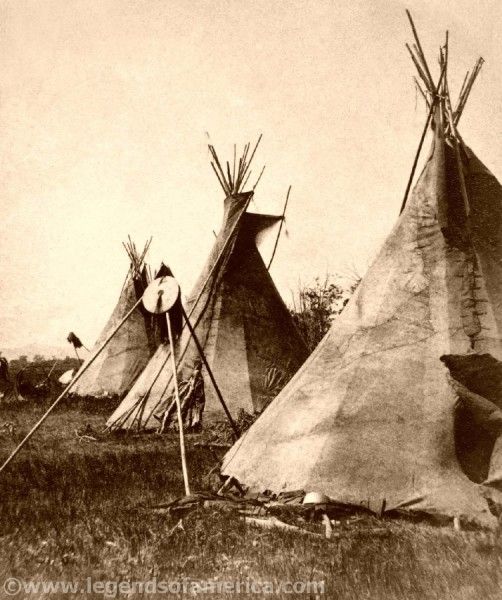
Nez Perce Tipis, Montana, 1871.
The main plan of the campaign was to engineer a successful retreat into Montana and form a junction with the hostile Sioux and Cheyenne under Sitting Bull. There was a relay scouting system: one set of scouts left the main body in the evening and the second a little before daybreak, passing the first set on some commanding hilltop. There were also decoy scouts set to trap Indian scouts of the army. I noticed that General Howard charged his Crow Scouts with being unfaithful.
Their most significant difficulty was meeting an unencumbered army while carrying their women, children, and old men, along with necessary supplies and household effects. Joseph formed an auxiliary corps to effect a retreat at each engagement upon a definite plan and in a definite order. At the same time, the unencumbered women were made into an ambulance corps to care for the wounded.
It was decided that the main rear guard should meet General Howard’s command in White Bird Canyon. Every detail was planned yet left flexible in accordance with Indian custom, giving each leader freedom to act according to circumstances. Perhaps no better ambush was ever planned than the one Chief Joseph set for the shrewd and experienced General Howard. He expected to be hotly pursued, but he calculated that the pursuing force would consist of not more than 250 soldiers.
He prepared false trails to mislead them into thinking he was about to cross or had crossed the Salmon River, which he had no thought of doing then. Some of the tents were pitched in plain sight. At the same time, the women and children were hidden on the inaccessible ridges, and the men were concealed in the canyon, ready to fire upon the soldiers with deadly effect and scarcely any danger to themselves. They could even roll rocks upon them.
In a few minutes, the troops had learned a lesson. The soldiers showed some fighting ability, but a large body of frontiersmen who accompanied them soon became disorderly. The warriors chased them nearly ten miles, securing rifles and ammunition and killing and wounding many.
The Nez Perce next crossed the river, made a detour, re-crossed it at another point, and then took their way eastward. All this was to delay pursuit. Joseph told me that he estimated it would take six or seven days to get a sufficient force in the field to take up their trail, and the correctness of his reasoning is apparent from the facts detailed in General Howard’s book.
He tells us that he waited six days for the arrival of men from various forts in his department. He followed Joseph with 600 soldiers, many citizen volunteers, and his Indian scouts. As it was evident they had a long chase over trackless wilderness in prospect, he discarded his supply wagons and took pack mules instead. But by this time, the Indians had a good start.
Meanwhile, General Howard sent a dispatch to Colonel Gibbons with orders to head Joseph off, which he undertook at the Montana end of the Lolo Trail. The wily commander did not know this move, but he was not to be surprised. He was too brainy for his pursuers, whom he constantly outwitted, and only gave battle when he was ready. He met Colonel Gibbons’ fresh troops at the Big Hole Pass and pressed them close. He sent a party under his brother Ollicut to harass Gibbons’ rear and rout the pack mules, thus throwing him on the defensive and causing him to send for help. At the same time, Joseph continued his masterly retreat toward Yellowstone Park, then a wilderness. However, this was a slight advantage to him since he must necessarily leave a broad trail, and the army was augmenting its columns daily with celebrated scouts, both white and Indian. The two commands came together, and although General Howard says their horses were by this time worn out, and by inference the men as well, they persisted on the trail of a party encumbered by women and children, the old, sick, and wounded.
It was decided to send a detachment of cavalry under Bacon to Tash Pass, the gateway of the National Park, which Joseph would have to pass, with orders to detain him there until the rest could come up with them. Here is what General Howard says of the affair. “Bacon got into position soon enough, but did not have the heart to fight the Indians because of their number.” Meanwhile, another incident occurred. Under the eyes of the chosen scouts and vigilant sentinels, Joseph’s warriors fired upon the army camp at night and ran off their mules. He went straight toward the park, where Lieutenant Bacon let him get by and pass through the narrow gateway without firing a shot.
Here again, it was demonstrated that General Howard could not depend upon the volunteers, many of whom had joined him in the chase and would show the soldiers how to fight Indians. In this night attack at Camas Meadow, they were demoralized, and while crossing the river the next day, many lost their guns in the water. After that, everyone packed up and went home, leaving the army to be guided by the Indian scouts.
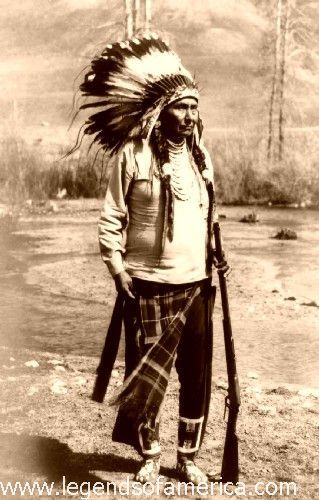
Chief Joseph, Nez Perce.
However, this succession of defeats did not discourage General Howard, who kept on with as many of his men as could carry a gun. Meanwhile, he sent dispatches to all the frontier posts with orders to intercept Joseph if possible. Sturgis tried to stop him as the Indians entered the Park, but they did not meet until he was about to come out, when another fight broke out, with Joseph again victorious. General Howard arrived on the battlefield soon afterward and saw that the Indians were off again; from there, he sent new messages to General Miles, asking for reinforcements.
Joseph had now turned northeastward toward the Upper Missouri River. He told me that when he got into that part of the country, he knew he was very near the Canadian line and could not be far from Sitting Bull, with whom he desired to ally.
He also believed that he had cleared all the forts. Therefore, he went more slowly and tried to give his people some rest. Some of their best men had been killed or wounded in battle, and the wounded were a significant burden to him; nevertheless, they were carried and tended patiently during this wonderful flight. Not one was ever left behind.
It is a general belief that Indians are cruel and vengeful, and surely these people had reason to hate the race that had driven them from their homes, if any people ever had. Yet it is a fact that when Joseph met visitors and travelers in the Park, some of whom were women, he allowed them to pass unharmed and, in at least one instance, let them have horses. He told me that he gave strict orders to his men not to kill any women or children. He wished to meet his adversaries on their terms of warfare. Still, he afterward learned that despite professions of humanity, white soldiers have not seldom been known to kill women and children indiscriminately.
Another remarkable thing about this noted retreat is that Joseph’s people stood behind him to a man, and even the women and little boys did each his part. The latter were used as scouts near the camp.
The Bittersweet valley they had now entered was full of game, and the Indians hunted for food while resting their worn-out ponies. One morning, they had a council to which Joseph rode over bareback as they had camped in two divisions a little apart. His 15-year-old daughter went with him. They discussed sending runners to Sitting Bull to determine his exact whereabouts and whether he would be willing to join forces with the Nez Perce. Amid the council, a force of United States cavalry charged down the hill between the two camps. This once, Joseph was surprised. He had seen no trace of the soldiers and had somewhat relaxed his vigilance.
He told his little daughter to stay where she was, and himself cut right through the cavalry and rode up to his teepee, where his wife met him at the door with his rifle, crying: “Here is your gun, husband!” The warriors quickly gathered and pressed the soldiers so hard that they had to withdraw. Meanwhile, one group fled, while Joseph’s band entrenched itself in a favorable position from which it could not easily be dislodged.
General Miles had received and acted on General Howard’s message, and he sent one of his officers, accompanied by some Indian scouts, into Joseph’s camp to negotiate with the chief. In the meantime, Howard and Sturgis came up with the encampment, and Howard had two friendly Nez Perce scouts who were directed to talk to Joseph in his own language. He decided that there was nothing to do but surrender.
He had believed that his escape was all but secure; at the last moment, he was surprised and caught at a disadvantage. His army was shattered; he had lost most of the leaders in these various fights; his people, including children, women, and the wounded, had traveled 1,300 miles in about 50 days, and he himself, a young man who had never before taken any important responsibility!
Even now, he was not conquered. He was well entrenched; his people were willing to die fighting, but the army of the United States offered peace, and he agreed, as he said, out of pity for his suffering people. Some of his warriors still refused to surrender and slipped out of the camp at night and through the lines. As he told me, Joseph had between three and four hundred fighting men in the beginning, which means over one thousand persons, and of these, several hundred surrendered with him.
His own account of the conditions he created was prepared by him with my help in 1897, when he came to Washington to present his grievances. I sat up with him nearly all of one night; I may add that we took the document to General Miles, who was then stationed in Washington, before presenting it to the Department. The General said that every word of it was true. In the first place, his people were to be kept at Fort Keogh, Montana, over the winter and then returned to their reservation.
Colville Reservation in Washington State.
Instead, they were taken to Fort Leavenworth, Kansas, and placed between a lagoon and the Missouri River, where the sanitary conditions wreaked havoc on them. Those who did not die were then taken to the Indian Territory, where the health situation worsened. Joseph repeatedly appealed to the government, and at last, with the help of Bishops Whipple and Hare, he was moved to the Colville Reservation in Washington. Here, the land was impoverished, unlike in their fertile valley. General Miles told the chief that he had recommended and urged that their agreement be kept. Still, the politicians and people who occupied the Indians’ land declared they were afraid he would break out again and murder innocent white settlers if he returned! What irony!
The great Chief Joseph died broken-spirited and broken-hearted (September 21, 1904). He did not hate the whites, for there was nothing small about him, and when he laid down his weapons, he would not fight on with his mind. But he was profoundly disappointed in the claims of a Christian civilization.
I call him great because he was honest and straightforward. Without education or special training, he demonstrated his ability to lead and fight when justice demanded. He outgeneraled the best and most experienced commanders in the United States Army, even though their troops were well-provisioned, well-armed, and, above all, unencumbered. He was great, finally, because he never boasted of his remarkable feat. I am proud of him because he was a true American.
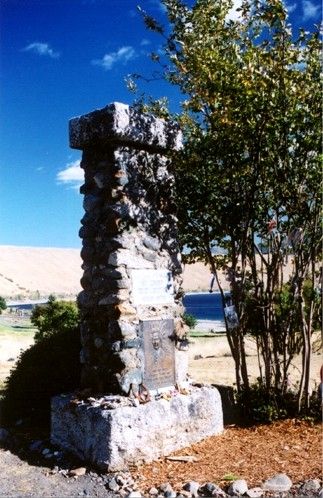
Nez Perce Chief Joseph’s grave marker, Wallowa
Lake, Oregon, photo courtesy of the Nez Perce.
By Charles A. Eastman, 1918. Compiled and edited by Kathy Alexander/Legends of America, updated November 2025.
Also See:
Nez Perce – A Hard Fight For Their Homeland
Nez Perce National Historic Trail
Excerpted from the book Indian Heroes and Great Chieftains by Charles A. Eastman, 1918. The text as it appears here, however, is not verbatim, as it has been edited for clarity and ease for the modern reader. Charles A. Eastman earned a medical degree from Boston University School of Medicine in 1890 and then began working for the Office of Indian Affairs later that year. He worked at the Pine Ridge Agency, South Dakota, and was an eyewitness to both events leading up to and following the Wounded Knee Massacre of December 29, 1890. He was part Sioux and knew many of the people he wrote about.