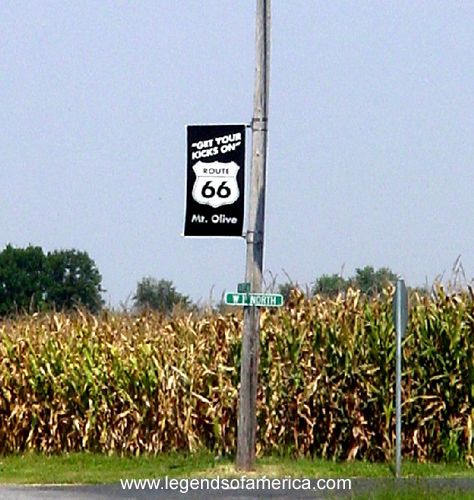
Route 66 in Mt. Olive, Illinois.
As the tallgrass prairie gradually rolls into the Ozarks, you will soon arrive in the small town of Mt. Olive. The land the town now sits on once belonged to a German immigrant named John C. Niemann, who bought forty acres in 1846. After he was established and had purchased even more land, he sent for his brothers, Fred and Henry, who bought property adjoining John’s farm.
Soon, more Germans came to the area, and Niemann built the first store to serve the many settlers. The store housed the post office, and Niemann became postmaster in what was then known as Niemann’s Settlement. In 1868, a man named Corbus J. Keiser purchased a half interest in the store, which was renamed Niemann & Keiser.
Afterward, Kieser, along with a man named Mient Arkebauer, laid out a town plat on Niemann’s original forty acres. The town was named Oelburg, which means “Mount of Olives.” In 1870, when the railroad came through, the settlement’s name changed once again to Drummond Station. A few years later, in 1874, Neimann sold his interest in the store. It would be more than a decade before the town finally settled on the name Mt. Olive.
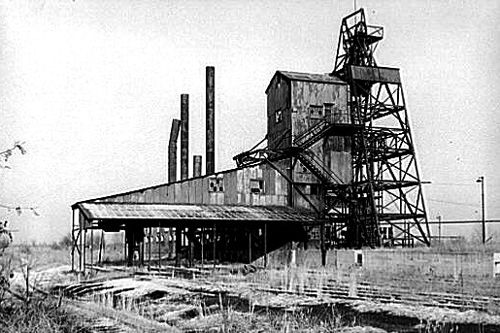
Illinois Coal Mine.
Meanwhile, C.J. Keiser began building an empire, opening the first coal shaft in 1875, establishing a milling business in 1876, and opening one of the first banks in 1882. Keiser was one of twelve original stockholders who owned the mine works. Coal mining in the area began to attract immigrants by the hundreds to work in the many mines.
While mining brought prosperity to southern Illinois, it also brought violence, property damage, and grief as turmoil raged between union activists and mine owners. After miners worked for years under dangerous, harsh conditions for very little pay, the first nationwide union, the United Mine Workers of America, formed in 1890 to fight unfair wages and company stores. During this time, mine companies controlled workers’ lives, as they owned the mining towns and nearly everything within them.
Miners lived in company houses and were often paid with scrip or coupons redeemable only at company stores, which charged higher prices than other retail businesses. In addition, workers had to buy their own tools, maintain them, and even buy the oil for the lamps they used underground. At first, the union had little effect on company owners because if union members went on strike, the company would take away their homes.
Though the next decade brought mostly defeat in efforts to organize against the mining companies, activists continued to rally. Starting on July 15, 1892, in Mt. Olive, a bastion of union miners, they began marching south from one coal town to the next, calling miners out of the pits. Holding impromptu rallies, they won moral and material support from communities and residents.
Though they gained community support, they did not recruit many miners into the union because of low wages and miners’ fear. By the great strike of 1897, only about 400 out of 35,000 Illinois coal miners belonged to the United Mine Workers of America. However, the dedication of a few began to make a difference. By early 1898, the union and management agreed that workers would be limited to an eight-hour day, receive a mutually agreed-upon wage, and that company stores would be eliminated.
However, in the fall of 1898, the Chicago-Virden Coal Company, along with many others, sought exemption from the agreement. Failing in that effort, management proceeded to lock the union workers out of the mines and imported black strikebreakers from the South. This, of course, provoked an immediate reaction among the union activists.
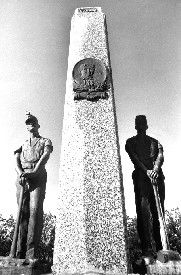
Mother Jones Monument at the Union Miners Cemetery.
On October 12, 1898, the feared violence began at Virden, Illinois, a small town some 40 miles North of Mt. Olive. When the train carrying 180 black strikebreakers and their families attempted to pass through a band of armed strikers, all hell broke loose as gunshots between the laborers and the armed guards broke out. In the melee, which became known as the Virden Massacre, seven miners and five guards were dead. Forty other miners, four guards, and the train’s engineer were wounded. The train was returned to St. Louis, Missouri, with its cargo still aboard.
Four of the miners killed were from Mt. Olive and were initially buried in the town cemetery. However, the owner of the land objected to the burials, and the Lutheran cemetery barred them from burial because the minister denounced the miners as “murderers.” In response, the local union purchased a one-acre site, and the bodies were moved to the new Union Miners’ Cemetery in 1899. Over the years, the union acquired additional land, and a monument was dedicated on October 11, 1936.
The cemetery is the final resting place of Mary Harris “Mother” Jones, a fierce advocate for miners’ and children’s rights. Before her death at age 100 in 1930, Mary Jones requested to be buried with “her boys”—the coal miners she championed for decades. The cemetery, listed on the National Register of Historic Places, is on the northwestern edge of town, just off I-55.
Long after the tumultuous years around the turn of the century, another coal miner named Henry Soulsby lived and worked in Mt. Olive. However, after an injury in the 1920s, he could no longer endure the hard labor of the mines and began looking for a different trade. He soon invested his life savings into a couple of lots at the corner of 1st Street and what would soon become Route 66. In 1926, the Soulsby Shell Station opened. Henry’s high school-aged son, Russell, helped out when he could and joined his father full-time after graduation. Later, Henry’s daughters, Ola and Wilma, also helped at the station.
The original station was just 13 by 20 feet wide with barely enough room for a desk, battery charger, and a few supplies. In 1937, they added a 30-by-12-foot extension to the back of the building. However, the station was not enlarged enough to include a garage. Instead, the Soulsbys utilized a drive-up ramp outside the station for oil changes and minor repairs. When Henry retired, Russell and Ola, who both proved adept at pumping gas, checking oil, and checking the engine for problems, took over the station.
During World War II, Russell became a communications technician. When he returned home, he began repairing radios and televisions at the station. In the 1950s, he devoted the station’s North side room to this new business. Though he made no structural changes to the building, he placed an antenna on the roof to test his work.
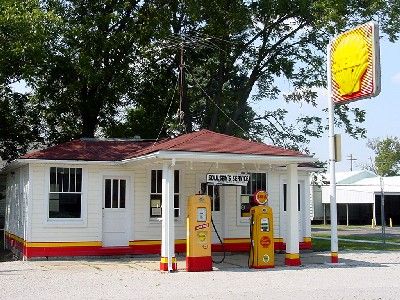
Soulsby’s Station.
In the late 1950s, Interstate 55 plowed through Illinois, supplanting most of the Route 66 traffic. Soulsby’s Station ended up a mile away from the new thoroughfare. However, his new television venture kept him in business. He and Ola pumped gas until 1991, when they could no longer keep up with new EPA regulations. After 65 years of pumping gas for Route 66 travelers, they removed the gasoline storage tanks. However, for the next two years, the station still stayed open, checking oil, selling soft drinks, and greeting an ever-growing group of new Route 66 travelers. Finally, the station closed its doors in 1993. In 1997, Ola passed away, and Russell sold the station at an auction, complete with everything in it.
However, with the new owner’s encouragement, he occasionally started greeting visitors again. Russell died in 1999. Today, the current owner and the Soulsby Station Society have restored the building to its original historic appearance, providing a classic example of early Route 66 for generations of Mother Road Travelers to come.
Today, Mt. Olive’s coal mines are gone, the traces of old Route 66 are fading, and the village has become a sleepy residential community primarily.
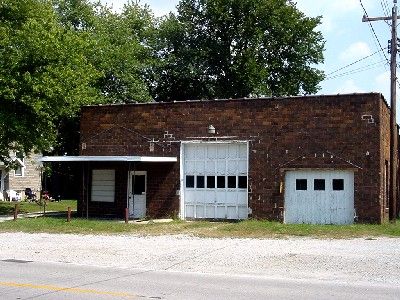
Another vintage relic of better days in Mt. Olive, Illinois
Continue your journey of the Mother Road by booking on down to Staunton and visiting Henry’s Rabbit Ranch. Along the way, keep your eyes open for an old vintage 66-era cocktail sign peeking up at the side of the highway.
©Kathy Alexander/Legends of America, updated October 2026.
Also See:
See Sources.