
Abner “Sharp” Grover was a Chief Scout for the U.S. Army during the Plains Indian campaigns between 1860 and 1878.
Thought to have been born in 1825, Abner Grover’s early years are unknown. His first appearance in government records lists him as a scout-spy and a guide for Fort Kearny, Nebraska, in 1864. Grover had clearly lived on the plains for several years, as shown by his ability to speak Cheyenne and Sioux. He was also married to a Sioux woman.
In 1868, Abner was hired by Lieutenant Frederick H. Beecher to scout the area northwest of Fort Wallace, Kansas. That year proved to be a time of uprising, with Indian raids sweeping through Kansas and Colorado. On one scouting expedition, Abner Grover and William Comstock encountered a band of Cheyenne. After being received coldly, the two scouts left the camp. Unexpectedly, Comstock and Grover were both shot in the back, with Comstock dying instantly. Using Comstock’s body as a shield, the wounded Grover held off the small party until nightfall. He then made his way to a set of railroad tracks where a passing train picked him up.

Fort Wallace, Kansas, 1867.
Orders were given for Major George Forsyth to recruit 50 experienced plainsmen. Using these expert hunters, General Phillip A. Sheridan believed they would have an advantage over unskilled soldiers. Abner Grover was one of the 50 and the head guide.
The group left Fort Wallace and followed a trail. While camping on the Arikaree River, the militia was awakened by the theft and subsequent escape of horses by a small band of Indians. As they grouped to try and recapture the horses, this group of 50 men spotted a charging band numbering in the hundreds. The scouts headed toward an island in the middle of the stream under the hail of bullets and arrows. The initial Indian charge wounded or killed half the force.
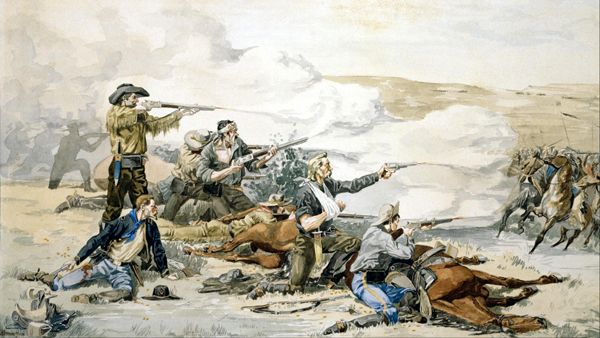
Battle of Beecher’s Island, Colorado by Frederic Remington.
With no natural defense, some of the men killed their horses and used them as a wall. During the scramble, Major Forsyth was wounded, and Lieutenant Beecher was killed. Forsyth placed Abner Grover in command. The fight became known as the Battle of Beecher Island. Afterward, the soldiers waited for reinforcements, which arrived as the Black “Buffalo Soldiers” Cavalry.
General George Custer said that the Arickaree fight was the most significant battle on the plains.
Meanwhile, Sharp Grover returned to Fort Wallace, Kansas.
On February 16, 1869, when Grover was in a saloon in Pond Creek, Kansas, he began to harass a man named Moody drunkenly. Having had trouble with Grover before, Moody shot and killed Grover. Grover was unarmed, having given his guns to the barkeeper. Moody was later set free as he claimed he had shot Grover in self-defense, thinking Grover was armed.

Abner Grover’s grave in Fort Wallace Cemetery by Kathy Alexander.
Abner Grover is buried in the old Fort Wallace Cemetery, which is now part of the Wallace Cemetery near Wallace, Kansas.
©Kathy Alexander/Legends of America, updated November 2026.
Also See:
Indian Wars of the Frontier West
Sources: