
From “Geronimo: His Own Story” by S.M. Barrett, 1905.
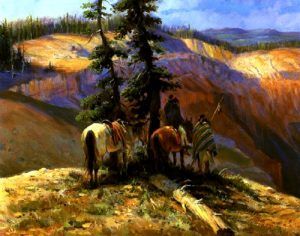
Calling the Mountain Spirits.
In the beginning, the world was covered with darkness. There was no sun, no day, and perpetual night with no moon or stars.
Yet all manner of beasts and birds existed. Among the beasts were many hideous, nameless monsters, as well as dragons, lions, tigers, wolves, foxes, beavers, rabbits, squirrels, rats, mice, and all manner of creeping things such as lizards and serpents. Mankind could not prosper under such conditions, for the beasts and serpents destroyed all human offspring.
All creatures had the power of speech and were gifted with reason.
Two tribes of creatures existed: the birds, or the feathered tribe, and the beasts. The former were organized under their chief, the eagle.
These tribes often held councils, and the birds wanted light admitted. The beasts repeatedly refused, and finally, the birds made war against the beasts.
The beasts were armed with clubs, but the eagle had taught his tribe to use bows and arrows. The serpents were so wise that they could not all be killed. One took refuge in a perpendicular cliff of a mountain in Arizona, and his eyes changed into a brilliant stone that may be seen in that rock to this day. When killed, the bears would each be changed into several other bears, so the more bears the feathered tribe killed, the more there were. The dragon could not be killed, either, for he was covered with four coats of horny scales, and the arrows would not penetrate these. One of the most hideous, vile monsters was proof against arrows, so the eagle flew high up in the air with a round, white stone and let it fall on this monster’s head, killing him instantly. This was such a good service that the stone was called sacred. They fought for many days, but the birds finally won.
After this war, although some evil beasts remained, the birds could control the councils, and the light was admitted; then mankind could live and prosper. The eagle was chief in this good fight; therefore, man wore his feathers as emblems of wisdom, justice, and power.
Among the few human beings alive was a woman blessed with many children, but the beasts had always destroyed them. If she succeeded in eluding the others, the dragon, who was very wise and very evil, would come himself and eat her babes.
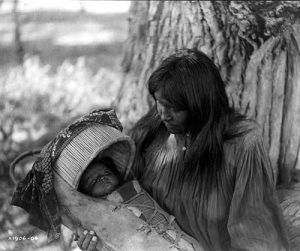
Apache Mother.
After many years, a son of the rainstorm was born to her, and she dug a deep cave for him. She closed the entrance to this cave and built a campfire over the spot. This concealed the babe’s hiding place and kept him warm. Every day, she would remove the fire and descend into the cave, where the child’s bed was, to nurse him; then she would return and rebuild the campfire.
Frequently, the dragon would come and question her, but she would say, “I have no more children; you have eaten all of them.”
When the child was larger, he would not always stay in the cave, for he sometimes wanted to run and play. Once, the dragon saw his tracks. This perplexed and enraged the old dragon, for he could not find the boy’s hiding place, but he said he would destroy the mother if she did not reveal it.
His poor mother was very much troubled. She could not give up her child, but she knew the dragon’s power and cunning and lived in constant fear.
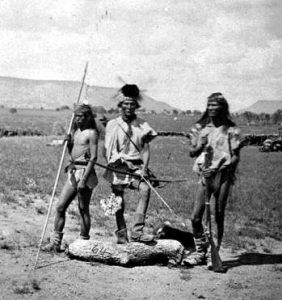
Apache Warriors.
Soon after, the boy said he wished to go hunting. The mother would not give her consent. She told him of the dragon, the wolves, and the serpents, but he said, “Tomorrow I go.”
At the boy’s request, his uncle, the only man then living, made a little bow and some arrows for him, and the two went hunting the next day. They trailed the deer far up the mountain, and finally, the boy killed a buck. His uncle showed him how to dress the deer and broil the meat.
They broiled two hindquarters, one for the child and one for his uncle. When the meat was done, they placed it on some bushes to cool. Just then, the dragon’s huge form appeared. The child was not afraid, but his uncle was so dumb and frightened that he could not speak or move.
The dragon took the boy’s parcel of meat and went aside with it. He set the meat on another bush and sat beside it. Then he said:
“This is the child I have been seeking. Boy, you are nice and fat, so when I have eaten this venison, I shall eat you.” The boy said, “No, you shall not eat me, and you shall not eat that meat.” So he walked over to where the dragon sat and the meat back to his seat. The dragon said, “I like your courage, but you are foolish; what do you think you could do?” The boy said, “I can do enough to protect myself, as you may bind out.” Then the dragon took back the meat, and the boy took it back. Four times in all, the dragon took the meat, and after the fourth time the boy replaced the meat, he said, “Dragon, will you fight me?” The dragon said, “Yes, in whatever way you like.” The boy said, ” I will stand one hundred paces distant from you, and you may have four shots at me with your bow and arrows, provided that you then exchange places with me and give me four shots. “Good, said the dragon. Stand up.”
Then the dragon took up his bow, made from a large pine tree. He took four arrows from his quiver, made of young pine tree saplings, each 20 feet long. He took deliberate aim, but just as the arrow left the bow, the boy made a peculiar sound and leaped into the air. Immediately, the arrow shattered into a thousand splinters, and the boy was seen standing atop a bright rainbow over the spot where the dragon’s aim had been directed. Soon, the rainbow was gone, and the boy stood on the ground again. This was repeated four times, and then the boy said, “Dragon, stand here: it is my time to shoot.” The dragon said, “All right, your little arrows cannot pierce my first coat of horn, and I have three other coats –shoot away.” The boy shot an arrow, striking the dragon just over the heart, and one coat of the great horny scales fell to the ground. With the next shot, another coat fell, then another, exposing the dragon’s heart. Then, the dragon trembled but could not move. Before the fourth arrow was shot, the boy said, “Uncle, you are dumb with fear; you have not moved; come here, or the dragon will fall on you.” His uncle ran toward him. Then he sped the fourth arrow with true aim, and it pierced the dragon’s heart. With a tremendous roar, the dragon rolled down the mountainside—down four precipices into a canyon below.
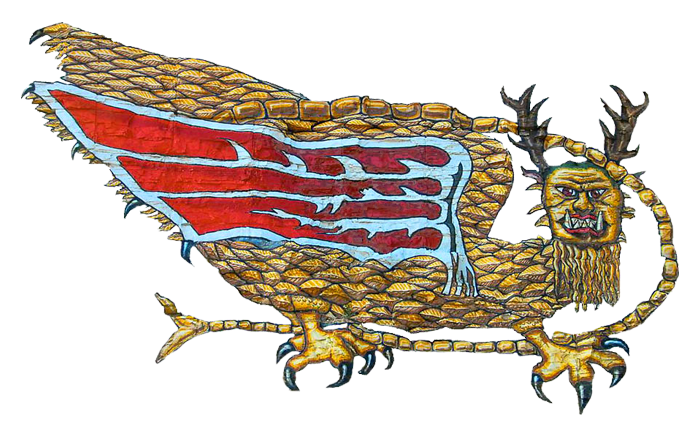 Immediately, storm clouds swept the mountains, lightning flashed, thunder rolled, and rain poured. When the rainstorm passed, fragments of the dragon’s huge body lay among the rocks far down in the canyon, and the bones of this dragon may still be found there.
This boy’s name was Apache. Usen taught him how to prepare herbs for medicine, hunt, and fight. He was the first chief of the Indians and wore the eagle’s feathers as a sign of justice, wisdom, and power. To him and his people, as they were created, Usen gave homes in the West.
Compiled and edited by Kathy Alexander/Legends of America, updated September 2026.
Excerpted from Geronimo: His Own Story as told by Geronimo to S. M. Barrett in 1905. The original book, published in 1906, is now in the public domain.
Also See: