
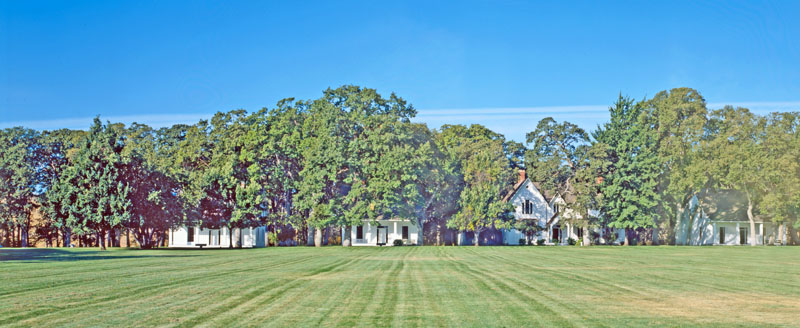
Fort Simcoe, Washington by James W Rosenthal.
Fort Simcoe was a United States Army fort erected in south-central Washington Territory to house troops sent to keep watch over local Indian tribes.
According to General George B. McClellan, who visited the site as a young lieutenant in 1853, the Yakama Tribe had a fort here as early as 1849 to ward off the Cayuse.
Before 1850, the site was used as a school where Native American children taken from their families were forced to cease practicing traditional customs and speak English. Punishment for non-compliant children included imprisonment in a small jail.
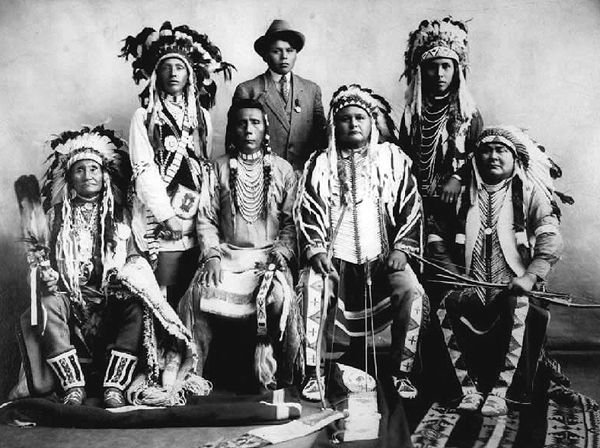
Yakama and Colville Reservation Indians, about 1910.
Once a Yakama Nation camping area, the rich, fertile region sparked discord between the tribes and Euro-American settlers, prompting the U.S. Army to construct a fort in August 1856. This was a year after a defeat of United States troops under Major G.O. Holler by the Yakama Tribe.
Architect Louis Scholl designed the fort. It was similar to the design of Fort Dalles, with blockhouses at each corner but no stockade, allowing barracks to define the fortification. It was located in an old oak grove watered by natural springs. The U.S. Army arrived in the Yakama region in the summer of that year.
That August, Major Robert S. Garnett supervised the building of Fort Simcoe, which two companies of soldiers constructed. Four buildings built in Maine, knocked down, shipped around Cape Horn, up the Columbia River, and over the hills to Simcoe by pack train, cost the Government nearly $350,000. The main building, the only one of the original group to escape razing or alteration, was once the commander’s residence, and later the Indian Agency headquarters.
James Harvey Wilbur and Captain Frederick Dent took on the challenge of creating a road to Fort Simcoe. They said that “the fort’s location also fits perfectly with the army strategic goal to carve out a road system that connected California with Washington Territory.”
This location allowed soldiers under the new commander to keep an eye out for visitors to the tribe, as well as keep an eye on the tribe itself.
Fort Simcoe is often viewed as part of a larger program of cultural genocide during this period, due to the Federal practice of tribal merging and enforced assimilation to American culture. The tribes were to learn about famous Americans and were given Christian/American names.
After three years, the fort was closed on May 22, 1859, and turned over to the Bureau of Indian Affairs.
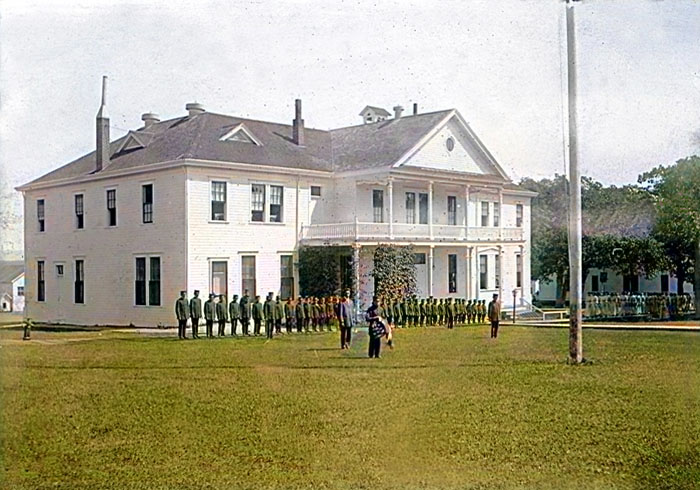
Fort Simcoe Indian Boarding School.
In the Fall of 1860, Fort Simcoe Indian Boarding School was established under the Yakama Indian Agency. James Wilbur, a Methodist preacher and teacher, opened the school. There were 18 students in the first class, 16 boys and two girls. It was open nine months a year. This school is older than the infamous Carlisle in Pennsylvania.
The first Indian agent, R.H. Lonsdale, was appointed in 1860 but was relieved of his duties several months later due to serious charges against him. In 1861, President Abraham Lincoln appointed A.A. Bancroft. However, Bancroft’s mishandling of relations with Native Americans drew complaints from James H. Wilbur, the Superintendent of Schools. In response, Bancroft had Wilbur removed from his position. Wilbur, armed with substantial evidence and data, then appeared before President Lincoln. As a result, the President recalled Bancroft and appointed Wilbur in his place in 1864. Wilbur’s tenure lasted for 16 years. Known to the Native Americans as Father Wilbur, he was recognized for his honesty, though he was also severe in his methods; it is said that an oak tree near the buildings was used as a whipping post.
In the Winter of 1898-1899, several epidemics sickened children and others at Fort Simcoe; five students died.
In 1922, the U.S. government decided to move the Indian agency from Fort Simcoe to Toppenish, which triggered extreme emotions. Moving the Indian Agency recalled the act of relocation for generations of the original tribes. The location of the fort also provided trading routes established by waterways or railroads.
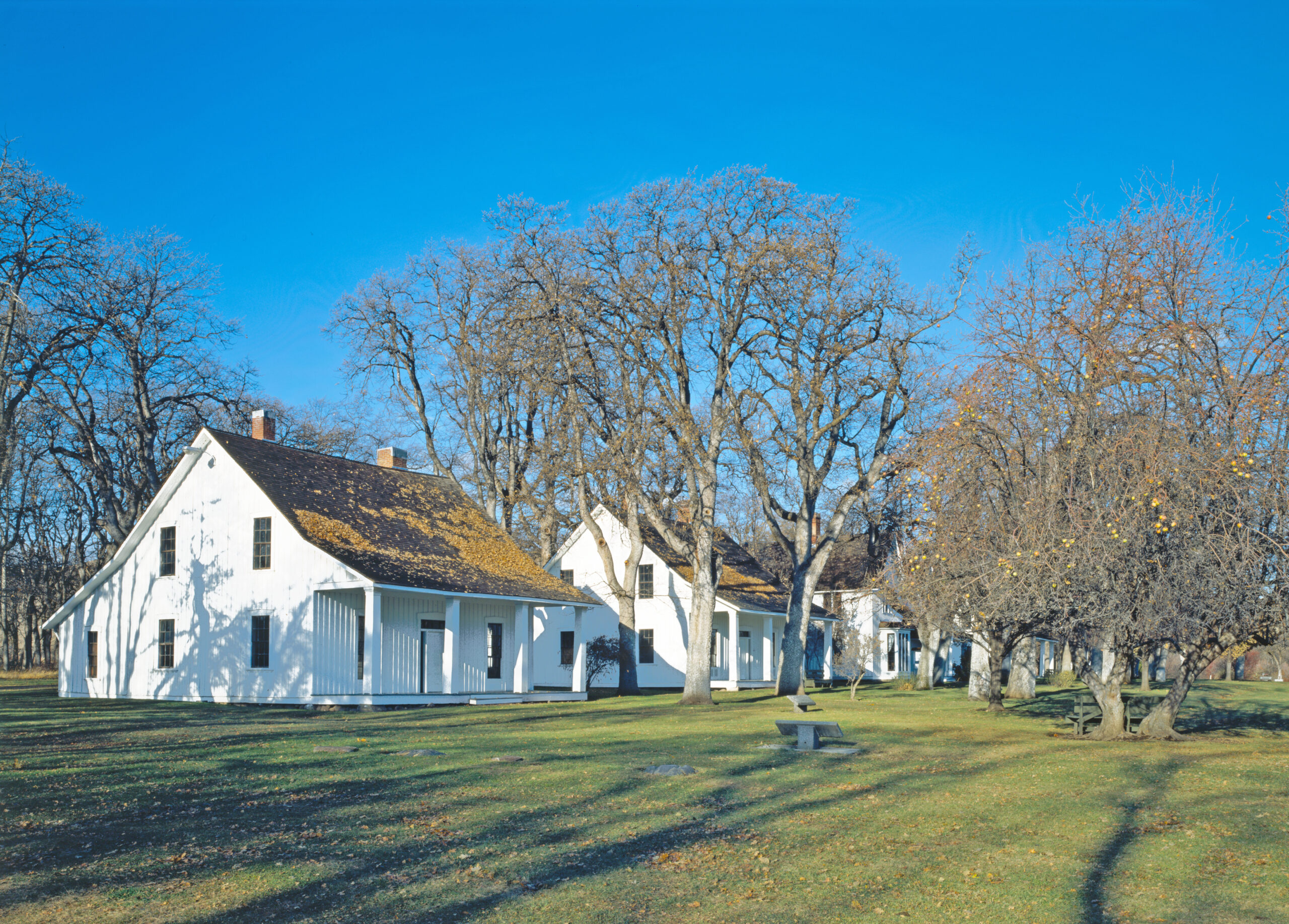
Officers Row at Fort Simcoe, by James W Rosenthal.
A restoration project was started in 1953 by the Washington State Parks & Recreation Commission.
The park was placed on the National Register of Historic Places in 1974.
The 200-acre, day-use heritage park serves as an interpretive resource that narrates the story of army life in the mid-19th century while also showcasing the lives of local Native Americans. Five original buildings remain standing at the fort, including the commander’s house, three captain’s houses, and a blockhouse. In addition, several other buildings have been recreated to resemble their original structures. The houses are furnished with period-appropriate items. The grounds are well maintained and easy to walk.
The most striking structures are the blockhouses anchoring the fort complex, built from hewn timber and designed purely for defense. Standing next to them, the Gothic Revival officers’ quarters feel almost out of place in the best possible way. Carefully maintained homes with decorative trim and peaked rooflines that look more like a New England neighborhood than a frontier military outpost. The commanding officer’s house is particularly photogenic. Historical markers throughout the grounds fill in the story as you walk, and the open space gives you room to slow down and let the place sink in. Having it entirely to yourself, as I did on that September afternoon, makes that even easier.
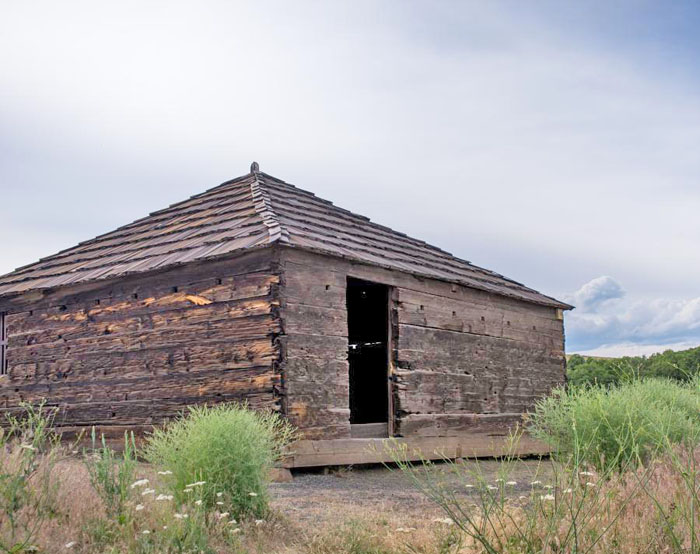
Fort Simcoe Blockhouse, by the Fort Simcoe Historical State Park.
The interpretive center, the original commander’s house, and two officers’ buildings with period furnishings are open to the public from April through September, Wednesday through Sunday. The original blockhouse and other recreated fort buildings are not open to the public. Special re-enactments and living history events are held during the year, as well as other special events.
Birdwatchers enjoy spotting a Lewis’s woodpecker, as it is a haven for this bird. Depending on the season, visitors might also see Northern Flickers, Nuthatches, and Steller’s Jays. Beyond birds, deer, elk, bobcats, and badgers have all been spotted in and around the park.
Visitors can bring equipment to play baseball, football, softball, and soccer in the large, open grassy area.
Fort Simcoe is one of the few remaining pre-Civil War forts in the West.
Fort Simcoe Historical State Park is on the Yakama Indian Reservation eight miles West of modern-day White Swan, Washington, in the foothills of the Cascade Mountains and near the base of the Simcoe Mountains.
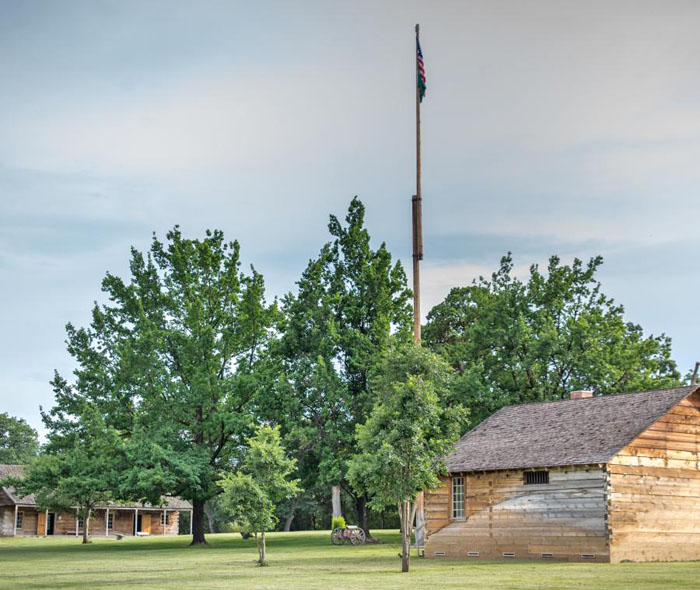
Fort Simcoe, Washington grounds, courtesy Washington State Parks.
©Kathy Alexander/Legends of America, updated August 2026.
Also See:
Washington – The Evergreen State
Sources: