
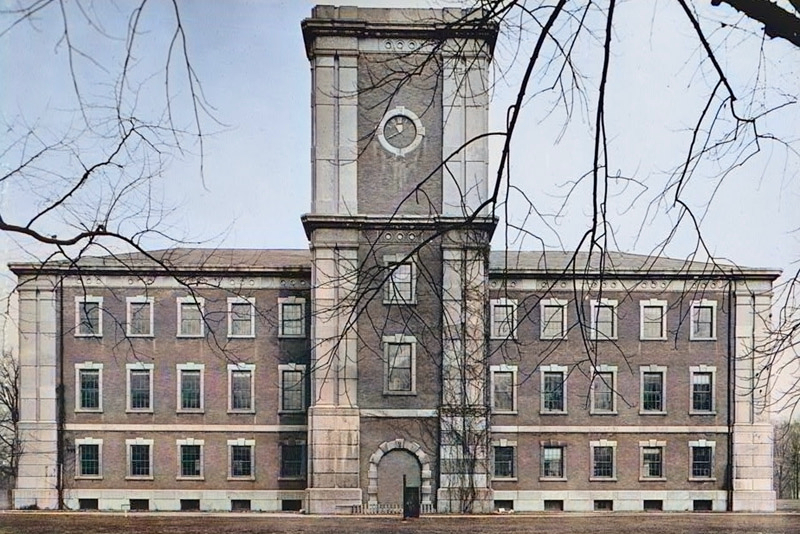
Indiana Arsenal in Indianapolis, Indiana.
Governor Oliver P. Morton established the Indianapolis Arsenal in 1861 at the beginning of the Civil War to provide Indiana troops with munitions.
The federal government’s call to arms at the start of the war caught state governments unprepared to equip their troops. Most states had meager supplies of arms, gunpowder, and ammunition. Indiana owned only 6,000 rusty, mostly broken rifles and muskets scattered among the state militia. Desperate for arms, the federal government and the states, including Indiana, competed on world markets to buy guns and equip troops.
Indiana also established a state arsenal to repair and refit firearms and to produce gunpowder and ammunition for state and federal purposes.
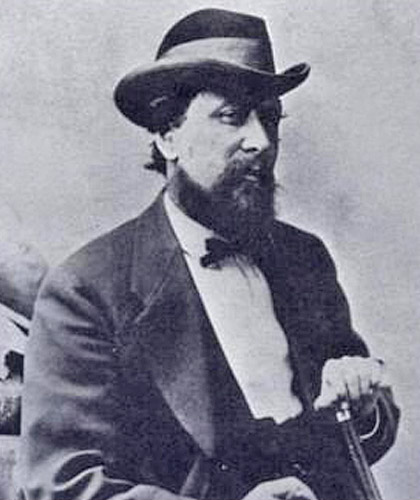
Herman Sturm.
Indiana Governor Oliver P. Morton appointed Herman Sturm, a civil engineer and chemist, to manage the state arsenal. He had studied ammunition manufacturing in Germany and had a gunpowder factory on the northwest corner of the State House grounds.
In April 1861, Sturm began teaching volunteers from the 11th Indiana Infantry the intricacies of cartridge construction in a blacksmith shop in Indianapolis. The arsenal’s operations later relocated to various sites around central Indianapolis. Initially, it was moved from the blacksmith shop to three temporary buildings located North of the State Capitol Building. One of these buildings was divided into three rooms: one for guards, one for civilian workers—where men and boys performed various tasks—and another for women and girls who made cartridges. As cold weather set in, the arsenal moved to a brick building on Washington Street, South of the State Capitol Building.
By September 1861, the arsenal employed around 250 workers, most of whom were women. Reports indicated that peak employment reached up to 700 workers.
Sturm faced challenges in paying his workers. The federal government purchased any surplus production from Indiana but was slow to settle its debts. As a result, Sturm often had to borrow money from local individuals, including himself, as well as from local banks to cover the monthly payrolls, which amounted to approximately $6,000. At one point, no funds were available from any source, and workers were given “certificates” or scrip instead. Fortunately, several businesses and banks in Indianapolis accepted these certificates. On one occasion, when the arsenal had to halt operations due to a lack of raw materials, workers received no pay at all.
Despite payroll difficulties, harassment from the Democratic press, and a possible spy in his workforce, Sturm successfully ran the state arsenal and managed its dedicated men and women. The arsenal turned a profit for the state, and hundreds of civilian employees supported both themselves and the war effort.
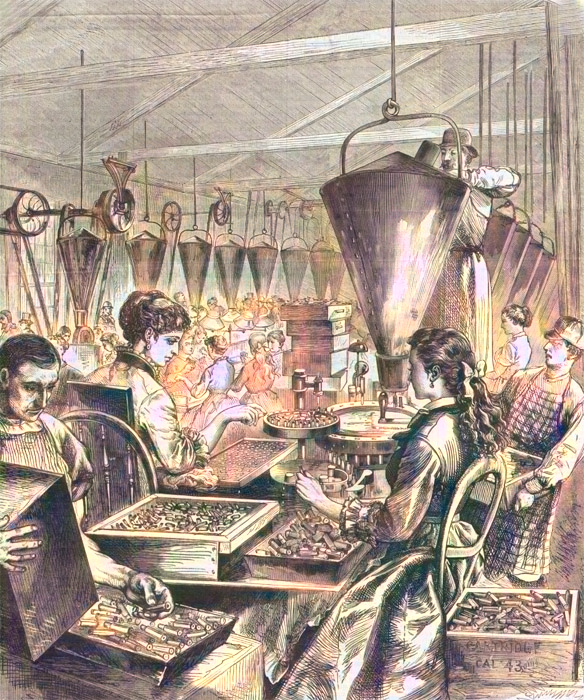
Making cartridges by Harper’s Weekly.
A total of 383 different women worked at the arsenal during the years. The most common age range for these women was between 13 and 23 years old; however, there were also two girls as young as 10 and one woman who was 82. Many of the female workers were either wives or daughters of skilled craftsmen or unskilled laborers, but there was also a physician’s daughter among them.
Making cartridges was a precise and dangerous task. Lead balls and gunpowder were placed into paper tubes, which were then tied at the ends. Women were often hired for this work because they could be paid lower wages and were viewed as more pliable and obedient than men. Additionally, women were considered to have greater dexterity and smaller hands, making them suitable for the intricate tasks involved.
Although women worked in a separate room from men, male supervisors monitored their activities. Cartridge makers were paid based on the number of pieces they produced, so they worked as quickly as possible to earn a decent daily wage. It has been estimated that a skilled worker at any arsenal could produce 800 cartridges in ten hours.
On July 11, 1862, Congress passed an act to build three permanent federal arsenals, including one at Indianapolis, for $100,000 each. In March 1863, 76 acres North of the Sturm property on today’s East Michigan Street were purchased for $35,000.
After a massive explosion in 1862 at Pittsburgh’s federal Allegheny Arsenal that killed 78 workers, mostly women, and injured 70 more, Sturm thought it prudent to move the state arsenal out of the downtown area. The operations moved to land East of town owned by Calvin Fletcher, Jr., and continued there until 1864, when the federal government, which had purchased the land, established its own arsenal on the same site.
In 1863, when it was deemed too dangerous because of its size, the facility was moved to a tract of farmland on the near East Side belonging to Sturm. Ammunition was purchased from the Indiana arsenal until after the fall of Vicksburg and Chattanooga, when the manufacture of ammunition in the West became less necessary.
That year, in a report to the Indiana General Assembly, Governor Morton noted that the arsenal provided valuable work for those struggling to support themselves, particularly for soldiers’ families. He instructed Colonel Sturm to prioritize hiring individuals whose relatives were in the military. Records show that many of these workers were young women and mothers whose husbands had enlisted, often working alongside family members.
The Indianapolis Daily Sentinel, a local Democratic newspaper, depicted female workers—who performed a dangerous and meticulous job—as if they were enjoying a party. Articles referred to them as “damsels” who “laugh, roll up the bullets, and sing patriotically,” and as “blushing young virgins and elderly matrons” who chat while preparing ammunition. The Democratic press, unhappy with the state arsenal and the war, directed their resentment toward the women workers.
In August 1863, Ordnance Captain Thomas J. Treadwell was appointed commander of the federal arsenal. That month, he sent Chief of Ordnance General James W. Ripley a plan for the Indianapolis facility, and excavation began that fall. Sturm sold the land needed for a road (now called Arsenal Avenue) connecting the arsenal grounds to the National Road (Washington Street).
The state arsenal closed on April 18, 1864.
The Indianapolis Arsenal tower was completed in 1865. The Federal Arsenal garrisoned about 50 troops beginning in 1865.
Nine other buildings were added by 1893 for $500,000.
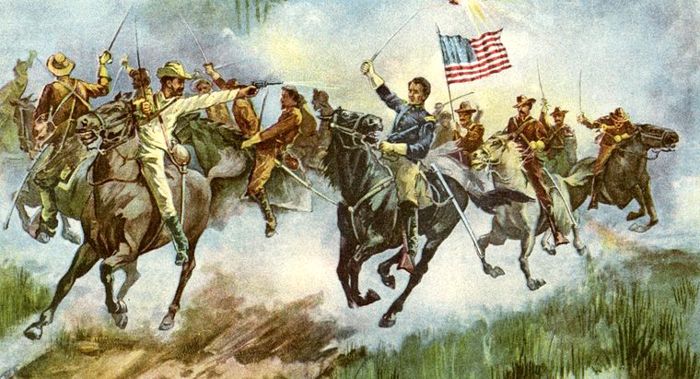
Spanish-American War.
Between 1865 and the outbreak of the Spanish-American War in 1898, the arsenal was used primarily as a storage facility for heavy artillery, lighter arms, and a limited amount of ammunition. At one time, 100,000 rifles were stored on the second and third floors of the principal building. During the Spanish-American War, the arsenal was upgraded from a third- to a first-class facility, and the shops were used to manufacture knapsacks, haversacks, blanket bags, and harnesses. Following the war, the arsenal rapidly declined.
In August 1902, an act of Congress ordered the arsenal vacated and closed. On March 27, 1903, the grounds were purchased for $154,000 by a committee of Indianapolis citizens with money donated to start a trade school. This school, Winona Technical Institute, began in September 1904, adding different trades until it was overwhelmed with financial difficulties in 1909. Placed in receivership in 1910, it gradually ceased operations.
Printing and machine shops were maintained when Arsenal Technical High School opened on the site in September 1912. Litigation concerning the property continued until 1916, when the Indiana Supreme Court affirmed an earlier circuit court decision conveying the arsenal grounds to the city schools, to be held in trust by the school board and forever kept intact and dedicated to educational uses.
Of the six buildings that remain, the most notable to the site was the Arsenal Building. Elsewhere on the Arsenal campus, other structures of that era include the red-brick Guard House, which also held military prisoners; the West Residence, where officers stayed; the two-story Barn; the Barracks, where soldiers were housed; and the Gunpowder Magazine. The grounds were landscaped with trees, roses, lilacs, and a grape arbor.
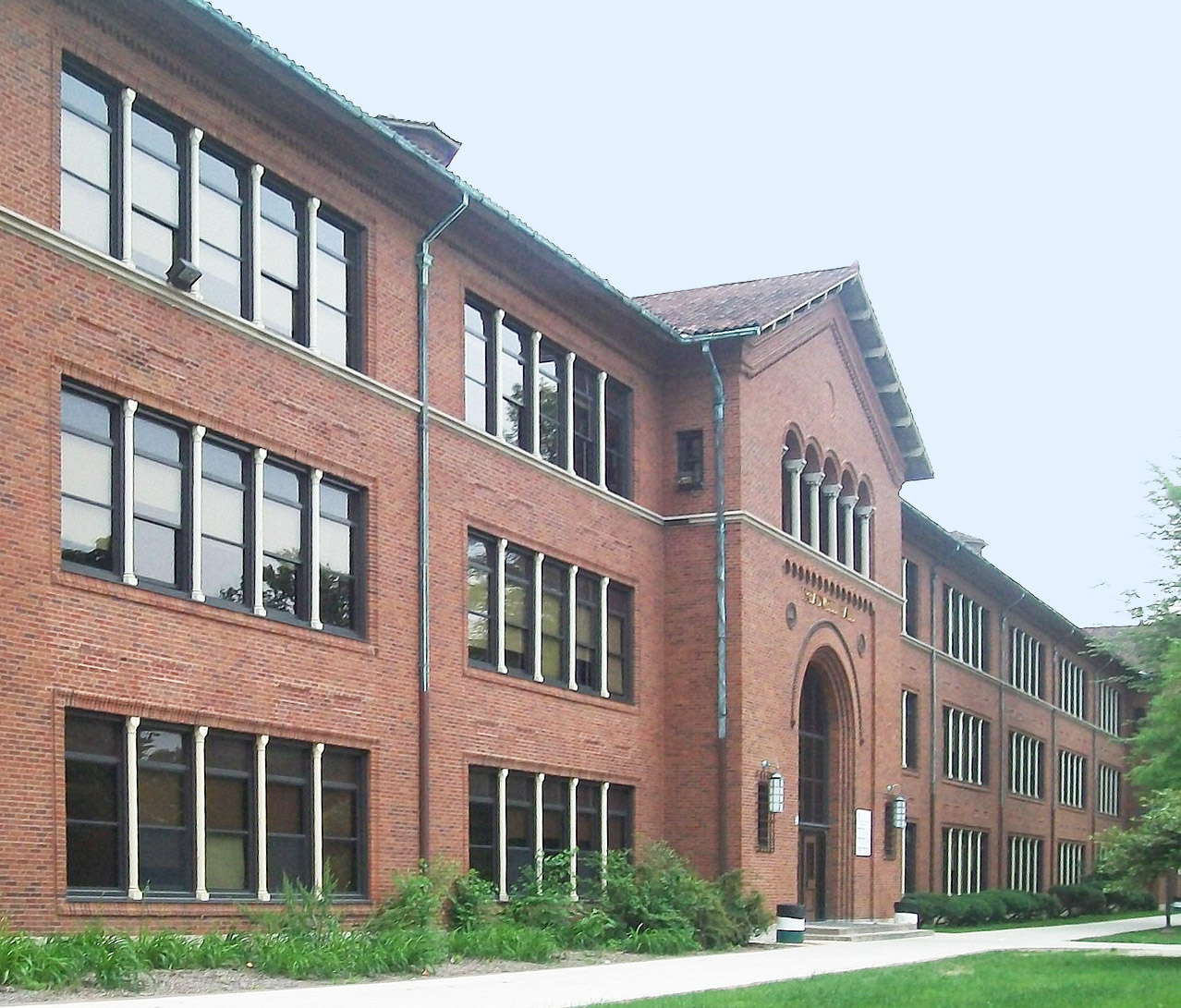
Arsenal Technical High School in Indianapolis, Indiana, courtesy of Wikipedia.
The Arsenal Technical High School remains operational today. The main arsenal building, seven stories high and completed in 1867, now serves as the school’s administration building. The interior was remodeled in 1932 and again in 1993 after a fire.
It is located at 1500 E. Michigan Street in Indianapolis.
©Kathy Alexander/Legends of America, August 2026.
Also See:
Forts & Presidios Photo Gallery
Soldiers & Officers in American History
Trading Posts of the Fur Trade
Sources:
Encyclopedia of Indianapolis
Indiana Historical Bureau
North American Forts