
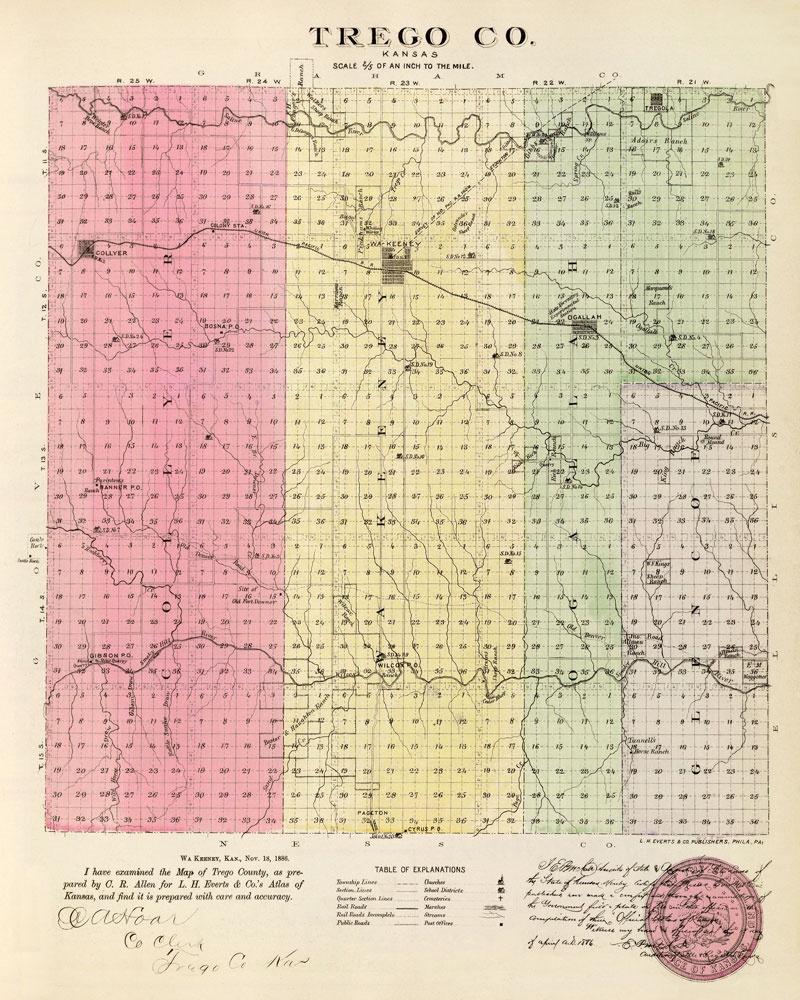
Trego County Map by L.H. Everts, 1887.
Fort Ogallah, Kansas, was founded by the federal government in 1871 as Park’s Fort. Also called Trego Station, it was established to protect railroad workers from Indian attacks. The post was among many transitory forts scattered across the plains. It was named after Thomas Parks, who the Indians killed on June 18, 1867. Though two-section houses were built, the “settlement” was mostly a tent encampment.
Years earlier, after President Abraham Lincoln signed the Homestead Act in 1862, the Kansas Pacific Railroad expanded West. At that time, Native Americans, who relied on regional hunting grounds to supply food, shelter, and clothing, discouraged such intrusions, leading to one cultural collision after another.
As a result, the post-Civil War Army protected construction crews and settlers. This led to transitory forts that paralleled the advancing track. Several years earlier, from 1866 to 1867, surveyors recorded surveys of Ellis and Trego Counties.
As the railroad extended West from Ellis, many early locomotives struggled to climb the steep grade to Ogallah.
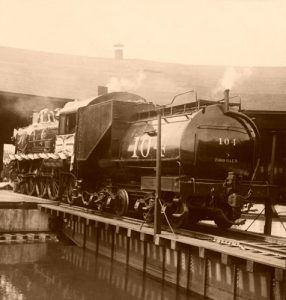
Union Pacific Railroad Engine by H.C. White, 1905.
In 1867, after a conflict with Native Tribes, a temporary Army encampment was established one mile West of town, protecting Union Pacific Railroad workers. At that time, the fort was a 30-foot-by-30-foot sod embankment with a deep well, where approximately 300 graders, under the direction of Thomas Parks, worked. Soldiers also gathered there for meals, water, and protection.
When Thomas Parks and fellow contractor Charles Saffel, accompanied by a 10th Cavalry Buffalo Soldier, traveled North to hunt meat for the camp in June 1867. Another group of three also headed North, driving a wagon to collect wood they’d cut on the Saline River. Indians attacked, wounding Fred Dick in the thigh.
Before this event, Fred Dick built a home for himself and his new bride at Parks Fort. At that time, a boxcar on the side of the track served as a telegraph office, and the deep well remained. Dick and his bride shared their home and fixed up two dugouts that soldiers had once used on the south side of the track. There, he could dry buffalo meat.
Hastily returning to camp, the three informed the military of the hunters’ danger. Parks’ dog returned to camp, wounded by an arrow, confirming the attack. A party of more than 50 soldiers and railroad workers then set out to search for Parks and his companions. They soon found signs of battle, including lances, pieces of cloth, cartridge hulls, trampled ground, and Saffel’s body, scalped and full of arrows.
Up the ravine, trapped by a collapsed limestone slab, they found Thomas Parks dead but not scalped. Upon removing the rock pinning Parks’ body, they found the badly wounded 10th Cavalry soldier.
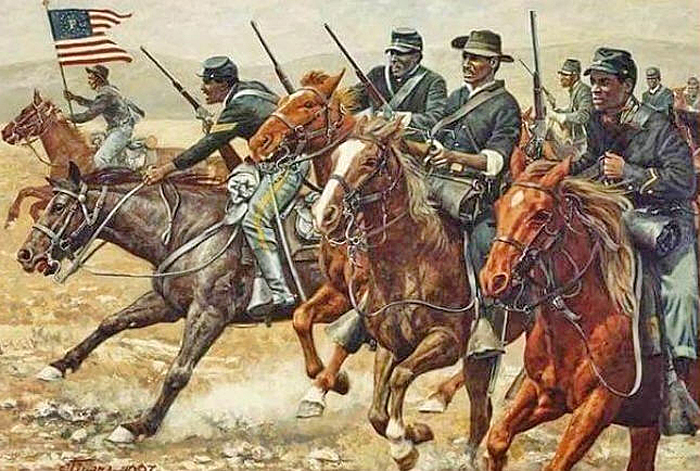
Buffalo Soldiers, courtesy of the U.S. Army.
After the Union Pacific Railroad established a pumping station there, a post office was established on December 28, 1871.
Less than a year later, the post office closed on November 20, 1872. When the railroad moved West, non-railroad workers moved into the section houses.
The post office reopened on May 28, 1874. At that time, it was more of a stopping point for the railroad than a settlement since it only had a tank, a well, and a windmill. Park’s Fort was renamed Trego on November 20, 1874.
The post office moved to Wakeeney on February 6, 1878. After the WaKeeney post office closed in April 1879, Trego’s post office reopened.
Another pioneer family stayed at Parks Fort in 1879 until they could claim their land. Claire Yoxall of the Cortwright family noted that in 1879, only the deep well remained.
The post office closed again on April 13, 1881. After almost a decade, it reopened on March 22, 1900, only to close for the last time on December 15, 1900.
Visit the Trego County Historical Museum in WaKeeney to view artifacts found near what once served as Park’s Fort.
The fort was two miles East of WaKeeney.
©Kathy Alexander/Legends of America, updated June 2026.
Also See:
Sources: