
By Ella M. Sexton, Stories of California, The Macmillan Company, New York, 1903.
A Spanish story written more than 600 years ago described California as an island rich in pearls and gold. The story says only black women lived there, and they had golden spears, collars, and harnesses for the wild beasts they had tamed to ride. This island was said to be a ten-day journey from Mexico and was supposed to lie near Asia and the East Indies. Among those who believed such tales about this wonderful island of California was the Spanish conquistador Hernán Cortés.
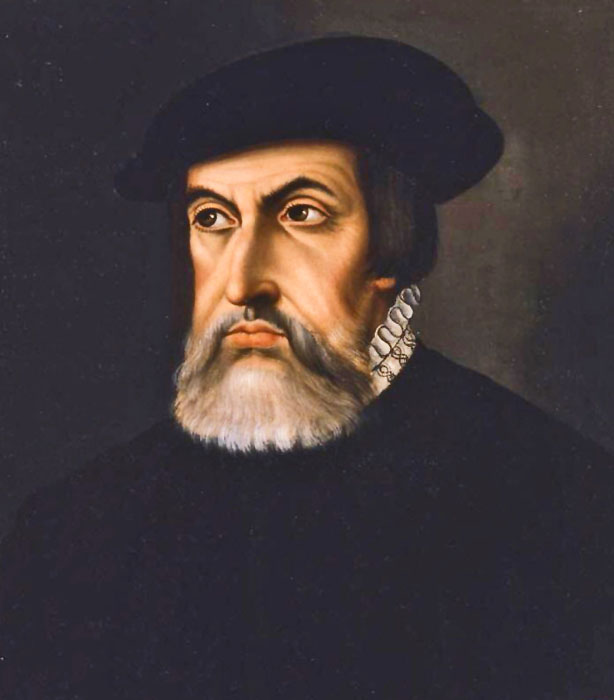
Hernán Cortés.
He had conquered Mexico in 1521 and had made Montezuma, the Mexican Emperor, give him a fortune in gold and precious stones. Then Cortés wished to find another rich country to capture, and he thought California would be the very place. He wrote home to Spain, promising to bring back gold from the island, as well as silks, spices, and diamonds from Asia. He was sure the two countries were near each other and that both might be found in the Pacific Ocean, or South Sea, as he called it, by sailing northwest.
Cortés built ships in New Spain (Mexico) for years and sent out men to hunt for this golden island. They found the Gulf of California, and Cortés finally sailed up and down its waters. He explored the land on both sides and saw only poor, naked Indians with few pearls but no gold. Cortés never found the golden island. However, his ships first sailed on the North Pacific and explored Lower California, and he was the first to use the name California for the peninsula.
It was left for a Portuguese ship captain, Juan Rodríguez Cabrillo, to find the port of San Diego in 1542. He was the first white man to land on the shores of California, and afterward, he sailed North to Monterey. Many Indians living along the coast came to his ship in canoes with fish and game for the white men. Then Cabrillo sailed North past Monterey Bay, almost near the Golden Gate. But the weather was rough and stormy, and without knowing of the fine harbor so near him, he turned his ship around and sailed South again. He reached the Santa Barbara Islands, intending to spend the Winter there, but he died soon after his arrival. The people of San Diego now honor Cabrillo with an annual festival. He was the sea-king who found their bay and first set foot on California ground.
Around this time, Ferdinand Magellan discovered the Philippine Islands, and Spain began sending ships from Mexico to those islands to buy silk, spices, and other valuable goods. The Spanish galleons, or vessels loaded with their costly freight, used to come home by crossing the Pacific to Cape Mendocino and then sailing down the California coast to Mexico. Before long, the English, who hated Spain and were at war with her, sent out brave sea captains to capture the Spanish galleons and their cargoes.
Sir Francis Drake, one of the boldest Englishmen, knew this South Sea very well, and on a ship called the Golden Hind (which meant the Golden Deer), he came to the New World and captured every Spanish vessel he sighted. He loaded his ship with their treasures, gold and silver bars, chests of silver money, velvets, and silks, and wished to return his cargo to England. He tried to find a northern or shorter route home and, at last, got so far North that his sailors suffered from the cold and his ship was nearly lost. Obliged to sail South, he found a sheltered harbor near Point Reyes and landed there in 1579. Drake claimed the new country for the English Queen, Elizabeth, and named it New Albion. Many friendly Indians in the neighborhood brought the commander and his men presents of feathers and beadwork. These Indians killed small game and deer with bows and arrows and had coats or mantles of squirrel skins.
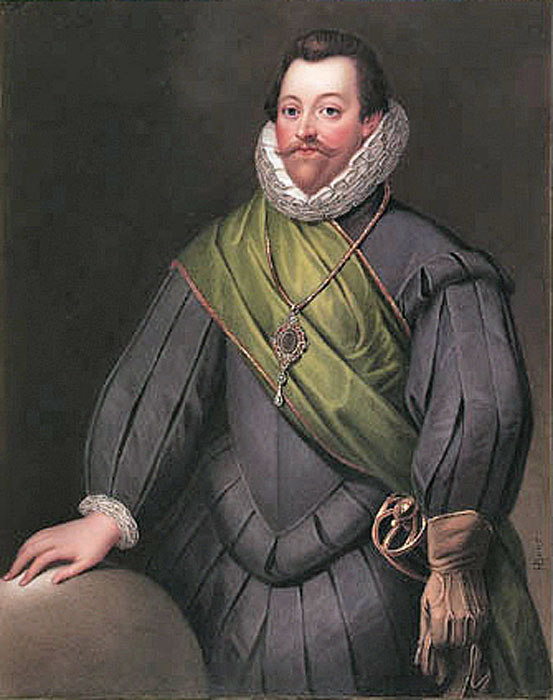
Francis Drake, by Henry Bone.
Francis Drake and his sailors repaired and refitted their vessel while staying at Drake’s Bay. They made several inland trips and saw the pine and redwood forests, with many deer feeding on the hillsides, but they did not discover San Francisco Bay. After leaving New Albion, Drake sailed the Golden Hind across the Pacific to the East Indies and the Indian Ocean, then around the Cape of Good Hope, home to England, with all the treasure he had taken. The queen received him with great honors, and his ship was kept for 100 years in memory of the brave admiral who had commanded it on this voyage.
During the next Century, several English vessel commanders sailed the South Sea while hunting Spanish galleons to capture, and these ships often touched down in Lower California for fresh water. Some captains explored the coast and traded with the Indians, but they made no settlements.
Then the Spanish tried to find and settle the country they had heard so much about, planning to establish stations where their trading ships could anchor for supplies and protection. On his second voyage for this purpose, Sebastian Viscaino landed at San Diego in 1602. Sailing on to the island he named Santa Catalina, Viscaino found a tribe of fine-looking Indians who lived in large houses and had canoes. They were good hunters and fishermen and clothed themselves in sealskins. Viscaino went on to Monterey and finally as far North as Oregon, but owing to severe storms and sickness among his sailors, he was obliged to return to Mexico.
For a long time after this failure to settle upon the coast, the Spanish came to Lower California for the pearl fisheries. Along the Gulf of California were many oyster beds, from which the Indians secured the shells by diving. Many oysters yielded large, valuable pearls, and the Spanish collected them in significant quantities from the Indians, who did not know their real value.
On this peninsula of Lower California, the Jesuit Padres founded 15 Missions, or settlements, each with a church. But later, the Jesuits were ordered out of the country, and their Missions were turned over to the Franciscan order of Mexico.
With the Franciscans’ arrival, a new period of California’s history began. Spain wanted to settle Alta California, the region North of the peninsula, and Father Serra, the head and leader of these Franciscans, was chosen to begin this work.
The old Missions of California are landmarks that remind us of Father Serra and his band of faithful workers.
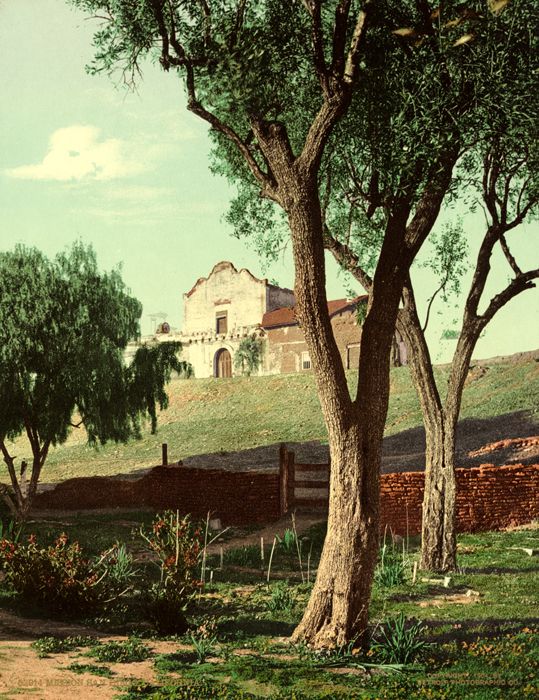
Mission San Diego, California by the Detroit Photo Co., 1904.
There were 21 beautiful missions. From San Diego to San Francisco, these Missions were located about 30 miles apart, and the sites were chosen so well that the finest cities of the state have grown around the old churches.
Father Junipero Serra was the president and leader of the Franciscan missionaries and the founder of the Mission. He was raised in Spain and dreamed of going to the New World, as the Spanish called America, to teach the Natives how to be Christians. He began his missionary work in Mexico, where he labored faithfully among the Indians for nearly 20 years. However, as his greatest wish was to preach to those in unknown places, he was glad to be chosen to explore Alta or Upper California.
Marching by land from Loreto, a Mission of Lower California, Father Serra, with Governor Portolá and his soldiers, reached San Diego in 1769. Here, he planted the first Mission on California ground. The church was a crude arbor of boughs, and the bells were hung in an oak tree. Father Serra rang the bells himself and called loudly to the wondering Indians to come to the Holy Church and hear about Christ. However, the natives were suspicious and unwilling to listen to the good man’s teachings, and several times they attacked the newcomers. Finally, after six years, they burnt the church and killed one of the missionaries. Later, there was peace, and the priests, or Padres as they were called, taught the Indians to raise corn and wheat and to plant olive orchards, fig trees, and grapes for wine. They built a new church and around it the huts, or cabins, of the Indians, the storehouses, and the Padres’ dwelling. In the early morning, the bells called every member of the Mission family to a church service. After breakfast of corn and beans, they spent the morning working outdoors or in the building. At noon, they served either mutton or beef with corn and beans, and at two o’clock, work began again and lasted until evening service. Cornmeal mush was the Indians’ favorite supper. They had many holidays during which their amusements were dancing, bullfighting, or cockfighting.
San Diego, called the Mother Mission because it is the oldest church, is now also mostly in ruins. But its friends hope to lay new foundations under the old walls and reinforce the firm ones with cement, preserving this monument to early California history. [Editor’s note: After detailed historical research, restoration and rebuilding work began in 1931 to restore Mission San Diego de Alcalá to its 1813 appearance. In 1941, it was rededicated as an active Catholic parish and continues to serve a congregation today.]
After Father Serra had started the San Diego settlement, he set sail for Monterey. He built an altar under a large oak tree at Monterey Bay, hung the Mission bells upon the boughs, and held the usual services. The Spanish soldiers fired their guns to honor the day and raised a large cross. The Indians had never heard of guns and were so frightened that they ran away to the mountains. The second Mission was built on the Carmel River, a little distance from the site of the first altar. This was called San Carlos of Monterey, and the settlement was the capital of Alta California for many years. It was also the Mission that Father Serra loved best, and after every trip to other, newer settlements, he returned to San Carlos as his home. The Monterey Mission is well preserved; books, carved church furniture, and embroidered robes used in the old services are still on display.
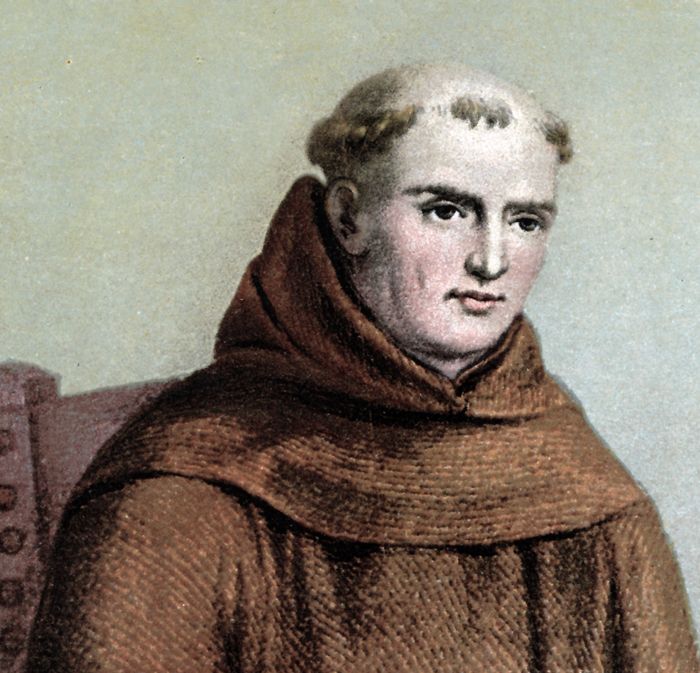
Father Junípero Serra
At San Diego and Monterey, soldiers built a presidio, or fort. These forts had one or two Spanish cannons and high walls, or stockades, to protect the Mission people from the Indians if necessary. They fired the cannons on holidays or to frighten troublesome Indians.
All the Mission buildings were made of brown clay, formed into large bricks about a foot and a half long, broad, and three or four inches thick. These bricks, dried in the sun, were called adobes and were plastered together and smoothed with mortar made of the same clay. Then they coated the outside and inside walls with lime stucco and whitewashed them. The roof timbers were covered with hollow red tiles, each about half the size of a sewer pipe, laid to overlap to keep out the rain. The floors were of earth-beaten hard, and the windows had bars or latticework but no glass. The large church was snowy white within and without and had pictures from Spain and much-carved furniture, such as chairs, benches, and the pulpit made by the Indians. One or two round-topped towers and five or six belfries, each holding a large bell, topped the church, with a great iron cross at the top.
Night and morning, the Mission bells rang to call the Indians to mass or service, and chimes or tunes were rung on holidays or for weddings. These mission bells were brought from Spain, and it was thought a blessing rested on the ship that carried them, but that shipwreck could not come to such a vessel. We read of one captain joyfully receiving the Mission bells to take to San Diego. As he said, when nearing the coast, his vessel struck a rock yet passed on safely because no harm could come to it with the bells on board. On his journeys, every missionary carried a bell with him for the new church he was to build. At each new stop, Father Serra hung the bell in a tree and rang it to gather the Indians and others for service.
San Antonio, a very successful Mission, was the third to be established and was located in a beautiful little valley in the Santa Lucia Mountains. Every kind of fruit grew in its orchards, and the Indians there were pleased and contented. They also made cloth, saddles, and other things in large workshops. San Gabriel, not far from Los Angeles and sometimes called the finest church of all, was the next to be built. This was the richest of the Missions and had great stores of wool, wheat, and fruit, which the hard-working Indians earned and gave to the church. The Indians, indeed, were almost slaves and worked all their lives for the Padres without rest or pay. At San Gabriel, the first California flour mill was built with a stream of water turning the wheel. Some of the old palms and olive trees are still growing there.
San Juan Capistrano, founded in 1776, was one of the best-known Missions. It had a seaport at San Juan, and vessels came to its port for the hides and tallow of thousands of cattle herded around the Mission. An earthquake destroyed the first fine church of this Mission, and its falling roof killed many people. It was rebuilt, however, and still shows its fine front and long corridors or porches around a hollow square where a garden and fountain used to be.
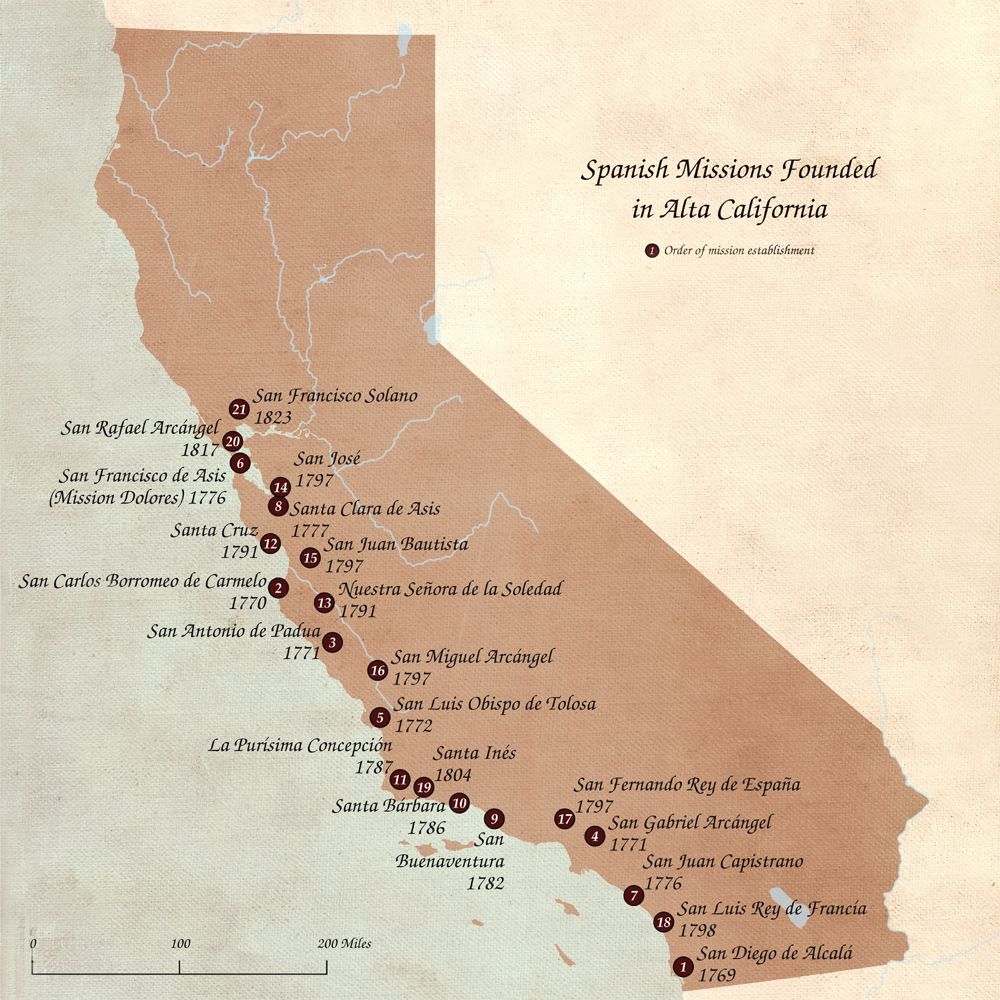
California Missions Map courtesy of Wikipedia.
Old records show that Father Serra believed the church should be named in honor of Francis, the founder and patron saint of the Franciscan Brotherhood of Monks to which these missionaries belonged. When Father Serra told Galvez this, the priest replied, “If our good Saint Francis wants a Mission, let him show us that fine harbor up above Monterey, and we will build him one there.” Several explorers had failed to find the port the Indians had described to the Spanish. At last, Ortega discovered it, and Father Palou consecrated the Mission of San Francisco in 1776. Near the spot was a small lake called the “Laguna de los Dolores”; from there, the church was at last known as Mission Dolores. But the great city bears the Spanish name “Saint Francis,” or “San Francisco.” A fort was erected where the present Presidio stands, and later, a battery of cannon was placed at Black Point. It is told that the Indians were very quarrelsome here and fought so among themselves that the Padres could get no church built for a year. In the Mission District of San Francisco, the old building with its odd roof and three ancient bells is a fascinating place to visit. You can see pictures and other relics of the past, and in the graveyard, many of San Francisco’s early settlers are buried. This was the sixth Mission of Alta California.
The Santa Barbara Mission, where Franciscan fathers still live, has a fine church with double towers and a long row of two-story adobe buildings enclosing a hollow square with a beautiful garden. One of the brothers, wearing a long brown robe just like Father Serra, takes visitors into the church and shows them the garden and a large carved stone fountain. Built of sandstone with two large towers and a chime of six bells, this church was finished in 1820.
The Santa Ynez Mission was severely damaged by the 1812 earthquake, which also ruined other Missions. Here, the Indians raised large wheat crops and herded many cattle. Over 1,000 Indians, it is said, attacked this church in 1822, but the priest in charge frightened them away by firing guns. This warlike conduct displeased the Padres, who wished the natives ruled by kindness, and the poor priest was sent away from the Mission.
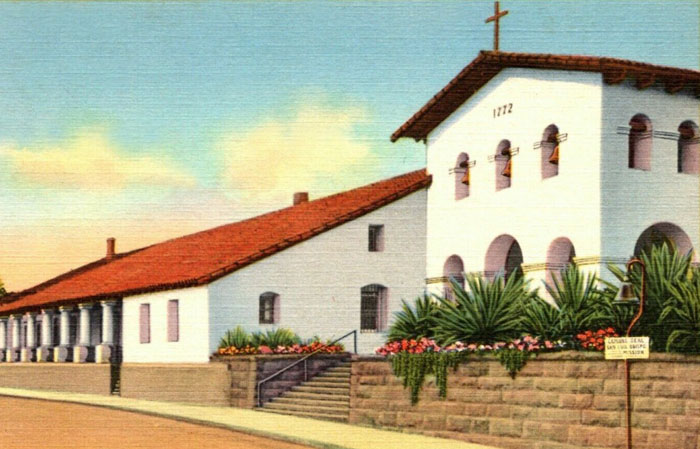
San Luis Obispo Mission, California.
One of the early Missions was San Luis Obispo, where services are still held. It was especially noted for the fine blue cloth the Indians wove from the wool of the Mission flocks of sheep. The Indians there also wove blankets and cloth from cotton raised upon their own lands.
San Juan Bautista, or St. John the Baptist, North of Monterey, had a splendid chime of nine bells said to have been brought from Peru and to have vibrant, mellow tones. San Miguel had a bell hung up on a platform in front of the church, and now at Santa Ysabel, 60 miles from San Diego, where the Mission itself is only a heap of adobe ruins, two bells hang on a rude framework of logs. The Indian bell-ringer rings them by a rope fastened to each clapper. The bells were cast in Spain, and they melted much silver jewelry and household plates with the bell metal. Near them, the Diegueño Indians worship in a rude arbor of green boughs with their priest, Father Antonio, who has worked among the tribe for 30 years. They live on a nearby rancheria and are making adobe bricks, hoping to build a church soon, like the old Mission, which has crumbled away.
The last of the Missions was built in 1823 at Sonoma and was very active in church work, with about 1,500 Indians baptized there.
Father Junipero Serra died in San Carlos at more than 70. Throughout his life in America, he endured great hardships and suffering to bring the gospel to the heathen, as he had dreamed of doing in his boyish days. Mrs. Stanford has erected a monument to his memory at Monterey, but the Missions he founded are his best and most lasting remembrances.
By Sexton, Ella M.; Stories of California, The Macmillan Company, New York, 1903. Updated & edited by Legends of America, September 25, 2026.
Also See: