
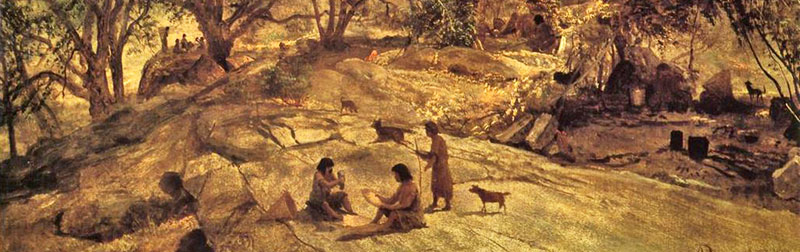
Mariposa Indian Encampment in California by Albert Bierstadt, 1872.
The Yokuts, also called Mariposan, a name derived from present-day Mariposa County, are native to central California.
Yokuts means “person” or “people.” Members of the Penutian language family. They occupied a strip about 250 miles long on the floor of the San Joaquin Valley, from the mouth of the San Joaquin River to the foot of the Tehachapi Mountains and the adjacent lower slopes or foothills of the Sierra Nevada Mountains, up to an altitude of a few thousand feet, from the Fresno River South. In the northern half of the Yokuts region, some tribes inhabited the foothills of the Coast Range to the West, where evidence shows they lived in the Carrizo Plain and created rock art in the Painted Rock area. The Yokuts are sometimes divided into the Southern Valley Yokuts, the Northern Valley Yokuts, and the Foothill Yokuts.
With numerous dialects, the Yokuts comprised as many as 60 separate hunter-gatherer tribes, speaking several related languages. They lived in many villages with up to 350 people in each tribe. Every tribe had a Head Chief, a sub-chief called Winatun, and a Village Chief.

Chukchansi Yokuts Chief by Edward S. Curtis, 1924.
Chiefs were generally wealthy and knowledgeable in religious matters. The chiefly office was hereditary and could be held by women and men. The chief sponsored ceremonies, hosted guests, aided the poor, mediated disputes, authorized hunts, and oversaw the execution of evil people such as sorcerers. Two other important offices were the jester, or clown, and the undertaker. The latter was usually a male-to-female two-spirit person who adopted the gender identity opposite their biological attributes and lived as that gender for the rest of their lives. Another office included the chief’s messenger.
Families arranged marriages with the couple’s consent. Polygamy was socially acceptable among the Yokuts, but it was rarely practiced. After living with the woman’s parents for a year, a couple lived in or near the husband’s parents’ home. The Yokuts observed parent-in-law taboos, meaning a son-in-law and mother-in-law never spoke directly to one another, and a daughter-in-law never spoke directly to her father-in-law. Divorce was not difficult within the tribe and could be achieved for reasons such as affairs, laziness, and infertility.
There were several Yokuts Bands:
Chaushila (Chowchilla)
Choinumni
Chukchansi
Gashowu
Lakisamni
Tachi
Wukchumni
In Yokuts culture, men usually hunted, fished, and built. They used spears, basket traps, and other tools for hunting animals. They caught lake trout, perch, chubs, suckers, salmon, and steelhead in lakes and rivers. They caught waterfowl such as geese, ducks, and mud hens with snares in the tule marshes. The Yokuts ate mussels and turtles. They killed antelope, elk, and deer when they came to the lakes to drink. Other animals and birds they ate included wild pigeons, quail, rabbits, squirrels and other rodents, and dogs.
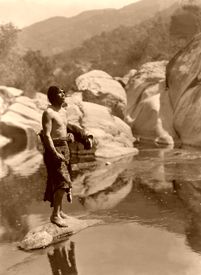
Quiet waters–Tule River Reservation, Yokut, Edward S. Curtis, 1924.
The women gathered, maintained the home, and cared for the children. Their staple food was derived from acorn mash, though they also gathered tule roots and iris bulbs to make flour. Other foraged food included manzanita berries, pine nuts, and seeds. Salt came from salt grass. They also cultivated tobacco.
They used bows and arrows for hunting and warfare. Although the Yokuts made some bows and arrows, they also obtained others through trade with other groups. The bows were backed with sinew, and the arrows had feathers. They caught other animals with traps and snares made from branches and brush. They set fish traps across streams. Spears were also used for fishing. Some birds were caught with nets made from milkweed fibers. An important tool was used to remove hot stones from the cooking basket. This was a stick about 30 inches long with a loop at one end, used to stir the mush and lift the stones.
The Valley Yokuts made canoe-shaped rafts from tule reeds tied together in bundles, often large enough to hold six people. They were pushed with long poles. The Foothill Yokuts made rafts by lashing two logs together.
Wood and stone were less plentiful in the San Joaquin Valley than in many parts of California. They obtained obsidian for knives and arrowheads through trade from the North and mountain areas. When obsidian was unavailable, they used other stones like chert, jasper, and quartz to make knives and scrapers. They sharpened animal bone pieces to make awls; they used pointed tools to punch holes and needles for sewing.
Tule reeds made many items, including baskets, cradles, and mats. They also made baby cradles, bowl-shaped cooking baskets, cone-shaped carrying baskets, flat basket trays, seed beaters, and water baskets. Some Foothill Yokuts made rough pottery bowls.
Men wore a piece of deerskin around their hips or went without clothes. Both rabbit skins and mud hen skins were used to make robes, which the people wore around their shoulders when the weather was cold. The Yokuts wore deer- or elk-skin moccasins only when walking in rough country. Yokut women wore a skirt made in two pieces: a narrow, fringed front part and a larger back piece. They made the skirts from tule reeds, marsh grass, or rabbit skins. They also wore a basket cap on their heads when carrying a burden basket, which was held on by a forehead strap.

Homes of Yokuts.
The Yokuts lived in permanent houses most of the year, leaving only in summer to gather food. Single families usually made oval-shaped houses, framed with side poles tied to a central ridge pole and covered with tule mats. The Southern Valley tribes often built larger houses for as many as ten families. These houses had steep roofs, with roofs and walls covered with tule mats. In the large house, each family had a fireplace and a door. However, no walls separated one family from another. Houses in the foothills and dry valleys were sometimes built with the floor dug down a foot or two into the ground. In marshy areas, the floor was level with the ground. Both Valley and Foothills Yokuts built shade roofs, like porches, outside their houses so they could work outside.
Each village had a sweat house, dug down into the ground and covered with brush and earth. Only men used them. Southern Valley Yokuts did not have dance or assembly houses, though Northern Valley villages may have used them.
The Yokuts had two important religious ceremonies, including the annual mourning rite and the first fruit rite. Yokuts ceremonies also included puberty rites, which for boys involved using the hallucinogen toloache, made from the jimsonweed (Datura stramonium). Many Yokuts dances and ceremonies were held outside, with brush fences surrounding the dance area. Eagle feathers were an important part of the ceremonial decoration. They used eagle down to make ceremonial skirts. They made tall headdresses using magpie tail feathers around a base of crow feathers.
Shamans—medicine men —were important because they were believed to have supernatural powers, helped conduct ceremonies, and could treat the sick. They derived their power from spirit animals through dreams or vision quests. They cured and presided over ceremonies and charged large fees for cures. Shamans could use their power for good or evil, and if they used it in ways that dissatisfied the tribe, they could be executed.
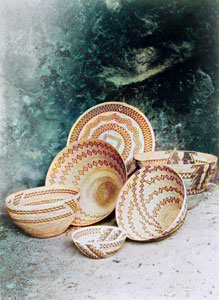
Tokuts baskets by Edward S. Curtis, colorized by Legends of America.
Yokuts artistic expression included music, singing, painting, and extensive basket weaving, with designs and images in the baskets. They also utilized tattooing and piercings. Some women had tattoos on their chins.
The Yokuts had several trading routes and traded with the coastal peoples, such as the Chumash tribe. They traded salt, soapstone, and obsidian and used marine shells as money, called keha, showing they had a functional monetary system. With these, they traded for plant and animal products, mussels, and abalone shells, and with the Miwok for baskets, bows, and arrows.
The first time the Yokuts encountered Europeans was in 1772 when Spanish troops were in the area searching for soldiers.
The first pre-contact population estimate of the Yokuts put them at 18,000 in 1770. However, later estimates suggested a substantially higher total—about 70,000 —one of the highest regional population densities in pre-contact North America.
In the 19th Century, the Spanish established missions, and as they expanded, they forced the Yokuts to work the land for farming. The harsh working conditions, along with disease and abuse, led to the death of many Indians. As their workforce dwindled, the missions moved farther inland, forcing those they encountered to convert and work.
In 1833, British fur traders brought malaria, which spread through the native population through their use of sweat lodges.
After acquiring California from Mexico after the Mexican-American War, the federal government signed the first state-wide treaty, setting aside seven and a half percent of California’s land area for proposed Indian reservations. This was the first of 18 proposed treaties, none of which the U.S. Senate ratified.
Gold was discovered in California in 1849. The 1850s were devastating for the Yokuts, who American gold prospectors and settlers nearly destroyed. In 1853, malaria spread once again among the Yokuts, killing more natives.
The newly-organized state government took a different approach. In 1851, California Governor Peter Burnett said that unless the Indians were moved East of the Sierras, “a war of extermination would continue to be waged until the Indian race should become extinct.”
By 1854, what was left of the Yokuts tribe was forced to move to the Fort Tejon Reservation. A few years later, the reservation was attacked by white vigilantes who killed most of the inhabitants, and by 1859 the reservation was completely abandoned.
In the next decades, settlers and eventually the California State Militia would wage war against the Yokuts and other native tribes in what became known as the Californian Genocide. The Yokuts were reduced by about 93% between 1850 and 1900, with many survivors being forced into indentured servitude sanctioned by the California State Act for the Government and Protection of Indians.
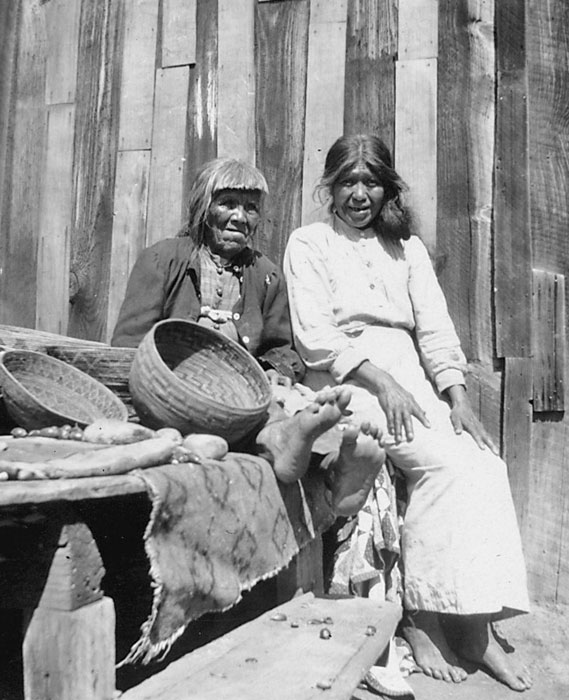
Chukchansi Yokuts women grinding acorns by the Bureau of Indian Affairs.
The Tule Reservation was established in 1873, and many Yokuts moved there. Yokuts found minimal employment in the logging industry as ranch hands and farm laborers into the 20th Century. Their children were forcibly sent to boarding schools early in the century.
Disease, violence, and relocation severely diminished the Yokuts population so much that today their numbers do not even come close to what they once were. In 1910, the Yokuts had an estimated population of 600. The Santa Rosa Rancheria was established in 1921.
The 1930 census showed a population of 1,145.
By the 1950s, most Indian children were enrolled in segregated public schools. A cultural revival began in the 1960s.
In 1990, about 1,150 Yokuts Indians lived on two Yokuts rancherias.
As of the 2010 census, 6,273 people identified as Yokuts. Many live on reservations with casinos, which are essential in providing the Yokuts with jobs, money, and healthcare. The most prominent tribe is the federally recognized Tachi.
Contemporary Yokut tribes include:
Santa Rosa Rancheria (Tachi)
Picayune Rancheria of Chukchansi Indians
Table Mountain Rancheria (Mono)
Tejon Indian Tribe of California
Tule River Indian Tribe of the Tule River Reservation
Tuolumne Rancheria
The contemporary Wukchumni and Choinumni communities are not yet federally recognized.
©Kathy Alexander/Legends of America, updated September 2026.
Also See:
Indigenous Americans Long Path to U.S. Citizenship
Native Americans – The First Owners of America
Native American Photo Galleries
Sources:
AAA Native Arts
Encyclopedia Britannica
Social Studies Fact Cards
Wikipedia