
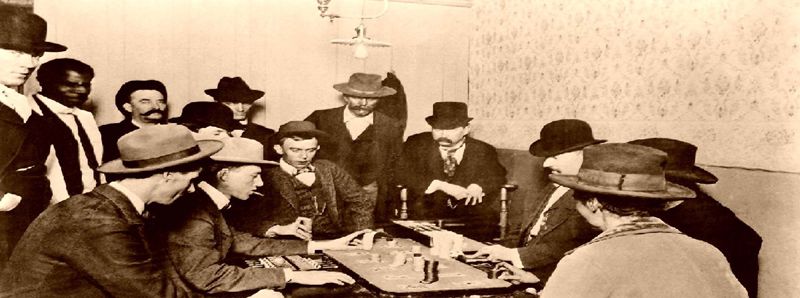
Faro is a gambling card game from about 1900.
Faro is a gambling card game that was derived from a card game called Basset. Faro originated in France in the late 17th Century. First known as Pharaon, it became extremely popular in Europe in the 18th Century. Shortened to Pharo or Faro, it soon spread to America and became the favored game during the California Gold Rush. The game then spread into gambling halls across the American Frontier, with illustrious names like Doc Holliday and Wyatt Earp often serving as Faro Dealers.
Not a direct relative of poker, Faro was played alongside its other popular counterpart and drew in the masses because of its fast action, easy-to-learn rules, and better odds than most games of chance. From 1825 to 1915, the game was the most popular entertainment in almost every gambling hall in the American West.
Though the rules are similar to Mini-Baccarat, Faro is played with only one deck of cards and allows for any number of players, referred to as “punters.” The Faro dealer was called the “banker.”
The Faro layout consists of a board where one card of each denomination is displayed at the top of the table, usually in spades. As the game commenced, each player would lay their stake on one of the 13 cards or place multiple bets on different cards. A “high card” box at the top of the layout also let players bet on the highest card.
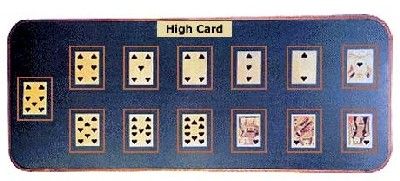
Faro Board.
After the banker burned a card, he dealt another card, called the “banker’s card,” and placed it to his right. He then dealt another card, called the “English card” or “player’s card,” and placed it to his left.
The banker won all the money staked on the “banker’s card,” while paying double the sums staked to those who bet on the “player’s card.” If the banker dealt a pair, he won half the stakes that were bet on the card. In a fair game, this provided the only house edge. Gamblers could also wager on the “High Card” bar at the top of the layout, betting that the “player’s card” would be higher than the “banker’s card.”

Faro in Tonapah, Nevada in 1905.
When these rules are reviewed, it becomes apparent that there is no significant edge for the dealer, or “house, which resulted in cheating by the “banker” becoming commonplace. Trick decks, sleight of hand, and modified automatic dealing boxes were used to give the house an advantage.
Cheating became so prevalent that editions of Hoyle’s Rules of Games book began their Faro section with a disclaimer, warning readers that an honest Faro bank could not be found in the United States.
One of the better-known cheating dealers was Soapy Smith, who had every one of his Faro games rigged at his Tivoli Club in Denver, Colorado.
A popular phrase often associated with Faro was “Bucking the Tiger,” thought to come from early cardbacks featuring a drawing of a Bengal Tiger. Another phrase for playing Faro was “twisting the tiger’s tail.” Places that sported several gambling halls, including alleys, streets, and districts, were often called “tiger town” or “tiger alley.”
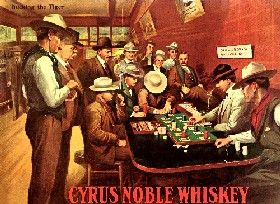
Faro Players.
Because the house odds were so low, legitimate Faro was virtually gone by 1925. However, when Nevada legalized gambling in 1931, the game saw a brief revival. Still, by the 1950s, it had fallen out of fashion again, as casinos promoted more profitable house games such as craps and roulette.
By this time, only five active Faro banks were known to exist in Nevada, the last of which was in Reno and closed in 1985.
Today, most young American gamblers have never even heard of Faro.
©Kathy Alexander/Legends of America, updated September 2026.
“A dollar picked up in the road is more satisfaction to you than the ninety-and-nine which you had to work for, and money won at faro or in stock snuggles into your heart in the same way.”
— Mark Twain in 1892
Frontier Lingo – Faro
Also See:
See Sources.