

Mission San Jose, San Antonio, Texas, by Kathy Alexander
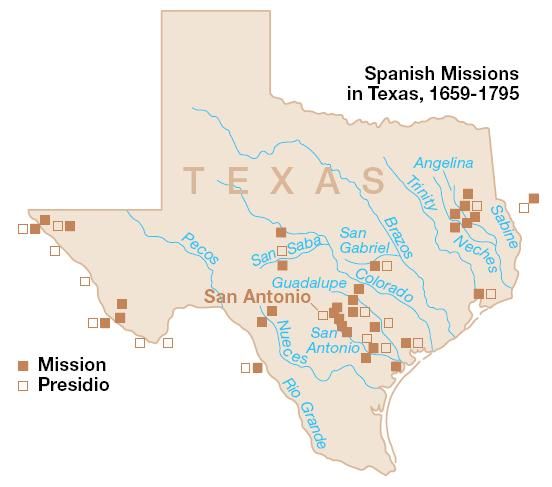
Spanish Missions in Texas Map, courtesy of the National Park Service.
Misión Nuestra Señora de la Bahía del Espíritu Santo de Zúñiga, Goliad
Mission Nuestra Señora de la Purísima Concepción de Acuña, San Antonio Missions National Historical Park
Mission San Antonio de Valero, The Alamo, San Antonio
Mission San Francisco de la Espada, San Antonio Missions National Historical Park
Mission San José y San Miguel de Aguayo, San Antonio Missions National Historical Park
Mission San Juan Capistrano, San Antonio Missions National Historical Park
Mission Santa Cruz de San Sabá and Presidio San Luis de las Amarillas, Menard
Misión Nuestra Señora de la Limpia Concepción del Pueblo de Socorro, Socorro
Mi Misión Corpus Christi de San Antonio de la Ysleta Sur, El Paso
~~

Our Lady of Loreto Chapel at the Presidio de la Bahia. Photo by Kathy Alexander.
The Spanish Missions in Texas were religious outposts established by Spanish priests and colonial authorities to spread the Catholic doctrine among Native Americans. With the Church and State closely linked in Spain, the crown permitted various Catholic religious orders to found mission communities to help the Spanish secure their claims to vast lands in North America.
Between 1632 and 1793, Spanish friars traveled North from Mexico into present-day Texas, where they built dozens of missions and presidios (military forts). In all, 26 missions were established and maintained in Texas with greatly varying results.
The goal was to establish autonomous Christian towns with communal property, labor, worship, political life, and social relations supervised by the missionaries. Seeking to make life within mission communities closely resemble Spanish villages and culture, the priests taught not only the Indians’ religion but also new life skills. They introduced European livestock, fruits, vegetables, and industry into the Texas area. Daily life followed a highly organized pattern of prayer, work, training, meals, and relaxation, punctuated by frequent religious holidays and celebrations.

The Nuestra Señora de la Concepción del Socorro Church in Socorro, Texas, by Kathy Alexander.
To become Spanish citizens and “productive” inhabitants, the Indians were taught vocational skills, including farming, blacksmithing, masonry, carpentry, weaving, and more. The long-term plan was for the Native Americans to mature in Christianity and absorb Spanish culture and political and economic practices until they no longer required special mission status. Then, as Spanish citizens, the communities could be incorporated into ordinary colonial society.
Although most of these missions fell short of their goal, several succeeded and grew into thriving settlements that are some of the state’s most important cities today. Spanish missionaries started the famed Texas cattle industry by bringing the first cattle from Mexico. The mission’s influence can still be seen across Texas in architecture, agriculture, and place names.
When the Spanish left the area, many of the missions were abandoned or fell into ruins, and their locations were lost over time. However, several others are well preserved and restored and are open to visitors. Some even continue to operate as Catholic churches.
© Kathy Alexander/Legends of America, updated October 2026.

Mission San Jose, San Antonio, Texas by Kathy Alexander.
Also See:
A Day in the Life of a Spanish Missionary
The Spanish Exploration of America
Sources:
National Park Service
Texas Mission Guide
Texas State Historical Association
Wikipedia