
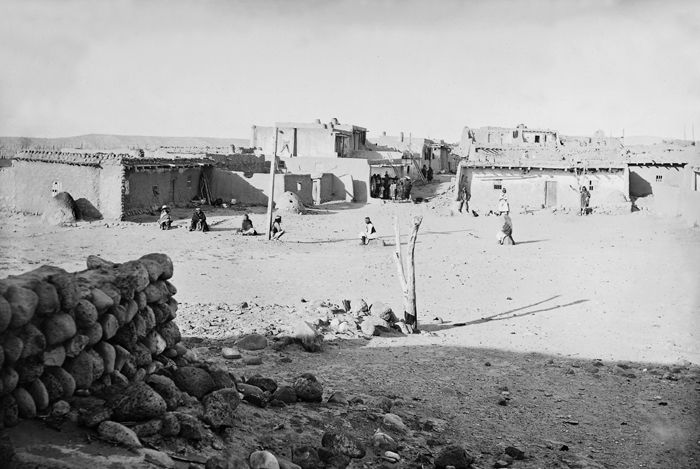
Zia Pueblo, New Mexico, by John K. Hillers, late 1800s.
The Zia Pueblo, situated atop a basalt mesa in north-central New Mexico, comprises Keresan-speaking Indians who have continuously occupied the site since the 13th Century. Over 600 years old, Zía Pueblo has two plazas, each with a kiva, surrounded by one- and two-story traditional dwellings of native rock surfaced with mud. Zia Pueblo is home to the Spanish mission of Nuestra Señora de la Asunción, whose construction began around 1694.
Archaeologists believe that the Zia people are descendants of the Ancestral Puebloan (Anasazi) people of the Four Corners region, who migrated to the Jemez River Valley sometime in the 13th Century.
Located between the slopes of the Sierra Nacimiento Mountains and the San Pedro River Valley, the Zia people have long lived an agricultural lifestyle, primarily growing corn, beans, and squash in shared or common ground, to which everyone contributed. They also grew minor crops such as peppers, onions, chilies, and tobacco in personal gardens. The people also hunted small and large game. People built homes at the pueblo with local basalt and mud mortar, covered in mud plaster.

Zia Buffalo Dancer by Edward S. Curtis, 1925.
Like the other Pueblos, the Zia believe in spirits called kachinas, who are said to visit occasionally and bring rain and clouds. Their religion includes over 300 kachinas, and festivals and ceremonies are held throughout the year, during which men dressed as kachinas dance among the people.
Spanish explorer Antonio de Espejo first encountered the Zia people in 1583. He noted that the largest pueblo was the one the natives called Tsiya, which the Spanish later renamed Zia. He also reported that the area was home to several thousand people. The Spanish explorers were impressed by the canals and complex irrigation system the Pueblo used to grow crops.
Spanish conquistador Juan de Oñate brought his Franciscan missionaries, soldiers, and settlers to New Mexico in 1598. Soon afterward, he sent missionaries across the region, and Franciscan Fray Alonso de Lugo was assigned to Zia, where he founded the mission of San Pedro y San Pablo. By 1613, tribal members built a church and convent. Spanish settlers and their religious orders slowly took control of the region and outlawed traditional Zia religious ceremonies. Tensions between the Spanish and the Zia, as well as other Pueblo communities, built up over the following decades, eventually resulting in the Pueblo Revolt of 1680. The rebellion successfully overthrew the Spanish regime, forcing the Spanish to flee the South.

Zia Pueblo Church, New Mexico.
The Spanish did not return for another nine years. In 1689, Governor Domingo de Cruzate attacked the Zia Pueblo in a failed attempt to retake New Mexico. However, his attack upon the Zia resulted in the deaths of 600 people, and the Spanish took 70 Zia Indians captive. Afterward, the remaining Zia people moved several miles north.
Three years later, Diego de Vargas led the successful campaign to retake New Mexico in 1692. The Zia people offered him no resistance when he asked them to move back to their original location. The church was not destroyed during the revolt, and the community was assigned a new priest in 1694, Fray Juan Alpuente. The church building was under construction by 1704. The Indian community at Zia built the church, cutting and hauling the pine vigas from the mountains for the roof and making thousands of adobe bricks. The community renamed the church Nuestra Señora de la Asunción. It is unclear whether the new church was rebuilt on the foundations of the earlier building.
Over the following decades, fighting and disease took their toll on the people, and by 1892, only about 120 residents were living in Zia.

Zia Pueblo Street Scene by Edward S. Curtis, 1924.
The original convento where the priest once lived is gone today, but the church remains with a cemetery in front. Unlike many New Mexican colonial period churches, Nuestra Señora de la Asunción escaped “modernization.” In 1923, the Committee for the Preservation and Restoration of the New Mexican Mission Churches made the Nuestra Señora de la Asunción a priority project. Zia workers replaced the rotting vigas and installed roofing paper and copper-lined canals to channel water away from the ceiling and building. These efforts, adding electric lighting and fresh stucco and paint, have kept Nuestra Señora de la Asunción de Zia part of the Pueblo community today.
Although the Pueblo itself is inconspicuous as it blends into the landscape, its Sun symbol is familiar to all New Mexicans. It is the official New Mexico State insignia appearing on the state flag. Today, the Zia Pueblo is home to about 650 people who continue to practice agriculture and raise livestock. They also make pottery that often displays their sun symbol or a bird motif. They continue to speak the Keresan language; many also speak Spanish and Navajo, and most also speak English.
The principal festival of the year for the Zia Pueblo is the Corn Dance on the feast day of Our Lady of the Assumption in August. Wonderful traditional costumes and ceremonies make this an important event in the Pueblo’s life and a major draw for visitors.
The Zia Pueblo is listed in the National Register of Historic Places for its long history and unique culture.
The Pueblo is located on NM Highway 44, 16 miles northwest of Bernalillo, New Mexico. No cameras, recording, or sketching are allowed. You can visit the pueblo daily from dawn to dusk, but it is closed during some religious ceremonies. The community offers a tribal museum, Zia Lake, the Zia Cultural Center, and shops featuring its well-known pottery.
More Information:

Zia Corn Dancers by Telesfor Gachupin, 1947.
Zia Pueblo
135 Capital Square Dr.
Zia Pueblo, NM 87053-6013
505-867-3304
©Kathy Alexander/Legends of America, updated September 2026.
Also See:
Ancient & Modern Pueblos – Oldest Cites in the U.S.
Sources: