

San Jose de Tumacacori, Arizona Bell by Frederick D. Nichols, 1937.
Founded by Jesuit Father Eusebio Francisco Kino in January 1691, Mission San Cayetano de Tumacácori was the first mission in what is now Arizona. It was part of the global Spanish colonization mission system.
Father Kino established the mission on the east side of the Santa Cruz River to create a self-sufficient agricultural community, convert local Indians to Catholicism, and generate revenue for Spain.
The native people who lived in the region around Tumacácori called themselves “O’odham,” meaning “people” in their language. However, the Spanish called them Pima and/or Papago. Their homeland included the area now known as Southern Arizona and the northern part of the Mexican state of Sonora. The O’odham were farmers who raised corn, beans, squash, and other crops using flood irrigation long before the Spanish arrived. The people called “Papago” by the Spanish are known today as the Tohono O’odham, or “desert people,” and continue to live and farm in southern Arizona. People from other indigenous groups lived at and around the mission as well, including Yaqui, Apache, Yuman, and Opata, in addition to the mission priests who originated from various parts of Europe and the Americas. Disease often spread in waves ahead of the Spaniards, decimating native villages before the Spaniards arrived. Still, the native peoples of Southern Arizona were resilient, surviving disease and European and American colonialism.
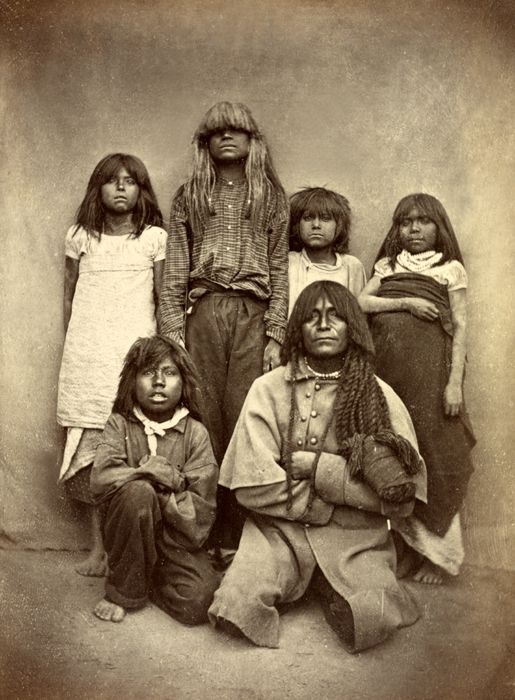
O’odham Indians by Carlo Gentile, 1870.
Missions were often established near existing Indian villages. The mission grounds were an institutionalized landscape with a highly defined spatial pattern that divided and separated land for religious use, priest quarters, specialized work areas, Christianized Indian quarters, mission agricultural/livestock lands, orchards, and irrigation ditches, or acequias. Native settlements around the mission consisted of large villages of mud-and-brush houses, numerous scattered smaller villages, and extended-family habitations. Wheat was the primary agricultural crop, followed by corn. The O’Odham adopted winter wheat from the Spanish. It became essential to their diet and could be harvested during what had previously been a lean time of year.
Ranching was also an essential part of mission life, and with herds of thousands of cattle and sheep, the people at the mission likely kept busy shearing, herding, and butchering these animals. The acequia fed orchards and fields where a large number of domesticated plants, such as wheat, maize, squash, watermelon, cantaloupe, lentils, peppers, and peaches, were grown.
For many years, the site served as a visita or visiting station of the mission headquarters at nearby Los Santos Ángeles de Guevavi. Services were held in a small adobe structure built by the village’s native inhabitants. After the Pima rebellion of 1751, the mission was moved to the present site on the west side of the river and renamed San José de Tumacácori. By 1757, the community had built a small adobe church. Following the expulsion of the Jesuits from the Spanish empire in 1767, the Franciscan order took over management of the Pimería Alta (upper Pima land) missions.
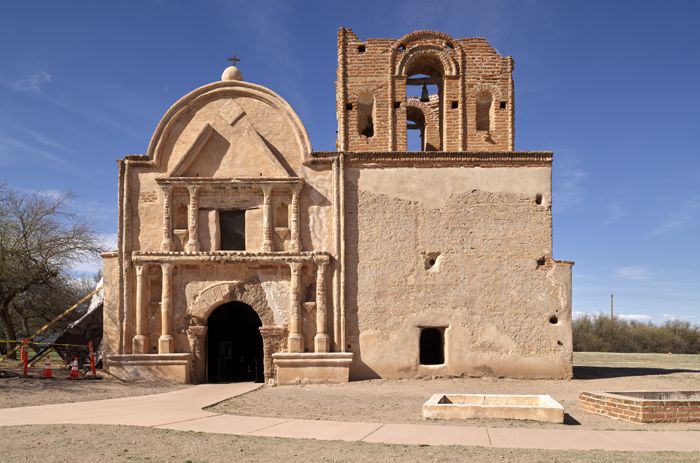
Tumacacori Mission south of Tucson, Arizona, by Carol Highsmith.
Bishop Antonio de los Reyes wrote a report on the condition of the area missions on July 6, 1772, stating:
“The village of San Jose at Tumacácori lies seven leagues to the south of Guevavi and one league from the Presidio of Tubac, in open territory with good lands. In this village, they have a church and a house for the Missionary, devoid of all ornament and furnishing. According to the Census Book, which I have here before me, there are 22 married couples, 12 widowers, 10 orphans; the number should be 93.”
The Franciscans began work in 1800 on an ambitious undertaking. This church would match the frontier baroque glory of the celebrated Mission San Xavier del Bac, not far to the north. Under the direction of a master mason and a crew of Indian and Spanish laborers, they laid five-foot thick cobblestone foundations that year, but construction ground to a halt as funds dried up. Over the next few years, they were able to add a few courses of adobe bricks, bringing the walls up to seven feet. These were plastered inside and out, and decorative handfuls of crushed brick were pressed into the wet plaster.
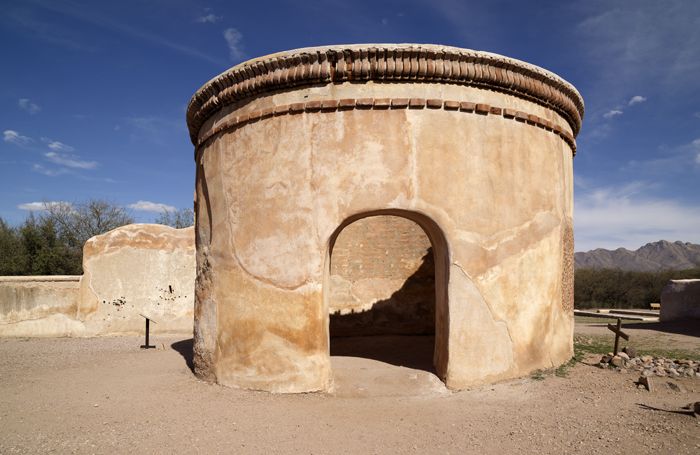
Tumacacori Mission by Carol Highsmith.
It was not until 1821 that work truly resumed. An enterprising Franciscan, Father Juan Bautista Estelric, sold 4,000 head of the mission’s cattle to a local rancher, Don Ignacio Pérez, and, with the first payment, hired a new master and pushed the work forward. The walls were raised to 14 feet, but the rancher stalled on his payments, and construction again ceased. Two years later, Father Ramón Liberós, a persistent friar, finally got the rancher to pay his bill, and work resumed. Within a few years, the church was nearly complete, although the bell tower was never capped with a dome. Attached to the main church are the baptistery and the sacristy. The church must have been a striking landmark in the flat Santa Cruz Valley, with its embellished, painted façade and plaster walls adorned with crushed red brick.
Apache raids and other stress factors in the 1840s eventually led to the abandonment of Tumacácori in December 1848. The inhabitants moved to Mission San Xavier del Bac, just south of Tucson.
Afterward, Tumacácori began falling into disrepair during the American period in Arizona. It became a National Monument in 1908 and was added to the National Park Service in 1916. Archeological and preservation work at the mission began in 1917, with excavations and the installation of a roof over the adobe church.
Today, the ruins of the large church remain a landmark in the Santa Cruz Valley, with its nine-foot-thick adobe walls supporting the bell tower and the choir balcony. The mission church building is maintained in a state of arrested ruin, with the goal of preserving the original structure rather than additional restoration or speculative completion of architectural features. Nearly everything in the church, except the roof and floor, is original. Some of the original interior decorations of the cupola in the sanctuary are still visible today. Near the church are the remains of the priest’s residence and a community area known as the convento, which encloses a large plaza where many of the mission’s main activities took place.
Visitors can also see the large lime kiln used to heat lime and produce mortar and plaster for the buildings. Lime helped preserve the adobe by protecting it from moisture. Behind the church are the ruins of a cemetery and the round mortuary chapel. Initially, this mortuary chapel was supposed to have a domed roof. Still, construction of that apparently never began, so the resulting incomplete structure is (and apparently has always been) open to the sky. Also on the site is a reproduction of a ki, or traditional O’odham house, much like the ones the O’odham would have lived in around the mission. Visitors can also walk by the aqueducts and the historic mission garden/orchard.
The Tumacácori National Historical Park in Southern Arizona also protects the ruins of two other missions — Los Santos Ángeles de Guevavi and San Cayetano de Calabazas. Visitors enter Tumacácori National Historical Park through the Tumacácori visitor center, which offers a video, museum, and bookstore. It is open daily, but there is a fee. Tumacácori National Historical Park is located 45 miles south of Tucson, Arizona, off exit 29 on I-19.
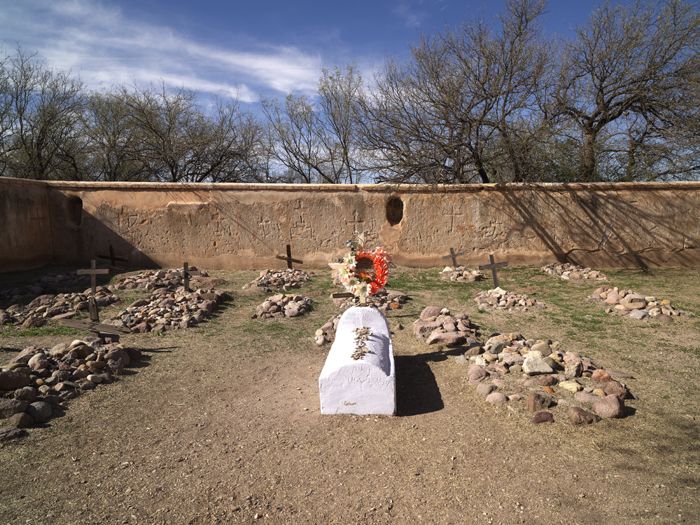
Tumacacori Mission Cemetery by Carol Highsmith.
More Information:
Tumacacori National Historic Park
1891 East Frontage Road
P.O. Box 8067
Tumacacori, Arizona 85640
520-377-5060
©Kathy Alexander/Legends of America, updated February 2026.
Also See:
List of Missions & Presidios in the United States
Missions & Presidios of the United States
Spanish Missions & Presidios Photo Gallery
Spanish Missions Architecture and Preservation
Sources: