
By Henry Cabot Lodge
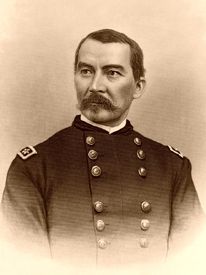
General Philip H. Sheridan.
General Philip H. Sheridan took command of the Army of the Shenandoah, Virginia, in August 1864. His coming signaled aggressive fighting and a series of brilliant victories over the rebel army. He defeated General Jubal A. Early at Winchester and again at Fisher’s Hill, General Alfred Torbert whipped General Thomas Rosser in a subsequent action, where the route of the rebels was so complete that the fight was known as the “Woodstock Races.” Sheridan’s plan after this was to terminate his campaign north of Staunton and then return to desolate the Valley, making it untenable for the Confederates and useless as a granary or storehouse. Then, he would move the bulk of his army through Washington and unite them with General Ulysses S. Grant in front of Petersburg. Grant, however, and the authorities in Washington favored Sheridan’s driving Early into Eastern Virginia and following up on that line, which Sheridan believed was a false move.
This critical matter was debated until October 16th, when Sheridan, having left the main body of his army at Cedar Creek under General Horatio Wright, determined to go to Washington to discuss the question personally with General Henry W. Halleck and the Secretary of War.
He reached Washington on the morning of the 17th at about eight o’clock, left at twelve, and returned to Martinsburg the same night at about dark. At Martinsburg, he spent the night and, the next day, with his escort, rode to Winchester, reaching that point between three and four o’clock in the afternoon of the 18th. There, he heard that all was quiet at Cedar Creek and along the front and went to bed, expecting to reach his headquarters and join the army the next day.
About six o’clock on the morning of the 19th, it was reported to him that artillery firing could be heard in the direction of Cedar Creek, but, as the sound was stated to be irregular and fitful, he thought it only a skirmish. Nevertheless, he arose and had just finished dressing when another officer came in and reported that the firing was still going in the same direction, but did not sound like a general battle. Still, Sheridan was uneasy and, after breakfast, mounted his horse between eight and nine o’clock and rode slowly through Winchester. When he reached the edge of the town, he halted a moment and then heard artillery firing in an unceasing roar. He now felt confident that a general battle was in progress, and as he rode forward, he was convinced, from the rapid increase of the sound, that his army was falling back. After he had crossed Mill Creek, just outside Winchester, and made the crest of the rise beyond the stream, the spectacle of a panic-stricken army burst upon his view. Hundreds of slightly wounded men, with hundreds more unhurt but demoralized, together with baggage wagons and trains, were all pressing to the rear in hopeless confusion.
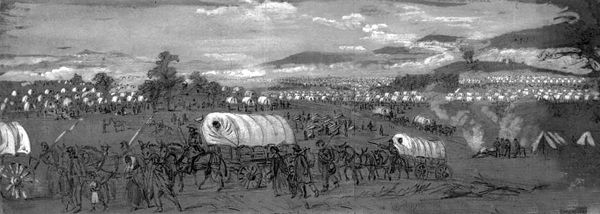
Sheridan’s wagons in Shenandoah Valley, Virginia.
There was no doubt now that a disaster had occurred at the front. A fugitive told Sheridan that the army was broken and in full retreat, and all was lost. Sheridan at once sent word to Colonel Edwards, commanding a brigade at Winchester, to stretch his troops across the valley and stop all fugitives. His first idea was to stand there, but as he rode along, a different plan flashed into his mind. He believed that his troops had great confidence in him and were determined to restore their broken ranks and, instead of merely holding the ground at Winchester, rally his army and lead them forward again to Cedar Creek. He had hardly made up his mind to this course when the news was brought to him that his headquarters at Cedar Creek were captured and the troops dispersed. He immediately set out with about 20 men as an escort and rode rapidly to the front. As he passed along, the unhurt men, who thickly lined the road, recognized him and, as they did so, threw up their hats, shouldered their muskets, and followed him as fast as they could on foot. His officers rode out on either side to tell the stragglers that the general had returned, and as the news spread, the retreating men in every direction rallied and turned their faces toward the battlefield they had left.

Battle of Cedar Creek, Virginia by Kurz & Allison.
In his memoirs, Sheridan said, speaking of his ride through the retreating troops: “I said nothing, except to remark, as I rode among them, if I had been with you this morning, this disaster would not have happened. We must face the other way. We will go back and recover our camp.” Thus, he galloped on over the twenty miles, with the men rallying behind him and following him in ever-increasing numbers.
As he went by, the panic of the retreat was replaced by the ardor of battle. Sheridan had not overestimated the power of enthusiasm or his ability to rouse it to a fighting pitch. He pressed steadily on to the front until, at last, he came up to Getty’s division of the 6th Corps, which, with the cavalry, was the only troops that held their line and were resisting the enemy. Getty’s division was about a mile north of Middletown on slightly rising ground and skirmished with the enemy’s pickets. Jumping a rail fence, Sheridan rode to the crest of the hill, and as he took off his hat, the men rose from behind the barricades with cheers of recognition.
It is impossible to follow in detail Sheridan’s actions from that moment, but he first brought up the 19th Corps and the two divisions of Wright to the front. He then communicated with Colonel Lowell, who was fighting near Middletown with his men dismounted, and asked him if he could hold on where he was, to which Lowell replied in the affirmative. All this and many similar quick orders consumed a great deal of time, but the men were still getting into line, and at last, seeing that the enemy was about to renew the attack, Sheridan rode along the line so that the men could all see him. As he rode by, he was received with the wildest enthusiasm, and the army’s spirit was restored. The rebel attack was made shortly after noon and was repulsed by General Emory.
This done, Sheridan again set to work to restore his line while General Merritt charged and drove off an exposed battery of the Confederates. By half-past three, Sheridan was ready to attack. The fugitives of the morning, whom he had rallied as he rode from Winchester, were again in their places, and the different divisions were all disposed of in their proper positions. With the order to advance, the whole line pressed forward. The Confederates at first resisted stubbornly and then began to retreat. On they went past Cedar Creek, where the pike made a sharp turn to the west toward Fisher’s Hill, Merritt and Custer fell on the flank of the retreating columns, and the rebel army fell back, routed, and broken, up the Valley. The day had begun in route and defeat; it ended in a great victory for the Union army. How near we had been to a terrible disaster can be realized by recalling what had happened before the general galloped down from Winchester.
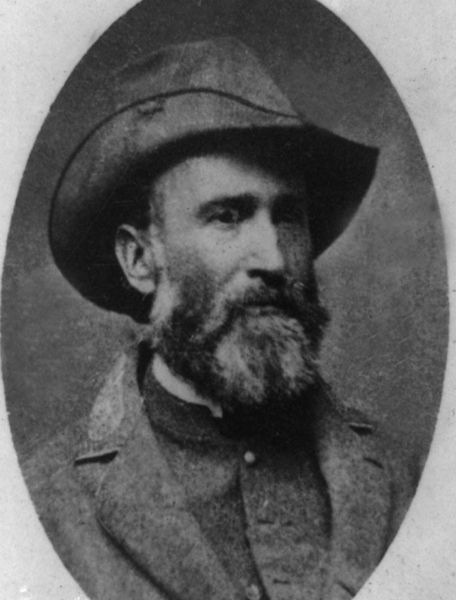
Confederate General Jubal A. Early.
In Sheridan’s absence, General Jubal A. Early, soon after dawn, made an unexpected attack on our army at Cedar Creek. Surprised by the assault, the national troops had given way in all directions, and panic had set in. Getty’s division with Lowell’s cavalry held on at Middletown, but, with this exception, the rout was complete. When Sheridan rode out of Winchester, he met an already beaten army. His first thought was to stand at Winchester and rally his troops around him. His second thought was the inspiration of the great commander. He believed his men would rally as soon as they saw him. He believed that enthusiasm was one of the great weapons of war and that this was the moment of all others when it might be used with a decisive advantage. With this thought in mind, he abandoned the idea of forming his men at Winchester and rode bareheaded through the fugitives, swinging his hat straight for the front and calling on his men as he passed to follow him. As the soldiers saw him, they turned and rushed after him. He had not calculated in vain upon the power of personal enthusiasm, but, at the same time, he did not rely upon any wild rush to save the day. The moment he reached the field of battle, he set to work with the coolness of a great soldier to make all the dispositions, first, to repel the enemy and then to deliver an attack that could not be resisted. One division after another was rapidly brought into line and placed in position, the thin ranks filling fast with the soldiers who had recovered from their panic and followed Sheridan and the black horse down from Winchester. He had already been two hours on the field when, at noon, he rode along the line, again formed for battle. Most of the officers and men then thought he had just come, while in reality, his rapid work had put them in the line he was riding along.
Once on the battlefield, the rush and hurry of the desperate ride from Winchester ended. First, the line was reformed, then the enemy’s assault was repulsed, making it impossible for them to retake the offensive. But, undazzled by his brilliant success up to this point, Sheridan did not mar his work by overhaste. Two hours passed before he was ready, and then, when all was prepared, with his ranks established. His army ranged in position; he moved his whole line forward and won one of the most brilliant battles of the war, having, by his power over his troops. His genius in action snatched a victory from a day that began in surprise, disaster, and defeat.
About the Author: Sheridan at Cedar Creek was written by Henry Cabot Lodge and included in the book he co-wrote with Theodore Roosevelt, Hero Tales From American History, published in 1895. Compiled and edited by Kathy Alexander/Legends of America, updated November 2025.
Sheridan at Cedar Creek inspired repulsed battalions to engage and taught the doubtful battle where to rage.
–Addison
Also See:
General Philip H. Sheridan – Civil War Hero & Ruthless Tyrant
Historical Accounts of American History
The Civil War (main page)