
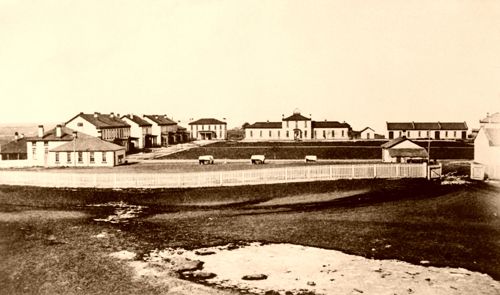
Fort Totten, North Dakota.
Located on the Fort Totten Indian Reservation, this North Dakota State Historic Site began in 1867 when soldiers built a log structure that soon grew to include dozens of buildings.
Situated on the southeastern shore of Devil’s Lake, it was built to protect the Totten Trail, an overland route that extended across Dakota Territory from southern Minnesota to the goldfields of western Montana, and later to control and protect the Totten Indian Reservation.
Fort Totten was just one of several posts built to protect the overland route. Others included Forts Abercrombie, Ransom, Stevenson, and Buford, as well as Fort Benton in Montana.
Early in the summer of 1867, General A.H. Terry advanced with a considerable force intothe Devils Lake Region, where work began on the fort, named for Brevet Major General Joseph Gilbert Totten, late Chief Engineer of the United States Army.
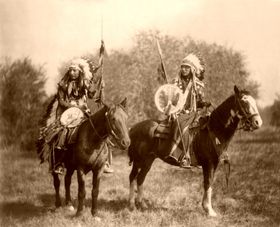
Sioux Indians on horseback, by Heyn, 1899.
The following year, soldiers began rebuilding and enlarging the fort. When the fort was first established, no Indians were in the immediate vicinity. However, the fort invited the Sioux the following Winter for a visit. After the Indians determined that the invitation was made in good faith, many began to come to the fort, some settling permanently. This was probably due to their starving condition, as the fort’s commander found it necessary to issue large quantities of rations during the first winter to prevent them from dying of hunger.
In 1870, J. W. Daniels, the Indian Agent on the Sisseton Indian Agency, Dakota Territory, recommended appointing an Indian Agent for the natives living around Fort Totten. The Indian Department then allocated the old log quarters for its use, and the first Indian Agent arrived in May 1871. In September of that same year, Indians were estimated to number more than 700, surviving on government rations and having planted over 100 acres of corn, potatoes, turnips, wheat, oats, and hay.
Though the Fort Totten Indian Reservation was provided for in a February 1867 treaty and 360 square miles set aside by an Executive Order in January 1870, it wasn’t formally established until 1878.
Meanwhile, the fort continued to expand in the 1870s, adding a sawmill, a granary, officers’ quarters, barracks, a hospital, a bakery, a commissary, a school, and more; most structures were built of brick.
A Catholic School was to be established at the Indian Agency, and by 1875, the agency had grown to five buildings. Finally, in 1878, the surrounding reservation was formally established for the Cut Head, Wahpeton, and Sisseton Sioux under an 1867 treaty.
Though the fort continued to serve as a military post, it spent most of the next decade serving Indian affairs. In 1890, Fort Totten was decommissioned, and the following year, it became the property of the Bureau of Indian Affairs.
For the next half-century, the buildings served as an Indian boarding school, health care facility, and reservation school, which operated until 1959. The next year, the Bureau of Indian Affairs transferred the bulk of the fort site to the State of North Dakota for historical purposes. The site then became Fort Totten State Historic Park, which was listed on the National Register of Historic Places in 1971.
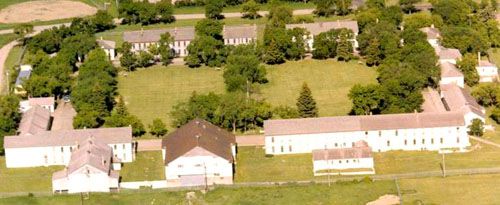
Fort Totten today, courtesy of Fort Totten State Historic Site.
Today, Fort Totten is one of the best-preserved military posts of the frontier era. Sixteen of its original buildings, including officers’ quarters, barracks, family units, the commissary, the bakery, and more, still stand. A museum is located in the historic hospital building.
Fort Totten is located in Benson County, on the Fort Totten Indian Reservation, just Southwest of Fort Totten, North Dakota.
Contact Information:
Fort Totten State Historic Site
P.O. Box 224
Fort Totten, North Dakota 58335
701-766-4441
©Kathy Alexander/Legends of America, updated September 2026.
Also See:
Forts & Presidios Photo Gallery
Soldiers & Officers in American History
See Sources.