
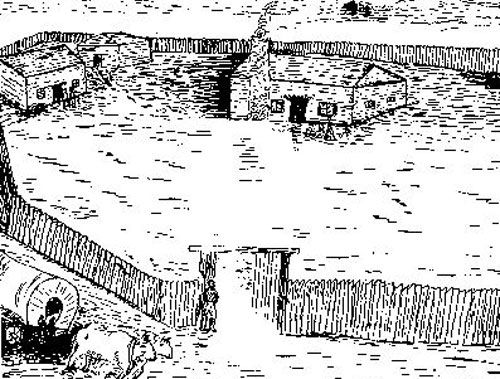
Typical trading post
By Hiram Martin Chittenden in 1902.
To one who has never given the subject of fur trading posts special attention, a large number of establishments, dignified with the name of forts, posts, or houses, that existed in the heart of the wilderness long before the tide of Western emigration had set in, would seem almost incredible. In 1843, there existed in the country west of St. Louis, Missouri, no fewer than 150 occupied or abandoned posts. The names of more than 100 have been recovered, while the casual hints scattered throughout the narratives and correspondence of the times make certain of the existence of a much larger number. Some of these were really great establishments and lasted many years; others were very temporary affairs, being occupied only for a season or two. Abandoned sites were frequently reoccupied, often by different companies that christened them with new names.
By far, the greater number of these posts lay along the Missouri River, and most of their names have long been buried in oblivion. Many are permanently lost, while others can not be cleared of uncertainty about their true location and ownership. Many of the names are perpetuated in towns and villages that have grown up on or near the old sites. Others who should have survived because of their great importance are no longer found today.
These establishments were generally designated as “Forts.” Their primary purpose was trade, but in a land of savage and treacherous inhabitants, they served the purpose of protection as well. Their construction was, therefore, adapted to both ends. The ground plan of the typical trading post was always a rectangle, sometimes square, but generally a little longer in one direction than the other. The sides varied in length from 100 to 400 feet, depending upon the magnitude of the trade, which the post had to accommodate. To ensure necessary protection, the fort was enclosed by strong walls of wood or adobe. There were a few posts built of adobe, but these were the exception. The typical fort was protected by wooden palisades or pickets, 12 to 18 feet high and 4 to 8 inches thick. In some instances, the pickets were squared and set in juxtaposition; in others, they were round pieces formed by sawing logs in half. They were set from 2 to 3 feet in the ground, and the earth was generally banked up to a small height against them. In some forts, there were musketry loopholes along the top of this embankment. For the purposes of guard duty and active defense, a plank walk was bracketed to the inside of the pickets, about four feet below the top, so that sentinels could walk there and observe the ground outside. In case of attack, the defenders could mount this walk and fire over the palisades or through the loopholes provided for the purpose.
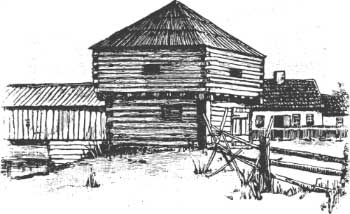
Blockhouse Fort.
The main reliance for defense consisted of two bastions, or blockhouses, as they were commonly called, placed at diagonally opposite corners of the fort. They were square in plan, 15-18 feet on a side, with two stories, and were generally covered with a roof. The lower floor was a few feet above ground level and was loopholed for the small cannon, which all the more important posts possessed. Above the artillery floor was another for the musketry defense, with about three loopholes on each exposed face. The blockhouse stood entirely outside the main enclosure, its inner corner joining the corner of the fort so that it flanked two sides; that is, the defenders in each bastion could fire along the outer face of two sides of the fort and thus prevent any attempt to scale or demolish the walls.
A “fort” thus constructed was really very strong and was practically impregnable to an enemy without artillery. A host of Indians armed with bows and arrows or with the indifferent firearms of those days could make no impression upon it, and the garrison could look with indifference upon any attack, however formidable, so long as they used reasonable precaution and were supplied with provisions and ammunition. There is no record of a successful siege of a stockaded fort in the entire history of the fur trade west of the Mississippi River.
The necessary prerequisite of defense having been satisfied, the other arrangements of the fort related to trade purposes. The entrance was through a strong, heavy door fitted with a wicket, through which the doorkeeper could examine a person applying for admittance. In the more elaborate posts, there was a double door with a room and a trading counter between them. The Indians were admitted only to this space for purposes of trade. In the single-door posts, trading was sometimes conducted through the wicket when there was suspicion of danger.
On the opposite side of the enclosure from the entrance stood the house of the bourgeois, usually the most pretentious building in the post. Nearby stood the office and the clerks’ house. Along one side of the quadrangle stood the barracks of the engages, while across the square were the storehouses for the merchandise, provisions, furs, and peltries. There were also buildings for shops, the most important of which was the blacksmith shop. A fur press was a necessary part of the establishment. The buildings usually stood with their back walls on the line of the enclosure, and for the distance they covered, they sometimes replaced the pickets. In the center of the enclosure was a large square or court in which ordinarily stood a piece of artillery trained upon the entrance and a flagstaff from which the ensign of the republic daily floated to the prairie breeze.
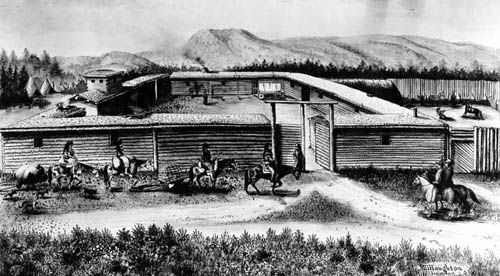
Fort Bridger.
Close to the fort, and itself protected by a strong enclosure, with communication through the fort’s walls, there was often a small field in which common vegetables were raised for the garrison. Then, there was always some protection for the horses, which were the great object of the Indian forays. Sometimes the corral was outside the fort, but in many cases the stock was brought within the walls. On the plains around the post, there was scarcely ever absent the characteristic tent of the Indian, and at certain seasons they were scattered by hundreds in every direction.
Near most of the larger river posts, some spot was selected where timber was abundant, at which the pickets and lumber for the posts were manufactured, the Mackinaw boats and the canoes were built, and such other work was done as the establishment required. These places were called “chantier,” French for shipyard, and the name has survived in one or two places, as at Chantier Creek in South Dakota and Shonkin Creek, which was first called Chantier Creek, a little below Fort Benton in Montana. The Fort Pierre site was commonly called the Navy Yard and was located about 20 miles above the post.
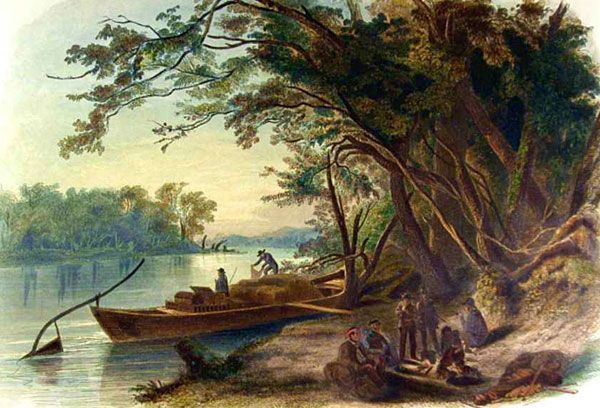
Mackinaw boat on the Missouri River.
The description given above applies only to the larger posts. There were, besides, a great number of smaller posts, which were intended for temporary occupancy only and were accordingly of a much less pretentious character.
In many cases, the traders’ resources did not permit anything other than the most primitive structures. Generally, these posts or houses were simply log buildings, perhaps two or three huddled together, but often only one. They were scattered all over the West and the names and localities of most of them have been forgotten.
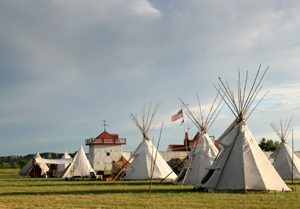
Fort Union, North Dakota Rendezvous Camp by Carol Highsmith.
In the upper Missouri River country, the smaller posts were not independent establishments but were connected with some larger post from which they received supplies, equipment, and men and to which they sent the product of their trade. Fort Union, North Dakota, and Fort Pierre, South Dakota, are the most prominent examples of the larger posts, to each of which a number of smaller establishments were connected.
Life at these trading posts, buried as they were in the depths of the wilderness, a thousand miles, often, from civilization, could not but be dull, uninteresting, and lonely, for the greater part of the year. Few indeed were the diversions that came to enliven the humdrum life of the garrison, yet occasionally there was excitement and hilarity to spare. For the most part, the steady routine of work kept up day by day — receiving and dismissing bands of Indians who came in to trade, watching the country for signs of buffalo and when they came sending parties out to hunt them, preparing and dispatching the winter express to St. Louis, Missouri, cutting wood for the annual steamboat at such posts as were on the river, keeping the account books, journals, and correspondence of the posts, receiving returns from subordinate houses, and baling and pressing furs.
Once or twice a year, bundles of newspapers arrived from the outer world, and they were read and reread until worn out by handling. Occasionally, distinguished visitors passed weeks or months at the post, thus adding a new and interesting element to its life. Hunting was the one great amusement, and in this, the buffalo chase stood supreme. There was, of course, a variety of games, and the Fort Pierre journal occasionally mentions them in its records. The arrival of bands of free trappers was always signalized by a season of debauch in which the astute trader got not only all the furs but generally all the money he had paid for them. As there were competing establishments at most of the important situations a degree of social intercourse was kept up between them. There were “calls” and “dinners” back and forth, for the exigencies of the competition were never permitted to interfere with those amenities which are naturally observed between man and man.
The most notable event in the life of the trading post was the arrival of the annual convoy from the States, whether the steamboat or keelboat on the Missouri River, the brigade in the mountains, or the caravan on the plains. This was the time when the business of the past year was closed up and a new year began. Engages whose terms of service had expired might now return home, while others came to take their places. The convoy brought merchandise for the next year’s trade, packages and letters from friends, and papers from the outside world. It took back the cargoes of furs and peltries gathered during the year and much of the force whose terms of service had expired and who did not wish to remain longer. The arrival of the Missouri steamboat, in particular, was an event looked forward to with the most eager interest. When the time had come to expect it, Indian runners were dispatched down the river a hundred miles or so to bring the first news of her approach. Then the bourgeois and his clerk would sometimes set out in a canoe and meet the boat on her way. When the lofty smokestacks burst into sight from behind the last bluff which excluded her from view, the fort let go, in joyful salute, such artillery as it possessed, while the whole population — traders, engages, and Indians — went down to the bank to bid welcome to the visitor.
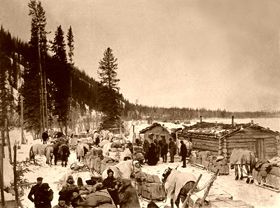
Early Trading Post.
At the more important posts, a daily journal of events was regularly kept. Fragments from Forts Pierre, Clark, and Union have been preserved and give us an inside view of the kind of life led there.
In the matter of geographical distribution, the controlling factor in the location of the posts was the convenience of the Indians. Not infrequently, the tribes arbitrarily designated the spots where the posts should be built. The country’s geography exerted an important influence on the commercial value of any given situation. The post at the mouth of the Yellowstone River, for example, commanded the commerce of two great rivers and became a most important establishment. So throughout the West, in all those situations like the mouth of the Yellowstone, the mouth of the Laramie River, the heart of the Blackfeet, Sioux, and Mandan countries, the headwaters of the Arkansas and South Platte Rivers, where the advantages for trade were greatest, the trading post arose. In general, there were two or three such posts belonging to different companies.
Compiled and edited by Kathy Alexander/Legends of America, updated March 2026.
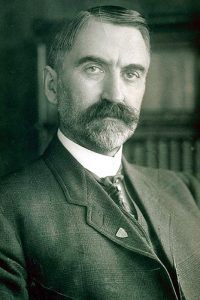
Hiram M. Chittenden, 1916.
About the Author: This article was written by Hiram Martin Chittenden and included in his book, The American Fur Trade of the Far West, published in 1902. Chittenden served in the Corps of Engineers, eventually reaching the rank of Brigadier General. During this time, he was in charge of many notable projects, including work at the Yellowstone and Yosemite National Parks and the Lake Washington Canal Project. He was also an author, penning historical volumes, tour guides, and poetry. The story, as it appears here, is not verbatim; it has been edited for clarity and ease for the modern reader.
Also See: