
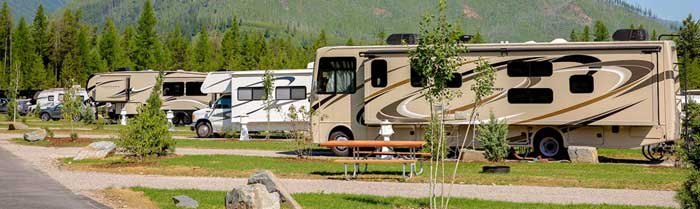
RVs at West Glacier RV Park in Montana.
120 AC/12 DC/LP-Gas – The power sources RV refrigerators use: 120 AC is 120-volt alternating current (same as in houses); 12 DC is 12-volt direct current (same as in motor vehicles); LP-gas. Some RV refrigerators can operate on two of the three sources, others on all three.
Anode Ro d – An anode rod, when used in a water heater, attracts corrosion, causing products in the water. These products attack the anode rod instead of the metal tank itself. Inspect the anode rod yearly and replace it when it is reduced to about 1/4 of its original size. The rods are used in steel water heater tanks, and an aluminum tank has an inner layer of anode metal to accomplish the same thing. Anode rods should not be installed in an aluminum tank!
Axle Ratio – The ratio between the pinion and ring gears in the differential multiplies the torque the engine provides. It is the number of driveline revolutions required to turn the axle one time. For example, with a 4.10:1 axle, the driveline turns 4.1 times for each complete axle revolution. The higher the number, the more torque and thus more towing power. However, the higher the number, the slower the speed.
Backup Monitor/Camera – A camera in the back of a motor home, with the monitor positioned somewhere on the driver’s dashboard, helps with backing up the motor home. It is also used while driving to monitor traffic behind and keep an eye on the towed vehicle.
Ball Mount – The part of the hitch system that supports the hitch ball and connects it to the trailer coupler. Ball mounts are available in load-carrying and weight-distributing configurations.
Black Water – Disposal water from the toilet system is held in a holding tank until you dump it, in large tanks or at a dumping station available at most campgrounds.
Black-Water Tank – An RV’s black water tank holds the sewage water from the toilet. Always dump it at a campground dump station or into the campsite sewer connection.
 Boondocking – Also known as dry camping, boondocking refers to camping without any hook-ups, meaning no electric, sewer, or water facilities. You can still have electricity from your RV batteries and water from your freshwater holding tank.
Brake Actuator – A device mounted under the dash of a towing vehicle to control the trailer’s braking system. Most Brake Actuators are time-delay based; the longer the tow vehicle brakes are applied, the “harder” the trailer brakes are applied.
Brake Controller – A device mounted under the dash of a towing vehicle to control the trailer’s braking system. The brake controller senses the tow vehicle’s braking force and applies a proportional force to the trailer braking system.
British Thermal Unit (BTU) – A measurement of heat that is the quantity required to raise the temperature of one pound of water 1 degree F. RV air-conditioners and furnaces are BTU-rated.
Break-Away System – A system designed to automatically lock the trailer brakes if the hitch fails and the trailer breaks away from the tow vehicle.
Camber – Wheel alignment – Camber is the number of degrees each wheel is off of vertical. Looking from the front, tops of wheels farther apart than bottoms means “positive camber.” As the load pushes the front end down, or the springs weaken, the camber can go from positive to none to negative (bottoms of the wheels farther apart than the tops).
Castor – Wheel alignment – The steering wheel’s desire to return to center after you turn a corner.
Condensation – Condensation results from warm, moisture-laden air contacting cold window glass. Keeping a roof vent open helps to reduce humidity levels. Adding roof vent covers helps prevent cold air from dropping down through the vent while still allowing moist air to escape. Using the roof vent fan when showering or the stove vent fan when cooking also helps prevent excess moisture buildup.
Converter – A converter converts 120-volt A/C (alternating current) to 12-volt DC (direct current). RV devices mostly run on 12-volt DC power supplied by the battery, which allows the RV to function independently. When “shore power” (an electrical supply) is available, the converter changes the voltage from 120 to 12 volts to supply the appliances and recharge the battery.
Diesel Puller – The term for a motor home with the diesel engine mounted in the vehicle’s front. Also known simply as a Puller.
Diesel Pusher – The term for a motor home with the diesel engine mounted in the vehicle’s rear. Also known simply as a Pusher.
Dinghy – The term for a vehicle you tow with your motor home. It is also known as a Toad.
Dinette – Booth-like dining area. The table usually drops to convert the unit into a bed at night.
Doughnut – A rubber ring that seals one’s dump hose and the campsite sewer connection, preventing gases and odors from escaping. Sewer doughnuts are required in many locations.
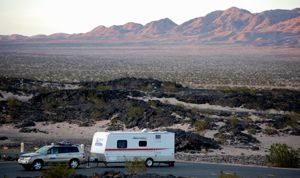
We boondocked at Amboy Crater.
Dry Camping – Also known as boondocking, dry camping refers to camping without any hook-ups, namely camping without hooking up to any electric, sewer, or water facilities. You can still have electricity from your RV batteries and water from your freshwater holding tank.
Dry Weight – The weight of the RV without any fuel, freshwater, propane, or passengers.
DSI Ignition – Direct spark ignition is the method used to ignite the main burner on a propane-fired appliance. The burner is lit with an electric spark, and an electronic circuit board monitors the flame. This ignition system is used in refrigerators, furnaces, and water heaters. Some stovetops now use DSI ignition to light the burners.
Ducted AC– Air conditioning is supplied through a ducting system in the ceiling. This system supplies cooling air at various vents throughout the RV.
Ducted Heat – Warm air from the furnace is supplied to various locations in the RV through a ducting system located on the floor. (similar to house heating systems)
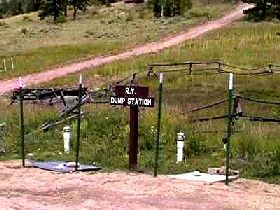
RV Dump Station.
Dump Station – A facility for dumping or emptying your black water and gray water holding tanks.
Dual Electrical System – An RV equipped with lights and appliances that run on 12-volt battery power when self-contained and, with a converter, on 110 AC at campgrounds or with an onboard generator.
Dually – A pickup truck, or light-duty tow vehicle, with four tires on one rear axle.
Equalizing Hitch – A hitch that uses spring bars placed under tension to distribute a portion of the trailer’s hitch weight to the tow vehicle’s front axle and the trailer’s axles. This hitch is also known as a weight-distributing hitch.
Fresh (Water) Tank – The gallons of fresh water that can be stored for later use.
Full Hook-up – The ability to connect to all three of the campground’s facilities: electric, water, and sewer.
Full–timers or Full–Timing – The term for people who live in their RV full-time, or at least the vast majority of their time.
Generator – An engine-powered device fuelled by gasoline or diesel fuel, and sometimes propane, for generating 120-volt AC power.
Gross Axle Weight Rating (GAWR) – The manufacturer’s maximum load weight, in pounds, that can be placed on the axle. If an axle has a 3500-lb. GAWR and the RV has two axles (tandem axles), then the RV would have a Gross Vehicle Weight Rating (GVWR) of 7000 lbs. (see GVWR below)
Gross Combined Weight (GCW) – The combined weight of the tow vehicle and the trailer.
Gross Combined Weight Rating (GCWR) – The manufacturer’s maximum load weight, in pounds, allowed for the trailer and tow vehicle. This rating includes the weight of the trailer, tow vehicle, fuel, water, propane, supplies, and passengers.
Gross Trailer Weight (GTW) – Gross trailer weight is the trailer’s weight that is fully loaded in its actual towing condition. GTW is measured by placing the fully loaded trailer on a vehicle scale. The scale should support the trailer’s full weight.
Gross Vehicle Weight (GVW) – The vehicle’s weight.
Gross Vehicle Weight Rating (GVWR) – The manufacturer’s maximum load weight, in pounds, allowed for the vehicle. This rating includes the vehicle’s weight plus fuel, water, propane, supplies, and passengers.
Generator – An electrical device powered by gasoline or diesel fuel, and sometimes propane, for generating 120-volt AC power.
Gray Water – The gray water tanks on an RV hold drainage water from the sinks and shower. It contains soap and food particles, and although it’s not seriously harmful, you should avoid dumping gray water on the campsite ground.
Gray (Water) Tank – The gallons of gray waste that can be held
Hitch Weight – The amount of a trailer’s weight that rests on the tow vehicle’s hitch. For travel trailers, this weight should be 10% to 15% of the trailer’s total weight. For fifth wheels, this weight should be 15% to 20% of the trailer’s total weight.
Heat Exchanger – A heat exchanger transfers heat from one source to another. For example, your furnace has a heat exchanger—the propane flame and combustion products are contained inside it, sealed from the inside. Inside air is blown over the exchanger’s surface, where it is warmed and then blown through the ducting system for room heating. The combustion gases are vented outside.
Heat Strip – A heat strip is an electric heating element in the air conditioning system that warms the air blown by the fan and through the ducting system. They are typically 1500-watt elements (about the same wattage as an electric hair dryer) and have limited function. Basically, they “take the chill off.”
Hitch Weight – The amount of a trailer’s weight that rests on the tow vehicle’s hitch. For travel trailers, this weight should be 10% to 15% of the trailer’s total weight. For fifth wheels, this weight should be 15% to 20% of the trailer’s total weight.
Holding Tanks – Most RVs have three holding tanks: Fresh Water, Gray Water, and Black Water. The freshwater tanks hold the water you pump into your RV when you don’t get water from an outside source. The Gray Water tank holds water from your kitchen and shower. The black water tank holds the water and waste from your toilet.
Hook-ups – The ability to connect to a campground’s facilities. The major types of hook-ups are electrical, water, and sewer. If all three hook-ups are available, it is called full hook-up. Some campgrounds may also include telephone and cable TV hook-ups.
Inverter – An inverter converts 12-volt battery power to 120-volt AC power. It is used when “boondocking” (camping without hook-ups) to power specific 120 VAC-only devices like a microwave oven. Available power depends on the batteries’ storage capacity and the inverter’s wattage rating.
Laminate – A sandwich of structural frame members, wall paneling, insulation, and exterior covering, adhesive-bonded under pressure and/or heat to form the RV’s walls, floor, and/or roof.
Livability Packages – items to equip a motor home for daily living, which may be rented at a nominal cost from the rental firm, rather than brought from home. Include bed linens, pillows, blankets, bath towels, pots and pans, kitchen utensils, and cutlery.
LP Gas – Liquefied Petroleum Gas – LP gas is used to fuel appliances in the RV, such as the stove, oven, water heater, and sometimes the refrigerator.
Often called propane. LP weighs 4.5 pounds per gallon.
Net Carrying Capacity (NCC) – Sometimes called the payload capacity, this is the maximum weight of fuel, water, propane, supplies, and passengers that can be added to an RV without exceeding the Gross Vehicle Weight Rating (GVWR). (see GVWR above)
Part–Timers – The term used for people who use their RV more than usual (more than just a few weekend trips a year) but still use it less than full time.
Payload Capacity – The maximum allowable weight that can be in or on a vehicle, including all cargo and accessories, fuel, fresh water, propane, passengers, and hitch loads.
Pilot – A small, standby flame used to light the main burner of a propane-fired appliance when the thermostat calls for heat. Pilots can be used in furnaces, water heaters, refrigerators, ovens, and stovetops.
Pop–Out – A room in an RV that pops out for additional living space.
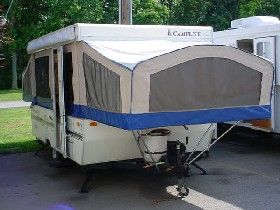
Pop Up.
Pop-up or Pop–Up – Another name for a folding camping trailer.
Porpoising – A term used to describe the up-and-down motion in an RV while traveling.
Propane -LPG, or liquefied petroleum gas, is used in RVs for heating, cooking, and refrigeration. It is also called bottle gas because of how it is sold and stored.
Puller – The slang term for a motor home with a front-mounted diesel engine.
Pull-Through –A camping site that allows you to pull through while setting up and leaving the area. A site you don’t have to back into or out of.
Pusher – Slang for a motor home with a rear-mounted diesel engine.
Rig – What many RVers call their units.
Roof Air Conditioning – An air conditioning unit mounted on the RV’s roof cools the RV when it is parked. When moving, most RVs are cooled by separate air conditioning units that are part of the engine, or a rooftop unit may cool them if a properly sized generator is installed.
RV – Short for Recreation Vehicle, a generic term for all pleasure vehicles that contain living accommodations. Multiple units are RVs, and people who use them are RVers.
Safety Chains – A set of chains attached to both the trailer A-frame and the tow vehicle while towing. Safety chains are intended to keep the trailer attached to the tow vehicle in the event of a hitch failure, preventing the trailer from completely separating.
Self-Contained – RV which needs no external electrical, drain, or water hook-up. Thus, it can park overnight anywhere. Of course, self-contained units can also hook up to facilities when at campgrounds.
Sewer Doughnut – A rubber ring that seals the dump hose and the campsite sewer connection so gases and odors don’t escape. Sewer doughnuts are required in many locations.
Shore Power – Electricity provided to the RV by an external source other than the RV batteries.
Slide–In – The term for a type of camper that mounts on a truck bed because this type of camper slides into the truck bed.
Slide–Out – A room or area in your RV that slides out to create additional living space.
Thermocouple – A device that monitors the pilot flame of a pilot model propane appliance. If the pilot flame is extinguished, the thermocouple causes the gas valve to shut off the gas flow to both the pilot flame and the main burner.
Tip–Out – The term used for an area or room in an RV that tips out additional living space. The Tip-Out was generally used in older RVs. Newer RVs mainly use a slide-out.
Toad – A “toad” is an RVers’ term for a towed vehicle behind a motor home. Some vehicles can be towed without any modifications; others cannot be towed at all, or at least without extensive alterations.
Toe – Wheel alignment – Toe measures whether the front of the wheels (looking down from the top) are closer (toe-in) or farther (toe-out) than the back of the wheels.
Tongue Weight – Tongue weight (TW) is the downward force exerted on the trailer coupler on the hitch ball. In most cases, it is about 10 to 15 percent of GTW. You can measure TW of up to 300 lbs. on a household scale by resting the trailer coupler on the scale and placing the scale on a box so the coupler is at its normal towing height. The trailer must be fully loaded and level.
Tow Bar – A bar used to connect a towed vehicle to the motor home for towing with all four wheels on the ground.
Trailer Brakes – Brakes built into the trailer are activated either by electric impulse or by a surge mechanism.
Underbelly – The RV’s underfloor surface is protected by weatherproofed material.
Unloaded Vehicle Weight (UVW)—Sometimes called the Dry Weight, this is the RV’s weight without adding fuel, water, propane, supplies, and passengers. The manufacturer’s UVW does not include any dealer-installed options.
Wastewater tanks – The gray water tank holds the wastewater from the sinks and showers. The black water tank holds the waste from the toilet.
Weight Carrying Hitch – A hitch designed to accept the entire hitch weight of the trailer. This hitch is also known as a deadweight hitch.
Weight Distributing Hitch – A hitch that uses spring bars placed under tension to distribute a portion of the trailer’s hitch weight to the tow vehicle’s front axle and the trailer’s axles. This hitch is also known as an equalizing hitch.
Weights – What weighs what?
- Propane weighs 4.25 pounds per gallon.
- Water weighs 8.3 pounds per gallon.
- Gasoline weighs 6.3 pounds per gallon.
- Diesel fuel weighs 6.6 pounds per gallon.

Legend of America on the road.
Wet Weight – The weight of the RV with the fuel, freshwater, and propane tanks full.
Wheelbase – The distance between the center lines of the primary axles of a vehicle. If a motor home includes a tag axle, the distance is measured from the front axle to the center point between the drive and tag axles.
Wide Body – The term for an RV exceeding the normal eight feet wide. Wide Bodies are usually 102″ (8′ 6″) wide.
Compiled by Kathy Alexander/Legends of America, updated October 2026.
Also See:
RV Tips, Tricks, Travel Information & More
See Sources.