

Belvidere Mansion, Claremore, Oklahoma.
The Belvidere Mansion in Claremore, Oklahoma, not only provides a peek at history but possibly even a peek at a ghost or two.
Listed on the National Register of Historic Places, the three-story mansion was built by John M. Bayless starting in 1902. Bayless, instrumental in building the Cassville and Western Railroad and the Arkansas & Oklahoma Railroad, moved his family from Cassville, Missouri, to Indian Territory in 1901. The following year, he built the castle-like mansion for his wife, Mary Melissa Bayless, and his seven children. Belvidere was successful in railroads, banking, and land development.
The Gothic-style brick home, with a tile roof and four towers, provided an entrance on the North side for guest carriages and a large covered porch at the front entrance, with a matching balcony directly above it. The floors were covered in tile, with wainscoted marble walls and pressed tin ceilings. Sliding pocket doors were used in several rooms, and many had fireplaces. Much of the trim and woodwork came from the 1904 World’s Fair in St. Louis. The mansion’s third floor was dedicated to a 2,400-square-foot ballroom.
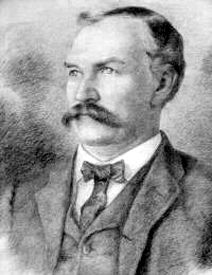
John M. Bayless.
Due to its immaculate details, the mansion took several years to build. At the same time, Bayless was also building a three-story Opera House, the Sequoyah Hotel, and an athletic building with an indoor swimming pool. However, Mr. Bayless never saw his grand mansion completed. In 1907, just six months before it was completed, Bayless died following an operation for appendicitis. At the time of his death, he was president of the Bank of Claremore.
Mary Bayless and her six surviving children finished the mansion after his death and resided there until 1919. Her children resided in Claymore, with her older sons becoming involved in the Bank of Claremore. Another became the local postmaster, and yet another became a State Supreme Judge.
The building then changed hands several times and, in the 1930s, was sold to an investor who turned it into apartments. Like other historic structures that become rentals, the mansion deteriorated over the years until the Rogers County Historical Society purchased it in 1991. Today, the beautiful old building has been restored to its former glory and furnished with period pieces.
Today, the mansion is open for tours and is available for special events.
Of the buildings that Belvidere built, only the mansion remains.
Over the years, numerous people have reported that John Bayless and other family members continue to “reside” in the beautiful old home. These allegations include unexplained noises, sightings of shadowy figures, toilets that flush by themselves, hot and cold spots, and feelings of being touched when no one is there.
On several occasions, paranormal groups have investigated the old mansion, seemingly finding the most paranormal activity on the second floor. There, psychics have “seen” children playing, as well as “meeting” a distressed John Bayless and a troubled young woman who allegedly committed suicide when she lived in the building as a tenant in the 1940s.
Contact Information:
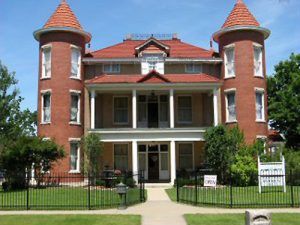
Belvidere Mansion, Claremore, Oklahoma, by Kathy Alexander.
Belvidere Mansion
4th & Chickasaw
Claremore, Oklahoma 74017
918-342-1127
©Kathy Alexander/Legends of America, updated October 2026.
Also See:
Claremore – Home of Will Rogers
Ghosts of the Tulsa Little Theatre
History and Haunting of the Gilcrease Museum
Skirvin Hotel in Oklahoma City
See Sources.