
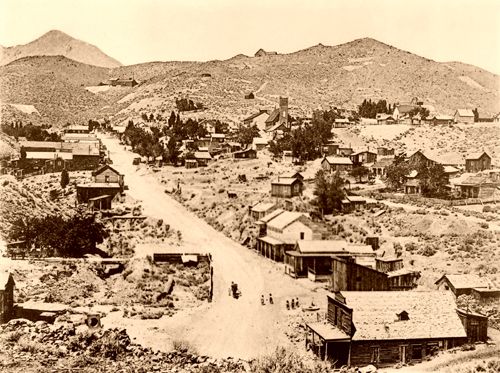
Silver City, Nevada, 1890.
As Nevada State Road 341 winds its way northward to the Queen of the Comstock Lode – Virginia City, it passes through two more mining camps. Though Virginia City got all the glory, Silver City and Gold Hill played an important role in the area’s history.
Silver City
John Orr and Nicholas Kelly discovered the first gold nugget in what would become known as Gold Canyon at Devil’s Gate, just North of Silver City, in June 1850. For the next ten years, the canyon became the scene of avid placer mining and a busy route to Virginia City, as thousands of miners made their way to the Comstock Lode.
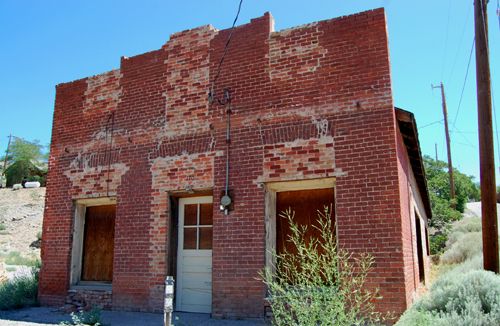
Silver City commercial building
During the brief Paiute War of May 1860, Silver City residents built a stone battlement atop the eastern summit of Devil’s Gate and constructed a wooden cannon for protection. Later that summer, Silver City erected one of the first stamp mills in Nevada Territory just South of Devil’s Gate.
By 1861, Silver City boasted several boarding houses, several saloons, four hotels, and a population of about 1,200 people. As Virginia City boomed, Silver City became an important freighting center with extensive stables and corrals to serve the many people traveling between the Comstock Lode mines of Virginia City and the processing mills located near Dayton and along the Carson River.
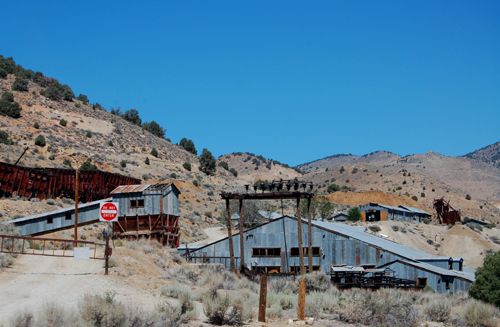
Silver City Mining Remnants
Devil’s Gate, just North of Silver City, is two large walls of rock on either side of the road to Virginia City. Formed from lava rock, the rock was blasted and widened for a toll road. At the same time, however, another type of “toll” was often extracted from travelers through Devil’s Gate – robbery. In the late 1850s and early 1860s, the narrow opening was a popular hideout for highwaymen. By relieving travelers of their watches, wallets, gold, and silver, Devil’s Gate earned a reputation for trouble, and most passed through armed.
Silver City thrived for several years, though its mines and mills were never as productive as Virginia City and Gold Hill. When the Virginia & Truckee Railroad was completed in 1869, it sealed Silver City’s demise. However, the small town today continues to display several historic structures, is dotted with old mining equipment, and has a substantial historic cemetery. On the South side of Silver City are the remains of a mostly intact mining facility.
Silver City is located about 11 miles northeast of Carson City, about 3 miles north of U.S. Highway 50 on Nevada State Road 341.
Gold Hill
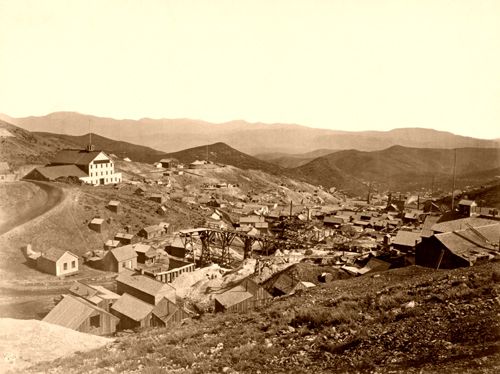
Gold Hill, Nevada, 1867
Continuing North for just another mile brings visitors to Gold Hill. This mining camp began around the same time as Virginia City in the late 1850s, when both silver and gold were found in the area. Initially, the camp was little more than a few miners living in tents and crude shacks. By the early 1860s, however, it rivaled Virginia City in size and population. The town incorporated in December 1862 to prevent annexation by Virginia City.
For the next two decades, the city thrived, at one point reaching some 8,000 residents.
Mines such as the Yellow Jacket, Crown Point, and Belcher brought in over $10 million each. An important stop on the Virginia & Truckee Railroad, the town boasted numerous businesses, churches, schools, and several firefighting companies.

Gold Hill Bank building
When the mines began to play out in the late 1870s, the town began to decline. Efforts to revive the mines were sporadic over the years, including the Yellow Jacket Mine, which operated from 1927 until 1942. When it too became unprofitable, people left in droves, and the following year the post office closed.
Though Gold Hill is a shell of its former self and home to fewer than 200 people, several historic buildings still stand, most notably the Gold Hill Hotel, built in 1859 and the state’s oldest operating hotel. The Virginia & Truckee Railroad Depot, built in 1872 and used until 1936, has been fully restored today and serves as the ticket office for the revived V & T Railroad.
The former Bank of California building, built in 1862, still stands. Over the years, the building housed a variety of businesses, and today appears to be utilized as an office of some sort. Numerous mining remains dot the area, including the Yellow Jacket Mineshaft and head frame and the Crown Point Mill. A couple of grand restored homes, along with numerous old mining shacks, dot the area.
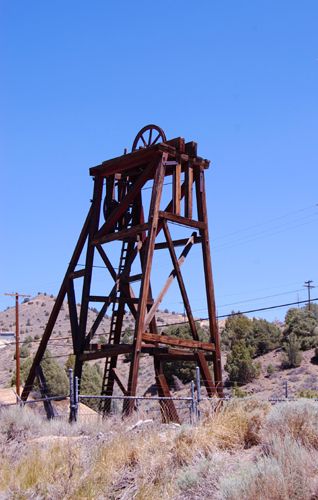
Gold Hill Keystone Headframe
Just another mile up the hill is Virginia City, the Queen of the Comstock Lode.
©Kathy Alexander/Legends of America, updated October 2026.
For more information and preservation, see The Comstock Foundation for History and Culture.
Also See:
Virginia City and the Comstock Lode