
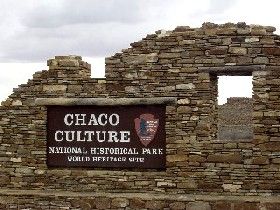
Chaco Culture National Historical Park.
Preserving one of America’s most significant cultural and historic areas, the Chaco Culture National Historical Park is remarkable for its distinctive architecture, numerous ruins, and ancient roads. The remote and isolated park is located in northwestern New Mexico, between Albuquerque and Farmington, in a relatively inaccessible valley cut by the Chaco Wash.
Once home to the Ancient Puebloans, Chaco Canyon was a major center of ancestral Puebloan culture between 850 and 1250 A.D.
By 1000 A.D., the Chaco culture had firmly established a spiritual, political, and economic center serving the Four Corners area. The region was estimated to contain as many as 5,000 people, living in approximately 75 settlements throughout the canyon.
In addition to its remarkable public and ceremonial buildings, the Ancient Puebloans built numerous roads, ramps, dams, and mounds, which required extensive well-organized planning, design, resource procurement, and construction. The distinctive architecture combines several design elements, astronomical alignments, geometry, landscaping, and engineering to create an ancient urban center that continues to amaze archaeologists and visitors a thousand years later.
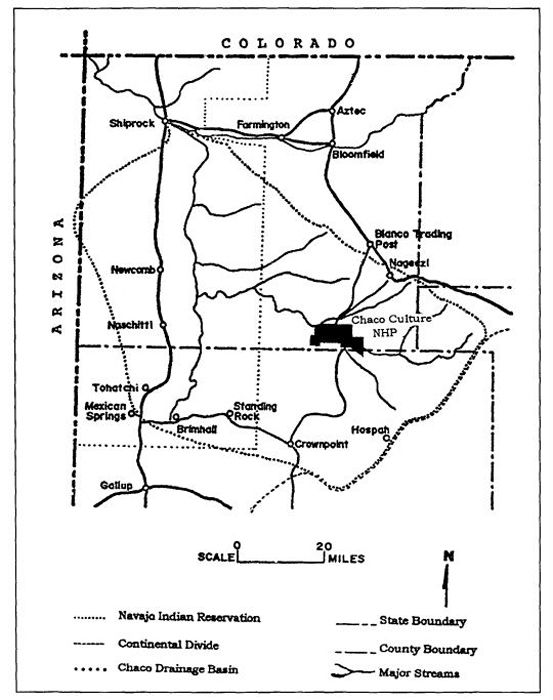
Chaco Canyon Map by the National Park Service.
Archaeological evidence suggests that the Ancient Puebloans occupied the area as early as 1200 B.C., when they survived as nomadic hunter-gatherers, using wooden clubs, hunting sticks, and spears. Some three centuries later, they began to make more permanent homes in caves and pit houses, where they constructed numerous woven baskets covered with mud and baked to make waterproof containers. Archaeologists identify these first people as Basket Makers.
About 700 A.D., the Ancient Puebloans began cultivating crops such as corn and squash and building permanent dwellings. These small, one-story masonry structures were the beginning of what would become the great pueblos of the Southwest.
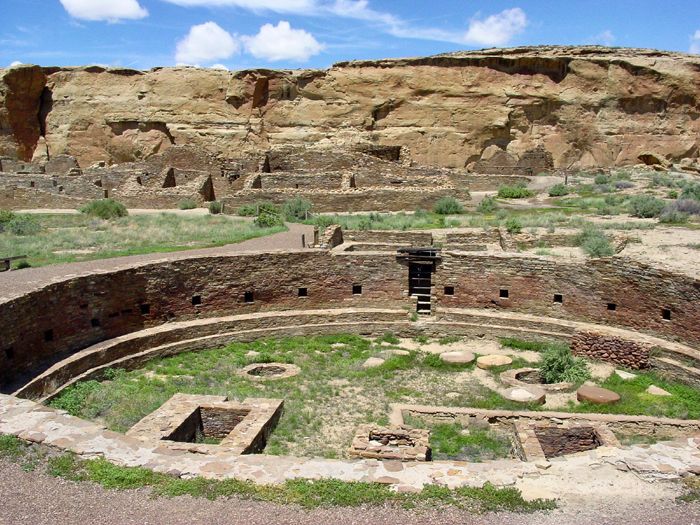
Chaco Canyon, New Mexico, by the National Park Service.
Some two centuries later, as their population grew, the communities expanded into larger, more closely compacted pueblos. Around this time, the Pueblo Bonito complex was built, beginning with one curved row of rooms near the north wall. Continuing to refine their building techniques, thick masonry walls and the generous use of mud mortar allowed walls to rise to more than four stories in height.
During this time, the Chacoans quarried sandstone blocks and hauled timber from great distances, assembling 15 significant complexes that remained the largest buildings in North America until the 19th century. Many of these buildings are thought to have been aligned to capture the solar and lunar cycles, which would have required generations of astronomical observations and centuries of skillfully coordinated construction.
More pueblos, including Chetro Ketl, Una Vida, Penasco Blanco, Hungo Pavi, and Kin Bineola, were also established around this time. Some large buildings exhibit evidence of being planned from the outset, in contrast to the usual Ancient Puebloan custom of adding rooms as needed. Over the next two centuries, more and more large pueblos with oversized rooms were built throughout the region. Eventually, an estimated 75 villages in the area were connected by an extensive road network.
From the 12th to the 13th centuries, many pueblos in Chaco Canyon were abandoned as a prolonged drought cycle in the San Juan Basin began around 1130. The Ancient Puebloans were at the height of their civilization when a lack of rainfall necessitated food storage. Even though they had designed an extensive system of dams and irrigation, the arid climate and overtaxed fields could no longer support the immense population. As famine spread throughout the region, residents began to leave, joining other pueblos near the Little Colorado River and the Rio Grande.
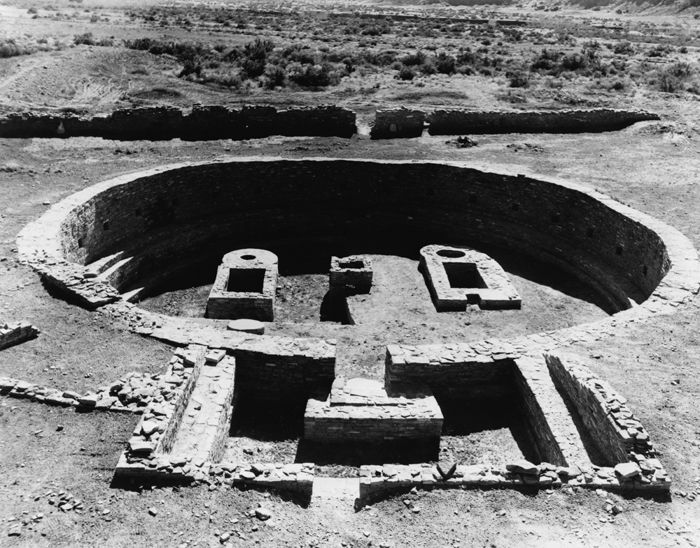
Pueblo Del Arroyo Kiva at Chaco Canyon, New Mexico, by the Historic American Buildings Survey.
Some archaeologists now believe that other factors, such as religious upheaval, internal political conflicts, and warfare, may have also contributed to the abandonment. By the 1300s, all the villages and pueblos in Chaco Canyon had been abandoned. As the ancient Indians left, their kivas were ceremonially burned, and most of their possessions were left behind.
Today, their descendants are members of 20 Indian tribes in New Mexico and Arizona, and many maintain connections to Chaco. These tribes include modern-day Pueblo Indians of New Mexico, the Hopi of Arizona, and the Navajo.
By the 1600s, the Navajo people primarily occupied the canyon. In 1680, the Pueblo Revolt against the Spanish briefly unified the Pueblo peoples of New Mexico and their neighbors. However, the Spanish returned in 1692 and reconquered the area, forcing many Pueblo peoples into exile. Many of these individuals sought refuge among the Navajo in Chaco Canyon and the surrounding area. These people intermarried and exchanged ideas.
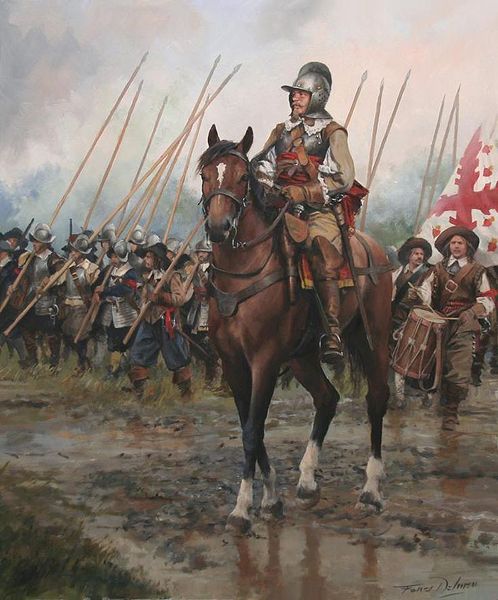
Spanish Conquistadors.
In 1774, Don Bernardo de Miera y Pacheco identified the Chaco Canyon area as “Chaca” on a Spanish map. In 1823, Jose Antonio Viscarra, the Spanish Governor of New Mexico, led a military force west of Jemez Pueblo onto Navajo lands. He noted many Chacoan buildings along the route.
Colonel John M. Washington led the first American expedition into the area in 1849. During the trip, Lieutenant James Simpson of the Army Corps of Topographical Engineers surveyed Navajo lands and wrote reports of the Chacoan sites. At the same time, the Kern brothers drew illustrations of the buildings. In 1877, artist and photographer William Henry Jackson, with the US Geological and Geographical Survey, produced expanded descriptions and maps of Chacoan sites and identified additional structures, including a stairway in the cliffs.
More expeditions and archaeologists followed in the next decades. Theodore Roosevelt established Chaco Canyon National Monument on March 11, 1907. In 1949, the University of New Mexico conveyed lands within Chaco Canyon National Monument to the National Park Service, thereby securing continued rights to conduct scientific research in the area. By 1959, the National Park Service had constructed the park visitor center, staff housing, and campgrounds. In the 1970s, several research projects, archaeological surveys, and limited excavations were conducted, providing extensive information about the Ancient Puebloans.
Archeological excavations in Chaco Canyon today are limited, as modern methods such as remote sensing now allow archaeologists to gather substantial information without disturbing fragile, irreplaceable sites.
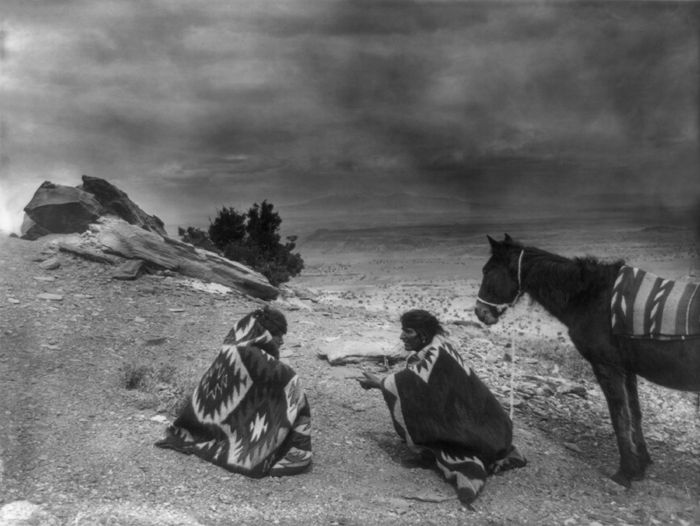
Navajo Men by William J. Carpenter, 1915.
In December 1980, an additional 13,000 acres were added to the park. The Park Service developed the multi-agency Chaco Culture Archaeological Protection Site program to protect Chacoan sites on adjacent Bureau of Land Management and Navajo Nation lands. The sites are part of the sacred homeland of the Pueblo Indian peoples of New Mexico, the Hopi Indians of Arizona, and the Navajo Indians of the Southwest, all of whom continue to respect and honor them.
Chaco Canyon Sites:
The Ancient Puebloans built numerous great houses, kivas, and pueblos throughout a nine-mile stretch of the canyon floor, perched on mesa tops and situated in nearby drainage areas.
A nine-mile paved loop accesses five major Chacoan sites from the Visitor’s Center, where self-guiding trails are available. Trail guides are also available in the sites’ parking lots or the bookstore. Each site usually takes 45 minutes to one hour to complete.
Four backcountry hiking trails are also available to access more remote sites and features. Free permits are available at the visitor center. The nine-mile loop and the Wijiji, Casa Chiquita, and Kin Klizhin trails may also be biked. Inquire at the visitor center for free permits and directions.

Ruins at Casa Chiquita, Chaco Canyon, New Mexico, by the National Park Service.
Casa Chiquita: This unexcavated village, located near the old north road to the canyon entrance, was built around 1100 A.D. It contains 59 rooms and three kivas, originally standing two or three stories high. A trail beginning at Casa Chiquita follows an old wagon road down the Chaco Wash, leading to Peñasco Blanco. Along this trail, numerous rock art and historic inscriptions are visible on the north-facing cliff face.
Casa Rinconada: The largest known great Kiva, the park stands on the south side of Chaco Wash, almost directly across from the Pueblo Bonito. The large subterranean Kiva had no surrounding residential or support structures and was once used for religious ceremonies. Casa Rinconada had 39-foot passageways from the underground structure to above-ground levels.
Chetro Ketl: Located about 1/4 mile southeast of Pueblo Bonito, Chetro Ketl is one of the largest pueblos in Chaco Canyon. Construction of the Pueblo is believed to have begun in 1020 A.D. and continued over the next three decades. The immense elevated earthen plaza, rising above the surrounding landscape, is estimated to contain 500 rooms and 12 kivas, including one great Kiva with a thin central courtyard. The 500-foot-long rear wall once supported five stories of rooms: the lower ones were used for storage, while the upper rooms contained living quarters. The walls are embedded with wooden beams, thought to have been carried from distant forests. The structure was abandoned by 1120. In the cliffs behind the ruin are ancient stairways that lead to prehistoric roadways to Pueblo Alto and other outlying communities.
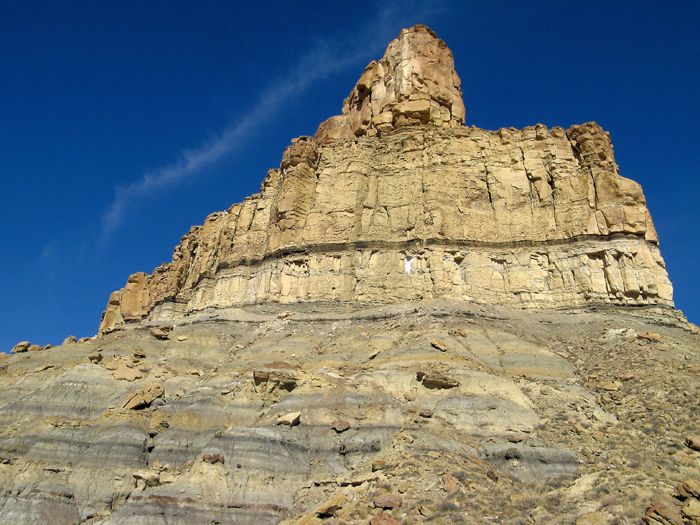
Fajada Butte, Chaco Canyon, New Mexico, by the National Park Service.
Fajada Butte – Rising some 400 feet above the canyon floor, Fajada Butte is visible for miles at the entrance of Chaco Canyon. High atop the imposing butte is a set of spiral petroglyphs carved into the cliff face behind three giant rock slabs. Functioning as a solar marker, a vertical shaft of light pierced the main spiral at its center. The site, known as the Sun Dagger, was discovered by Anna Sofaer in 1977, who conducted an extensive investigation and published results showing how the spirals may have tracked the lunar cycle. Unfortunately, in 1989, the rock slabs shifted, and the effect was ruined. The rooms, thought to have been used by Chacoan astronomers, were also places of worship. The loss of the Sun Dagger prompted the World Monuments Fund to place Chaco Culture National Historical Park on its Most Endangered Monuments list in 1996. Today, the site is closed to visitors.
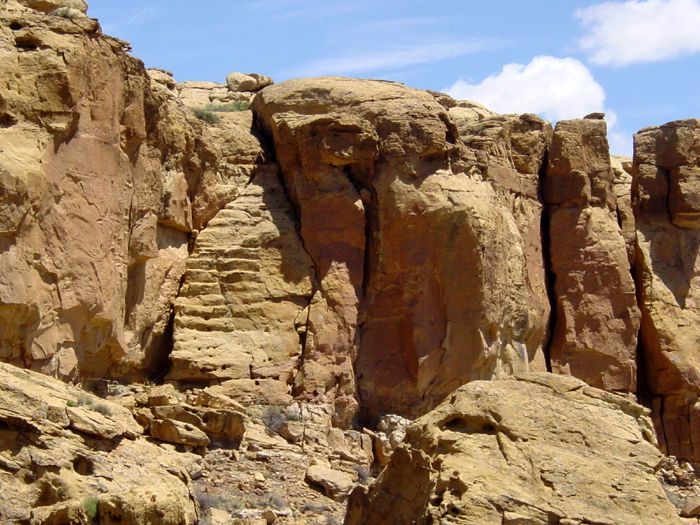
Hungo Pavi Staircase at Chaco Canyon, New Mexico, by the National Park Service.
Hungo Pavi: “Reed Spring Village” is about a mile from Una Vida at the junction of Chaco and Mockingbird Canyons. Thought to have been built around 1000 A.D., the medium-sized Pueblo contained some 73 ground-floor rooms and two kivas in the structure that reached four stories in height. It lies at the base of a prehistoric stairway that ascends the mesa and of an ancient road linking it to the Chacoan road system.
Kin Kletso: Located about 1/2 mile west of Pueblo Bonito, Kin Kletso was built in two phases between 1125 and 1130 A.D. by people who came to Chaco Canyon from the Northern San Juan Region. The walls were constructed of large sandstone blocks laid in two or more rows. The medium-sized Pueblo, which the Navajo call the “Yellow House,” contains approximately 55 ground-level rooms, four kivas, and a tower kiva. Excavated in the early 1950s, evidence of an obsidian production industry was found here.
Kin Nahasbas: This isolated great Kiva was constructed in the mid-1000s. Nestled against the North Mesa, the ruins are located just north of Una Vida.
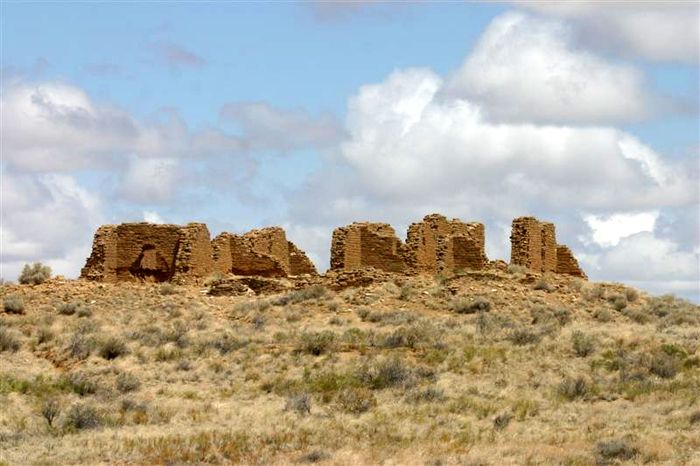
New Alto, Chaco Canyon, New Mexico, by the National Park Service.
New Alto or Nuevo: Located just east of Pueblo Alto, the Pueblo was among the latest constructed in the late 1100s. Despite a decrease in the population in the rest of the canyon, the Pueblo contained about 28 rooms and a kiva. It is speculated that it may have been built by Indians who had migrated from the Mesa Verde area.
Peñasco Blanco: Blanco, Spanish for “white cliff,” is a large arc-shaped great house built in five stages between 900 and 1125 A.D. One of the first large pueblos built in the canyon, the ruins display the evolution of Chacoan masonry over the centuries. Sitting atop the northernmost point of West Mesa, the Pueblo overlooks the confluence of the Chaco and Escavada Washes. Reaching four stories tall, the Pueblo contained approximately 160 ground-floor rooms, two great kivas in the central plaza, and two more outside the Pueblo. Near Peñasco Blanco is a well-known cliff painting that contains a crescent moon, a ten-pointed star, a handprint, and a sun sign. Citing its astronomical significance, many have speculated that the pictograph represents the sighting of a supernova in July 1054 A.D. or the appearance of Halley’s Comet in 1066 A.D.
Pueblo Alto: Located on a mesa flat due north of Pueblo Bonito, this grand house is thought to have been built between 1020 and 1050 A.D. Serving the area’s residents as a community house, archaeological evidence suggests periodic episodes of occupancy and feasting. It has been estimated that only five of the 85 rooms were constructed for permanent residents. In contrast, the others were used for community events and industry, including bead, turquoise, and chert tool processing. Ancient stairs lead from the large Pueblo to the top of the mesa.
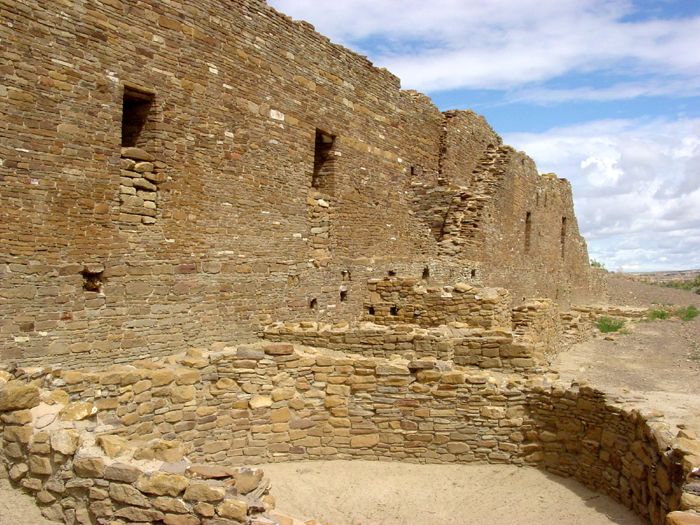
Pueblo del Arroyo at Chaco Canyon, New Mexico, by the National Park Service.
Pueblo Bonito: This D-shaped Pueblo is the largest Great House in the park, spanning nearly two acres, and is believed to have once been as tall as five stories. Approximately 650 rooms surrounded the central plaza, and throughout the settlement, there were about 40 kivas and numerous ceremonial meeting places. The Pueblo was occupied from the mid-800s to the 1200s, with a population of approximately 1,200 at its height. Pueblo Bonito is one of the most extensively excavated and studied sites in North America and is considered sacred by many Native American groups.
Pueblo del Arroyo: Located near Pueblo Bonito at the side drainage known as South Gap, the Pueblo was built in stages over a relatively short time. The central portion was built around 1075, with the north and south wings, the plaza, and the tri-walled structure built in the early 12th century. The building once boasted approximately 280 rooms and more than 20 kivas.
Tsin Kletzin: In the early 1100s, Tsin Kletzin was located on the south mesa top above Casa Rinconada. The unexcavated great house lies near a large earthenware structure known as the Weritos Dam, where ancient Puebloans obtained water. Because Tsin Kletzin has two roads leading to it from the north but no roads continuing southward, it is thought that it served as a destination point.
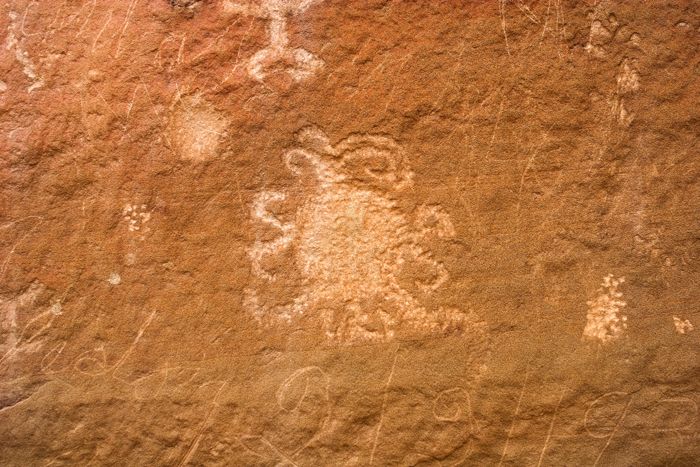
Petroglyph at Chaco Canyon, New Mexico, by the National Park Service.
Una Vida: This Chacoan public building, closest to the Visitor’s Center, was one of the earliest constructed, beginning sometime in the mid-800s. Construction is believed to have continued on the great house until the late 1000s. Una Vida includes approximately 150 rooms and five kivas. The great house was known to the Navajo as a “witchcraft woman’s house” due to its association with a well-known legend where a witch held hostages atop Fajada Butte without food or water. On the cliff face behind Una Vida is an Ancient Puebloan pictograph depicting humanoid and geometric forms, as well as four-legged animal shapes, possibly big-horned sheep.
Wijiji: With just over 100 rooms, Wijiji is the smallest of the great houses. It is thought to have been built around 1110 A.D. It is located in a narrow wash about a mile from Una Vida, and the site appears to have been used in part as a calendrical station.
Because of the aridity and remoteness of the San Juan Basin, Chaco’s record of evolving complexity is almost unrivaled in its preservation. It continues to testify to the organizational and engineering capabilities not found elsewhere in the American Southwest.
Today, Chaco Canyon is a UNESCO World Heritage Site, and some locations are off-limits to the public due to erosion and because the Hopi and Pueblo people consider them sacred ancestral homelands.
The National Historical Park also offers guided tours, hiking and biking trails, camping, and night sky programs. It is situated on the Trails of the Ancients Byway, one of the designated New Mexico Scenic Byways.
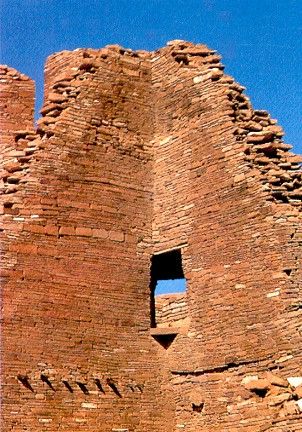
Chaco Canyon Ruins.
Chaco Canyon is located in northwestern New Mexico. The preferred and recommended access route to the park is from the north via US 550, County Road 7900, and County Road 7950. Turn off US 550 from the north at CR 7900, three miles southeast of Nageezi and approximately 50 miles west of Cuba (at mile 112.5). This route is signed from US 550 to the park boundary (21 miles). The route includes 5 miles of paved road (CR 7900) and 16 miles of unpaved road (CR 7950).
All sites and trails are open from sunrise to sunset.
Contact Information:
Chaco Culture National Historical Park
PO Box 220
Nageezi, New Mexico 87037-0220
505-786-7014
©Kathy Alexander/Legends of America, updated December 2025.
Also See:
Ancient & Modern Pueblos – Oldest Cites in the U.S.
National Parks, Monuments & Historic Sites
Pueblo Indians – Oldest Culture in the United States
Sources:
Chaco Culture National Historical Park
Chaco Research Archive
Wikipedia