
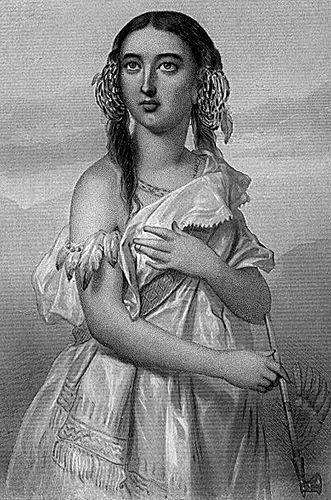
Illustration of Pocahontas, by Mary Cowden Clarke, 1883.
Pocahontas (1595?- 1617) was the daughter of a powerful Powhatan Indian Chief, Wahunsunacawh, in Virginia. She was born in the Tidewater region of Virginia around 1595 and was called Matoaka. However, at an early age, she adopted the nickname Pocahontas, meaning “Little-wanton,” for her playful and frolicsome nature, and was considered an “Indian Princess” in popular culture.
Pocahontas probably saw white men for the first time in May 1607 when the Englishmen landed at Jamestown, Virginia. One of the first people she met was Captain John Smith, leader of the Virginia Colony at Jamestown. Later that year, in December, Smith led an exploration along the Virginia and the Chesapeake Bay rivers when the Powhatan Indians took him captive. Smith would live to tell the romanticized story, which would become legendary. The tale would also come under scrutiny many years later by historians, who question its authenticity.
But, as Smith tells it, a few days after his capture, he was taken to the Powhatan’s official residence at Werowocomoco, 12 miles from Jamestown. The great chief, Wahunsunacawh, welcomed him and offered him a feast.
However, afterward, several warriors grabbed him, forced him to stretch out on two large, flat stones, and stood over him with clubs as though ready to beat him to death if ordered. Suddenly, the chief’s daughter, little Pocahontas, rushed and took Smith’s head in her arms to save him from death. Pocahontas pulled him to his feet, and the chief declared they were now friends. He then adopted Smith as his son or a subordinate chief.
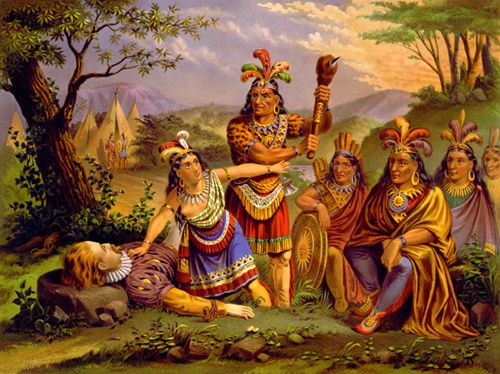
Pocahontas saving John Smith, New England Chromo Co,1870.
This mock “execution and salvation” ceremony was traditional among Native peoples, and, if Smith’s account is valid, Pocahontas’ actions were likely part of a ritual.
Relations with the Indians remained generally friendly for the next year, and Pocahontas was a frequent visitor to Jamestown. She delivered messages from her father, accompanied other tribe members with food and furs to trade, and spent time visiting with John Smith during these visits.
Unfortunately, relations with the Powhatan and the Jamestown settlers deteriorated. Though necessary trading continued, hostilities became more open. Pocahontas’ visits to the fort became much less frequent. In October 1609, a gunpowder explosion badly injured John Smith, forcing him to return to England. When Pocahontas next visited the fort, she was told that her friend Smith had died.
In 1610, Pocahontas lived with the Patawomeck Indians, was either engaged to or briefly married to an Indian named Kocoum, and lived in Potomac country. But her relationship with the Englishmen was not over. When a resourceful member of the Jamestown settlement, Captain Samuel Argall, learned where she was, he devised a plan to kidnap her and hold her for ransom. With the help of Japazaws, a lesser chief of the Patawomeck Indians, Argall lured Pocahontas onto his ship. When told she would not be allowed to leave, she “began to be exceeding pensive and discontented,” but she eventually became calmer and even accustomed to her captivity. Argall sent word to Powhatan that he would return his beloved daughter only in exchange for the English prisoners Powhatan held, some arms, and tolls that the Indians had stolen, and some corn. After a while, Powhatan sent part of the ransom and asked that they treat his daughter well. Argall returned to Jamestown in April 1613 with Pocahontas.
Pocahontas was eventually moved to a new settlement, Henrico, under Sir Thomas Dale’s leadership. Here, she began her education in the Christian faith and met a successful tobacco planter named John Rolfe in July 1613. Pocahontas was allowed relative freedom within the settlement, and she began to enjoy her role in the relations between the colony and her people. After almost a year of captivity, Dale brought 150 armed men and Pocahontas into Powhatan’s territory to obtain her entire ransom. Attacked by the Indians, the Englishmen burned many houses, destroyed villages, and killed several Indian men.
They finally sent Pocahontas ashore, where she reunited with two of her brothers, whom she told that she had been treated well, was in love, and wanted to marry the Englishman John Rolfe. The Powhatan Chief consented to this, and the Englishmen departed, delighted at the prospect of the “peace-making” marriage, although they didn’t receive the full ransom.
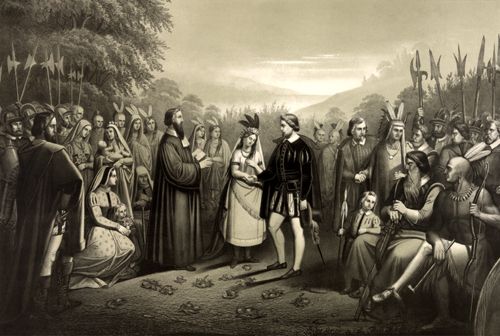
Pocahontas marries John Rolfe, by Joseph Hoover, 1867.
John Rolfe was a very religious man who agonized for many weeks over the decision to marry an Indian, but finally decided once she had been fully converted to Christianity. Pocahontas was baptized, christened by the name Rebecca, and later married Rolfe on April 5, 1614. A general peace and a spirit of goodwill between the English and the Indians resulted from the marriage.
Sir Thomas Dale made an important voyage back to London in the Spring of 1616. His purpose was to seek further financial support for the Virginia Company. To ensure spectacular publicity, he brought about a dozen Algonquian Indians, including Pocahontas, her husband, and their young son, Thomas.
The arrival of Pocahontas in London was well-publicized. She was presented to King James I, the royal family, and the rest of London society. Also in London at the time was Captain John Smith, the old friend she had not seen for eight years and believed was dead. Smith relates that she was initially too emotionally overwhelmed at their meeting to speak. After composing herself, Pocahontas talked of old times.
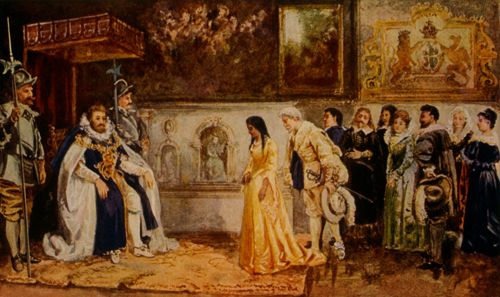
Pocahontas at the court of King James, by Richard Rummels, 1907.
After seven months, Rolfe decided to return his family to Virginia. In March 1617, they set sail. It was soon apparent, however, that Pocahontas would not survive the voyage home. She was deathly ill from pneumonia or tuberculosis. She was taken ashore, and, as she lay dying, she comforted her husband, saying, “all must die. ‘Tis enough that the child liveth.” She died on March 21, 1617, and was buried in a churchyard in Gravesend, England, at the age of 22.
Pocahontas played a significant role in American history. As a compassionate little girl, she saw that the colonists received food from the Indians so that Jamestown would not become another “Lost Colony.” She is said to have intervened to save individual colonists’ lives. In 1616, John Smith wrote that Pocahontas was “the instrument to preserve this colony from death, famine, and utter confusion.” Pocahontas not only served as a representative of the Virginia Indians but also as a vital link between the Native Americans and the Englishmen.
Compiled and edited by Kathy Alexander/Legends of America, updated January 2026.