
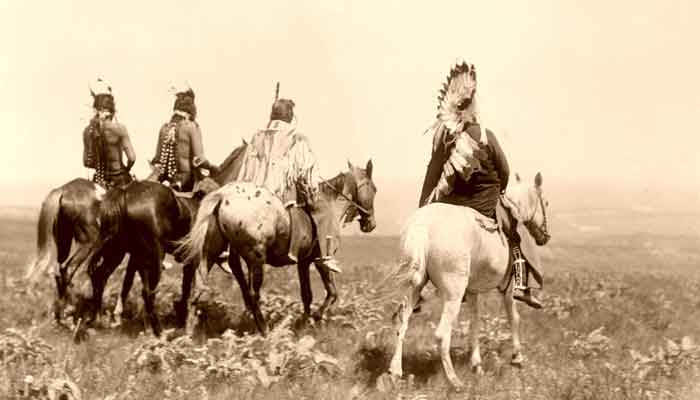
Absaroka (Crow) Warriors.
The Crow are also called the Apsáalooke, Absaroka, and Apsaroke. Their name was given to them by the Hidatsa and meant “people [or children] of the large-beaked bird.” Historically, they lived in the Yellowstone River Valley. A Siouan tribe, they were once part of the Hidatsa, living around the headwaters of the upper Mississippi River in northern Minnesota and Wisconsin. Later, the Crow moved to the Devil’s Lake region of North Dakota before splitting with the Hidatsa and moving westward.
Settling in Montana, the tribe split once again into two divisions, called the Mountain Crow and the River Crow. Two Frenchmen first encountered them in 1743 near the present-day town of Hardin, Montana. When the Lewis and Clark expedition came upon them in 1804, they estimated that there were some 350 lodges with about 3,500 members.
Like many other Plains Indians, the Crow traditionally lived in teepees, though theirs were often larger than those of other tribes. Constructed of buffalo skins and wooden poles, flying from the poles were not scalps, but strips of red cloth. Their main source of food was bison, but they also hunted mountain sheep, deer, and other game.

Apsaroke / Crow Winter Camp, 1908. Photo by Edward Curtis.
The Crow men were extremely proud of their long hair, which was allowed to grow incredibly long, sometimes even dragging the ground, and was usually decorated with various items. Unlike the men, Crow women had short hair. While the men were known as skilled horsemen and hunters, the women were accomplished at decorating both men’s and women’s clothing with beads, embroidery, and dyed porcupine quills, making the clothing particularly handsome.
Explorers described the wandering tribe of hunters as extremely superstitious, skillful horsemen, and despising the whites, though they weren’t known to kill them, usually preferring to plunder them. The Crow had more horses than any other Plains tribe, numbering some 10,000 in the mid-1800s and more than 40,000 by the beginning of the 20th century. They also had hundreds of dogs, with one explorer counting more than 500. Unlike some other tribes, they did not consume dog.
The Crow were matrilineal, with descent following the maternal line and the husband moving in with the wife’s family. Females held significant roles in the tribe, often attaining high-ranking status, including as chiefs.
Today, the vast majority of the Crow live on the Crow Indian Reservation in south-central Montana. The reservation, covering more than 3,600 square miles, is the fifth-largest Indian reservation in the United States. Wyoming borders it to the south and the Northern Cheyenne Indian Reservation to the east. The reservation encompasses approximately 2.3 million acres, including the northern end of the Bighorn Mountains, the Wolf Mountains, and the Pryor Mountains. The Bighorn River flows north from Yellowtail Dam and joins the Little Bighorn River just outside Hardin, Montana. The city of Billings is approximately 10 miles northwest of the reservation boundary.
Membership in the Apsáalooke Nation numbers about 11,000, with almost 8,000 residing on the Crow Indian Reservation. Eighty-five percent speak Crow as their first language.
The Apsáalooke/Crow People are known for the strength of their Apsáalooke ammaalaátuua (Crow writing system) and clan system. The Crow Indian language is a part of the greater Siouan language family. The Apsáalooke Ashammalíaxxiia, Clan System consists of several active clans:
Ashshitchíte/the Big Lodge, Ashhilaalíoo/ Newly Made Lodge
Uuwatashe/ Greasy Mouth, Ashíiooshe/ Sore Lip Clan
Xúhkaalaxche/ Ties the Bundle Clan
Biliikóoshe/ Whistling Waters Clan Ashkápkawiia/ Bad War Deeds Clan
Aashkamne/ Piegan clan. The other name they are called is: Aashbatshua or Treacherous clan
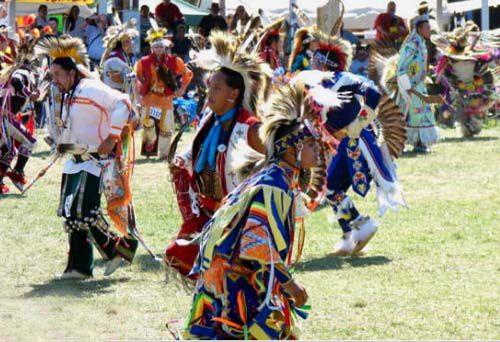
Crow Pow Wow.
The Apsáalooke Nation’s headquarters is located at the Crow Agency, where the tribe hosts the Annual Crow Fair, featuring a pow-wow, rodeo, and parade. During this event, held on the third weekend in August, the area becomes known as “The Teepee Capital of the World,” where as many as 1,500 teepees can be seen spread across the Little Bighorn River valley.
More Information:
Apsáalooke Nation
Baacheeitche Avenue
P.O. Box 159
Crow Agency, Montana 59022
406-638-3700
©Kathy Weiser/Legends of America, updated April 2026.
See our Crow-Apsaalooke Photo Gallery HERE
Also See: