
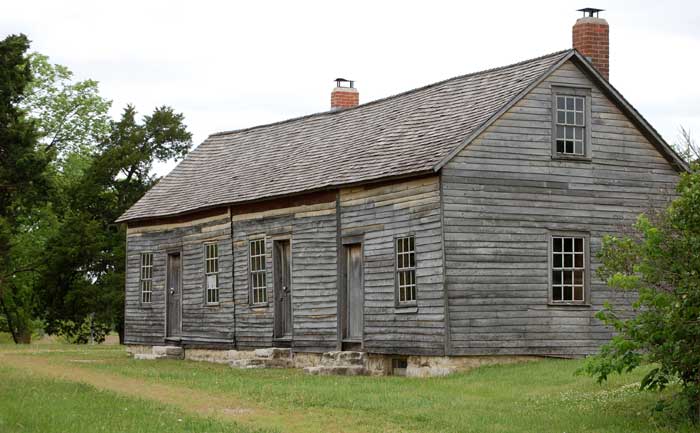
Hollenberg Station, Kansas, photo by Dave Alexander.
“In mid-century America, communication between St. Joseph on the fringe of western settlement and gold mining communities of California challenged the bold and made skeptical the timid. Into this picture rode the Pony Express. In rain and in snow, in sleet and in hail over moonlit prairie, down tortuous mountain path… pounding pony feet knitted together the ragged edges of a rising nation.”
— Frank S. Popplewell
The local area had a significant Native American population. The Pawnee Indians resided west of Hanover; the Kanza tribe lived to the south; and the Otoe Indians were located to the north.
The Otoe Reservation, on the Kansas-Nebraska border, operated from 1854 to 1883. Their reservation was 160,000 acres. When the Otoe tribal lands were sold in 1883, the land sold for a record-high average of $12.22 per acre. By comparison, most other Native American tribes in the central and northern Great Plains were paid only 10¢ per acre. Some Otoe Indians were relocated to Red Rock, Oklahoma, while many mixed-race Otoe Indians were integrated into the local German community.
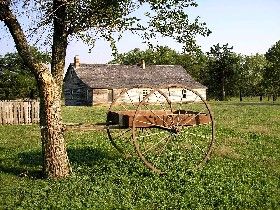
Hollenberg Pony Express Station, Kansas, by Kathy Alexander.
Five miles northeast of Hanover, Kansas, is the only remaining Pony Express stop still in its original location. Built on Cottonwood Creek in 1857 by Gerat H. Hollenberg, this station was also the largest stop along the Pony Express route. Intending to capitalize on the many wagon trains passing his way on the Oregon-California Trail, Hollenberg’s six-room building initially served as a grocery store, tavern, and unofficial post office. Three years later, it became a Pony Express station and later a stagecoach station.
The Pony Express Route, which ran 2,000 miles from St. Joseph, Missouri, to Sacramento, California, operated for only 18 months, from April 1860 through October 1861. Amazingly, these young riders carried approximately 35,000 pieces of mail over more than 650,000 miles and only lost one sack of mail during this time.
Before the Pony Express, the railroads and telegraph lines extended no further west than St. Joseph, Missouri, and mail traveled west by stagecoach and wagons, a trip that could take months if it arrived at all. The Pony Express alleviated this problem with riders who could dramatically reduce the time it took to deliver the mail. But it was a dangerous job, fraught with Indian attacks, rough terrain, and severe weather.
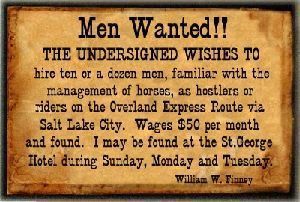
Pony Express Want Ad
For this reason, a Pony Express, an 1860 advertisement in California, read: “Wanted. Young, skinny, wiry fellows not over 18. Must be expert riders, willing to risk death daily. Orphans preferred.” Most of the riders were around 20, but one was only 11, and the oldest was in his mid-40s. Usually, they weighed about 120 pounds. One hundred eighty-three men rode for the Pony Express, each receiving $100 monthly. Riding in a relay fashion, each rider would cover about 75-100 miles before another rider took his place. However, riders received fresh horses every 10-15 miles. The entire one-way trip would take about ten days.
While the Pony Express dramatically improved the communication between the East and West, it was a financial disaster for its owners. Hoping to gain a million-dollar government mail contract, the Central Overland California and Pikes Peak Express Company spent about $700,000 on the project, losing about $200,000 of their investment. The owners failed to secure the million-dollar contract, and when the telegraph was completed in October 1861, the company declared bankruptcy and closed.
Afterward, most of the 163 stations fell into ruins, but somehow, the Hollenberg Station managed to survive. In 1869, the nearby town of Hanover was founded, and its residents made every effort to preserve the old station. The building is now part of a state historical park and operates as a museum and visitor center.
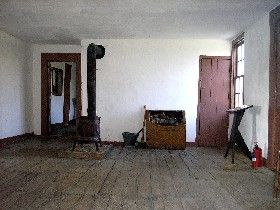
Hollenberg Station Interior by Kathy Alexander.
However, according to many visitors and staff members, some Pony Express riders have lingered at the station long after the building ceased to serve the Pony Express. Many claim to have heard pounding hoofs thundering through the night and the distant sounds of young men calling out as their phantom mounts near the station. Others have even claimed to have seen the riders. Witnesses also report hearing many strange sounds and experiencing cold spots within the building.
Hollenberg Station is four miles north of U.S. 36 on K-148 and one mile east on K-243 in Hanover, Kansas. It is open seasonally.
©Kathy Alexander/Legends of America, updated May 2026.
Also See:
Legends, Ghosts, Myths & Mysteries
Pony Express – Fasted Mail Across the West