
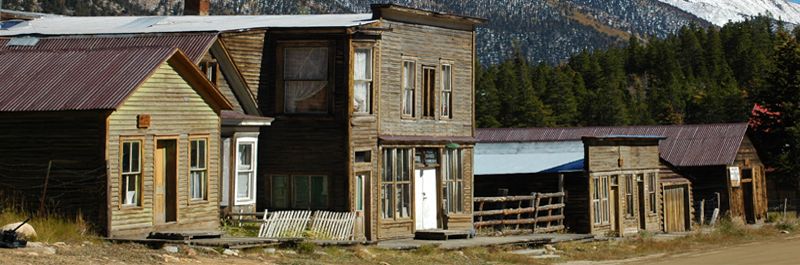
St. Elmo, Colorado Main Street Buildings by Reletta Clumsky.
~~
St. Elmo, Colorado, a former gold mining camp in Chaffee County, is nestled 1000 feet below the timberline in the Sawatch Range, 20 miles southwest of Buena Vista. Today, it is one of the best-preserved ghost towns in Colorado, and the entire district was placed on the National Register of Historic Places in 1979.

St. Elmo, Colorado, Main Street, about 1885, colorized.
The area was initially settled in 1878 and was officially established in 1880, when gold and silver mining drew many people to the region. Though the settlement was first called Forest City, the small town’s name was changed when the post office objected because there were too many towns with the same name. The new name was derived by Griffith Evans, one of the founders, who was reading a romantic 19th-century novel by the same name.
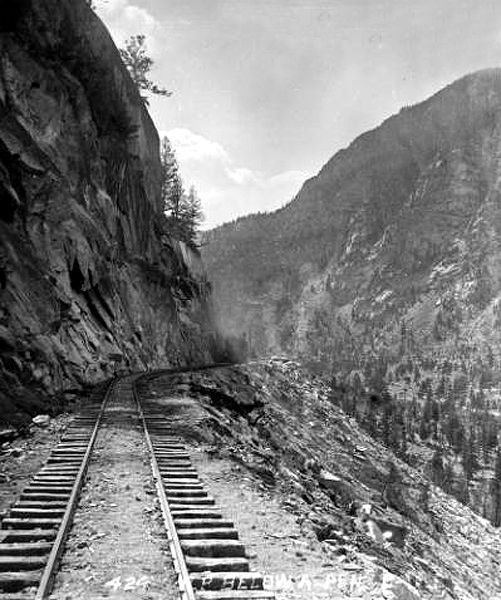
Denver, South Park & Pacific Railroad below St. Elmo, Colorado by Joseph Collier, about 1885
The town was laid out in six feet of snow and provided for the miners working nearby. Beginning with a high moral character, the settlement followed the path of other booming mining towns, reaching a population of more than 2,000 and adopting all the trappings of a single male population, including saloons, dance halls, and bawdy houses. When the Alpine Tunnel was under construction, St. Elmo became the scene of raunchy Saturday night sprees.
In 1881, the Denver, South Park and Pacific Railroad came through the area, and a station was built in St. Elmo. From here, the tracks continued to Romley, Hancock, and through the historic Alpine Tunnel. St. Elmo was considered the primary source of supplies arriving by train for the area settlers. Eventually, the town boasted smelting works, several merchandise stores, five hotels, a telegraph office, a town hall, five restaurants, two sawmills, a schoolhouse, a weekly newspaper called the Mountaineer, and numerous saloons and dance halls.
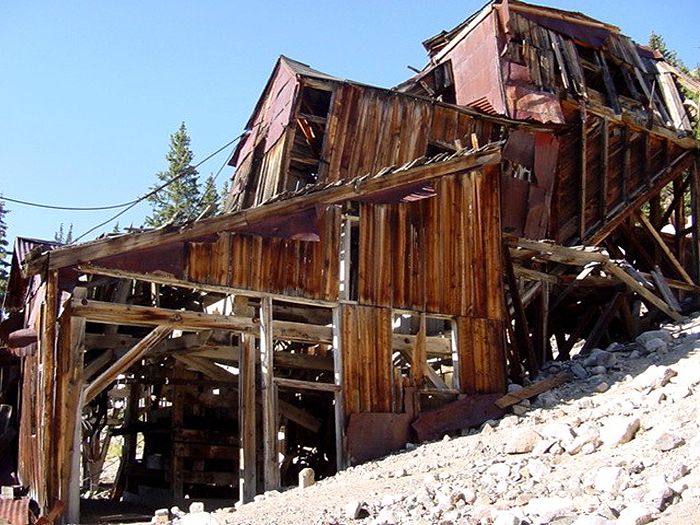
Mary Murphy Mine, St. Elmo, Colorado by Kathy Alexander, 2004.
The miners worked at several mines throughout the area that were rich in silver, gold, copper, and iron. The principal mines were the Mary Murphy, the Theresse C, the Molly, and the Pioneer. The Murphy Mine, situated high up on the mountain, some 2,000 feet above the railroad, was the largest and most successful, shipping as much as 50-75 tons of ore per day to the smelters at Alpine. The Murphy and the Theresse C. ran more in gold than in silver. Altogether, there were over 150 patented mine claims in the immediate area.
In 1881, Anton Stark, a cattleman, brought a herd to the railroad and was so taken with the town that he and his family quickly took up residence. Anton became a section boss for one of the local mines, and his wife, Anna, managed a general store and the Home Comfort Hotel, which later became the home of the post office and telegraph office. Anton and Anna raised three children – Tony, Roy, and Annabelle, who worked in the hotel and the store. The hotel was said to be the cleanest in town, the meals the best, and the supplies at the store more plentiful than those at other establishments.
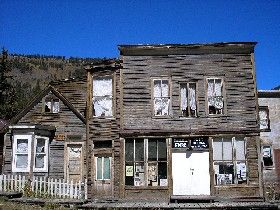
The Stark Home and Store in St. Elmo, Colorado, began as the Home Comfort Hotel. Photo by Kathy Alexander.
The Stark family was part of St. Elmo’s elite, a high-class group that attended church regularly. Anna was said to have been a humorless woman who severely controlled her children, believing that they were better than the other townsfolk — miners, railroad men, prostitutes, and hard women. The children were rarely allowed to leave home and were forbidden to attend local dances or social activities. In the end, they had only each other for company.
In 1890, a fire destroyed the business section, and the town was never entirely rebuilt. This was about the same time that St. Elmo’s reached its peak population, with approximately 2,000 residents. Afterward, many of the mines were depleted, and many of the miners left the area. More mines continued to fail in the ensuing years, and the closure of the Alpine Tunnel in 1910 marked the beginning of a significant decline in St. Elmo.
The railroad continued to run until 1922, and it has been said that the rest of St. Elmo’s population rode the last train out of town, never to return.
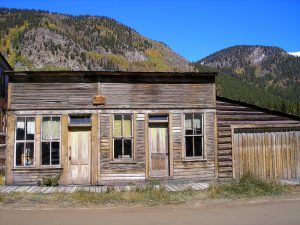
St. Elmo, Colorado, buildings by Kathy Alexander.
For many years, Roy and Tony Stark attempted to influence developers to reopen the mines. Still, when they were unsuccessful, they turned to tourism, leasing the empty cabins to vacationers and continuing to operate the general store. After Anton Stark’s death, Anna realized that the tourism trade was not providing for the family and sent Annabelle to work in the telegraph office in Salida, 20 miles south of St. Elmo.
The lonely and attractive girl was finally able to escape the prison that her mother had made for her in Saint Elmo. Before long, she met a young man named Ward, and in 1922, they married, sending a telegram to her family to announce their move to Trinidad. Though no one seems to know why the marriage didn’t work, just two short years later, she returned to St. Elmo, where she spent the rest of her life.
In 1925, the Mary Murphy Mine, the principal gold mine of the Chalk Creek Mining District, also closed. From 1870 to 1925, it produced 220.000 ounces of gold, worth $4.4 million at the time. It also produced a considerable amount of silver, lead, and zinc.
In 1926, the railroad tracks were torn up, and the railroad grade was converted into a road from Nathrop to St. Elmo. However, the Stark family stayed, believing that St. Elmo would thrive again, and they bought up property at tax sales.
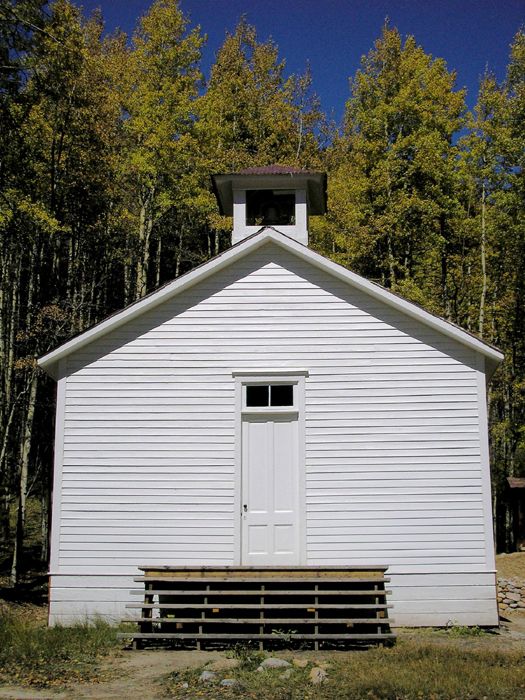
St. Elmo, Colorado School by Kathy Alexander.
The three eccentric Stark children, along with their mother, maintained their existence by continuing to run the general store and rent cabins to tourists. However, the town’s general condition deteriorated. By 1930, the population of Saint Elmo had dwindled to only seven.
In 1934, Roy Stark passed away, and his mother, Anna, died a short time later. The only residents left were Annabelle and Tony, who lived in the dead town without indoor plumbing or electricity. Rarely bathing or changing clothes, they neglected the old hotel, allowing the place to pile up with trash and discarded items, while continuing to run the Home Comfort Store. The store, said to have been “sour-smelling”, contained faded tins of outdated food and stale tobacco.
In 1947, when Muriel Sibell Wolle’s book, Stampede to Timberline, was published, Tony and Annie were incensed, claiming that it was not the tattered store or their eccentricities that drove away business, but rather Mrs. Wolle’s statements in the book.
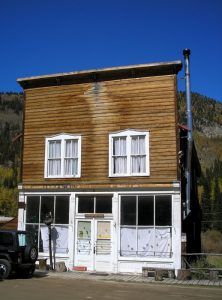
Old store in St. Elmo, Colorado, by Kathy Alexander.
Though Annabell was always said to have been kind and generous to the few who still frequented the store, the locals began to call her “Dirty Annie” because of her filthy clothing and tangled hair. She was also known to have roamed the old town, with rifle in hand, to protect her property. The town office closed on September 30, 1952.
Eventually, Tony and Annabelle were sent away to a mental institution for their own safety and that of others. However, after just a few weeks, a sympathetic friend convinced the authorities that they were of no harm to anyone, and they were released. Tony died a short time later, and Annabelle was sent to a nursing home in 1958, where she died in 1960. Their property was left to the sympathetic friend who had helped them.
Afterward, the town’s survival was mainly due to the Stark family and their descendants, who remained the sole year-round residents for many years. According to local legend, perhaps at least one of them, Annabelle Stark, still keeps a ghostly watch over the town.
Shortly after Annabelle’s death, the friend’s grandchildren were said to have been playing in a room of the hotel, when suddenly all the doors in the room slammed shut and the temperature dropped nearly 20 degrees. The terrified children refused to play in the hotel again.
Another one of the grandchildren, a young woman in her twenties, decided to take on the hotel as a project, cleaning out the rooms, making minor repairs, and washing down the walls and floors. After cleaning up for the day, she and her friends would put away their tools and cleaning supplies, only to find them scattered across the floor when they returned the next day. After this continued to occur, they started placing the items in a padlocked closet, but they would still be scattered across the floor when they came back.
On another occasion, a skier was said to have seen a very attractive woman in a white dress framed in the second-story window of the old hotel. The owner was away on vacation, so who could it have been? The young woman’s eyes were focused on something in the distance, and when the skier followed her gaze, she saw a group of snowmobilers who were riding through the street. The skier flagged down the group, informing them that snowmobiling was illegal in St. Elmo. The group apologized and rode away. When the skier looked back at the hotel, the woman nodded to her, then turned away and vanished.
The legend of Annabelle’s ghost endures among the part-time residents of Saint Elmo, who believe that she continues to protect her property from vandals and trespassers.
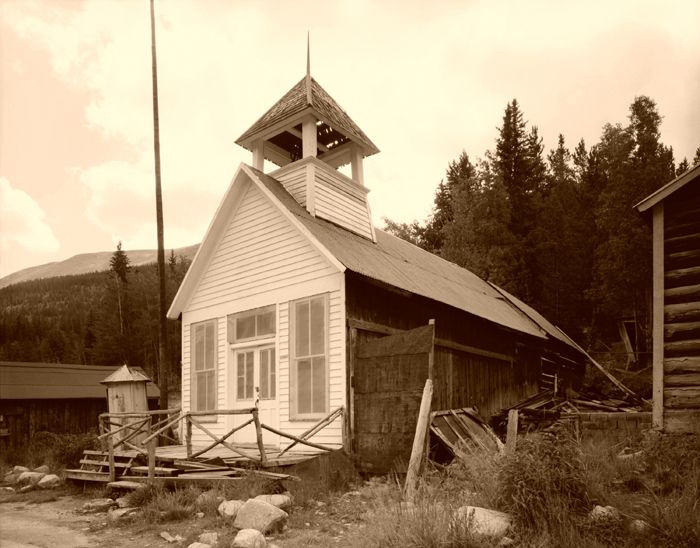
Town Hall, St. Elmo, Colorado, 1984.
On April 15, 2002, Saint Elmo destroyed six of the buildings, including the old Town Hall and Jail, and some of the Stark family dwellings.
On July 6, 2002, tJuly 6nt Elmo Property owners passed a resolution to donate the Town Hall property, as well as the Saint Elmo School House, to the Buena Vista Heritage Museum. The Museum plans to work closely with the Association and residents to preserve and protect Saint Elmo.
St. Elmo today features numerous preserved structures, all of which are privately owned. It is one of the best-preserved ghost towns anywhere in Colorado and still has a few residents. The remaining structures include a general merchandise store, which still operates from May through October, a church, a school building, many other business structures, and numerous cabins. Many of these date back to the 1880s and 1890s.
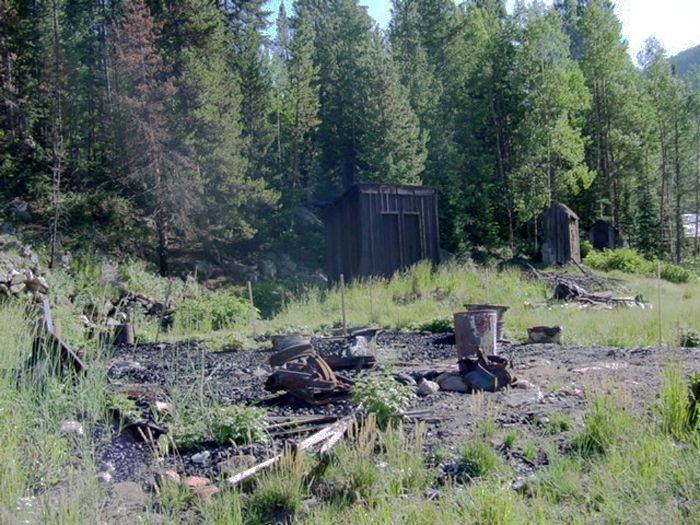
Lot where the St. Elmo Town Hall stood, by Kathy Alexander, 2004.
There are many great four-wheel-drive trails throughout the area. Rock hounds will find quartz and aquamarine, and camping and upper-mountain fishing are also abundant.
Directions: To get to Saint Elmo, from Buena Vista, take US 285 south to Nathrop, and then County Road 162 west for approximately 16 miles to Saint Elmo.
©Kathy Alexander/Legends of America, updated September 2025.
Also See:
The Alpine Tunnel – An Engineering Marvel
Colorado Ghost Town Photo Galleries
Ghost Towns & Mining Camps of Colorado
Sources:
Crofutt’s Grip Sack Guide of Colorado, 1885
Eberhart, Perry; Guide to the Colorado Ghost Towns and Mining Camps, Sage Books, 1959
National Register of Historic Places
Wolle, Muriel Sibell, Stampede to Timberline; Aircraft Press, May 1950; Denver, Colorado