

Homesteader George O. Waters, Dry Valley, near Comstock, Nebraska, by Solomon D. Butcher, 1887.
The free homestead law has been called the most important act ever passed in the United States for the welfare of the people.
In 1852, a political group called the Free Soil Party demanded free homesteads for the people. In 1854, Congressman Galusha A. Grow of Pennsylvania introduced the first free homestead bill in Congress. People in the West and poor people everywhere favored the bill; however, strong opposition remained.
The first Homestead Act required the settler to pay 25¢ cents an acre for his land and was passed by Congress in 1860; however, President James Buchanan vetoed it.
The Free Homestead Act was not finally passed and signed by then-President Abraham Lincoln until May 20, 1862. The law took effect on January 1, 1863.
Under this law, any man or woman 21 years old or the head of a family could own 160 acres of undeveloped land by living on it for five years and paying $18.00 in fees. They were also required to build a home, make improvements, and farm the land before they could own it outright. Alternatively, the homesteader could purchase the land for $1.25 per acre after having lived on it for six months.
Daniel Freeman made the first claim under the Homestead Act for a farm in Nebraska on January 1, 1863. Today, Freeman’s homestead stands as the Homestead National Monument near Beatrice, Nebraska. Freeman lived on and worked the land until his death on December 30, 1908. His wife Agnes lived on the homestead until shortly before she died in 1931. In 1936, by an act of the United States Congress, the site of Freeman’s homestead was recognized as the “first” homestead in the United States when it was designated as the Homestead National Monument of America.
Settlers from all walks of life, including newly arrived immigrants, landless farmers from the East, single women, and former slaves, came to meet the requirements.
People interested in homesteading had to file their intentions with the nearest land office. After checking for any ownership claims, the prospector paid a $10 filing fee to temporarily claim the land and a $2 commission to the land agent.
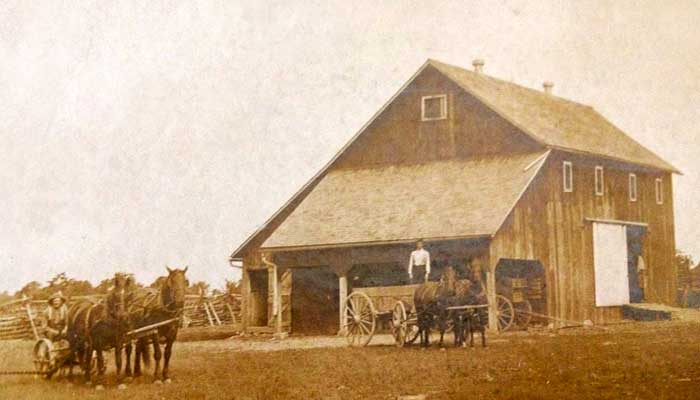
Homestead Barn.
When all requirements were complete, and the homesteader was ready to take legal possession, he or she found two neighbors or friends willing to vouch for the truth of their statements about land improvement and sign the “proof” document.
After completing this final form and paying a $6 fee, the homesteader received the patent for the land, signed by the current President of the United States. This paper was often proudly displayed on a cabin wall and represented the culmination of hard work and determination.
By the end of the 19th Century, over 570 million acres remained open to settlement, but very little was usable for agriculture. As the Frontier moved West onto the arid Great Plains, the land a homesteader could claim increased to 640 acres.
In Wyoming, Montana, and Colorado, homesteading cut into the access of the large ranches to the public domain, where hundreds of thousands of cattle grazed upon the open range, a practice called free grazing. Ranchers fought back by themselves (or with their cowboys), homesteading prime spots that provided water access. At times, tensions escalated into violence, conflicts called range wars, for example, the Johnson County War in Wyoming.
Ironically, the Homestead Act was often used as a scam. The available land was often too poor to farm, especially in the middle of the plains, where droughts were common. Because of hardships like these, few families stayed for the full five years.
Many corporations also took advantage of this act. They paid people to buy top-of-the-line property with abundant resources such as timber, minerals, and oil. Then, the settlers would claim later that they had “improved” the land. In reality, the improvements made to the land were minimal.
The Homestead Act of 1912 reduced the homestead requirement from five to three years; however, by this time, most of the land in the lower 48 states had already been taken.
The Taylor Grazing Act of 1934 substantially decreased the land available to homesteaders in the West. Because much of the prime land had been homesteaded decades earlier, successful homestead claims dropped sharply after this time.
Homesteading continued on a small scale in Alaska. Much of the remaining public domain was included in the National Forests or is administered by the Bureau of Land Management.
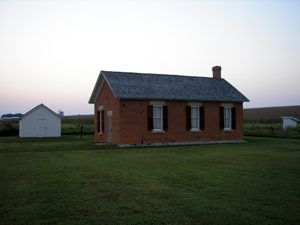
Freeman School.
The Federal Land Policy and Management Act of 1976 ended homesteading. The government believed the best use of public lands was to keep them under its control. Alaska was the only exception, where the law allowed homesteading until 1986.
Kenneth Deardorff made the last claim under the Homestead Act for 80 acres of land on the Stony River in southwestern Alaska. He fulfilled all requirements of the Homestead Act in 1979, but he did not receive his patent until May 1988. Therefore, he was the last person to receive title to land claimed under the Homestead Act.
Homestead farmers, who claimed some 270 million acres over the years, became the nation’s agricultural producers. Additionally, strong communities committed to social values, education, and personal responsibility were spawned throughout the territories covered by the Homestead lands.
The economic, agricultural, and social stability generated by the Homestead Act was utterly inconceivable in other times and places — and formed a large part of the foundation of American prosperity in the 20th Century.
© Kathy Alexander/Legends of America, updated September 2026.
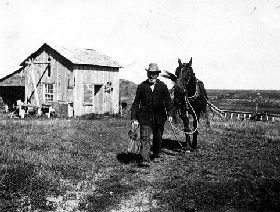
North Dakota Homesteader about 1909.
Also See:
Struggle For Possession – The First Emigrants (by Randall Parrish 1907)
The Frontier In History by Emerson Hough (1918)
Westward Expansion and Manifest Destiny (main page)
See Sources.
Another fun video from our friends at Arizona Ghost Riders: Houses in the Wild West