
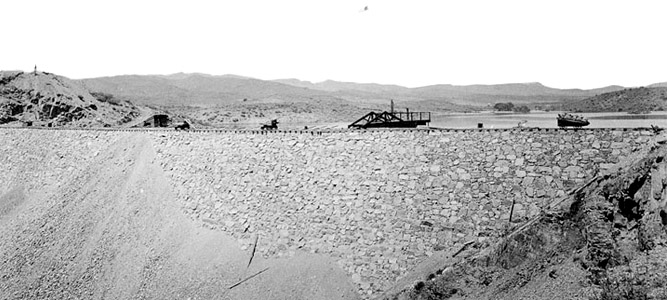
Walnut Grove Dam is under Construction in Arizona.
Arizona’s Worst Disaster by Jim Liggett is a book about the Walnut Grove Dam Disaster of 1890. Even today, it is the largest natural disaster in Arizona’s history. The dam was located on the Hassayampa River North of Wickenburg, Arizona, and was built to provide water for hydraulic mining and irrigation. At the time, Prescott, Arizona, was the capital of the Arizona Territory before it became a state in 1912.
The book recounts the Walnut Grove Dam’s story from conception to failure and its legal consequences. It includes colorful characters such as Henry Wickenburg, Buckey O’Neill, and Governor Alexander Brodie. Subsequent attempts to rebuild the dam and the fate of the Hassayampa River over the past century are included.
In the early morning of February 22, 1890, water overtopped the dam by three feet before it finally gave way. The dam superintendent felt this was going to happen, so he sent a rider downstream to warn people to get out of the canyon and onto higher ground. The story goes that the rider passed by a saloon, purchased a bottle of whiskey, and never made it downstream to warn anyone. In the end, it was estimated that 70 to 100 people lost their lives as the wall of water swept through the canyon toward Wickenburg.
Professor Liggett’s research goes back to the time when the dam was proposed and how it was financed. At the time, many investors were from back East, which meant selling interest in a water company so they could build the dam. As you read, you can see how people who knew nothing about the project were hustling for investment money—not much different from today.
The dam’s purpose was to supply water for hydraulic mining downstream and irrigation. Gold mining was the flashpoint for investors, who were hoping to cash in on a large return. Gold strikes had abounded in the area, and the streambeds were plentiful with gold nuggets. The water company they invested in was set to reap a nice return by supplying water to the goldfields.
As you read the book, you will see that what we take for granted today in engineering and hydrology was not available then. This created a major problem in the dam’s design, which, combined with the lack of historical information on water flows, ultimately led to failure.
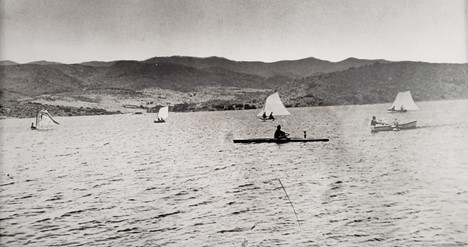
Walnut Grove Reservoir.
When they first started building the dam, the structure was leaking so badly that fish were said to be swimming through it. They stopped construction, hired another engineer and construction company, and rebuilt it from the ground up. In the end, the dam rose to 110 feet and, when filled, held back nine billion gallons of water. People boated, fished, and hunted in the reservoir. It was also short-lived.
John Wickenburg, the town’s owner, owned the Vulture Gold Mine at that time. It was rich in gold ore, and a large processing mill sat on the Hassayampa River in a small town called Seymore, just downstream of Wickenburg. Seymore probably would have never existed without the mill, but in its heyday, it had over 200 residents, a saloon, and a laundry.
When the wall of water hit Wickenburg, it destroyed all the orchards and farmland John Wickenburg had along the river. At Seymore, the wall of water destroyed the gold processing mill and swept it downstream.
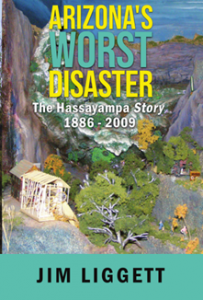
Arizona’s Worst Disaster.
Professor Liggett goes on to weave stories together about the losses incurred downstream and the people who lost everything. One story was about Bob Brow’s saloon, which had been washed away along with its safe and a barrel of whiskey. Twenty years later, a newspaper mentioned that the safe had never been found. Bob Brow later owned the Palace Saloon in Wickenburg, which is still in operation today.
About the author: Jim Liggett graduated high school in Prescott, Arizona, attended Texas Tech University in Lubbock, and then went to Stanford, where he received his master’s and Ph.D. degrees in engineering. Later, Jim joined the faculty at Cornell University, where he remained for 35 years. After retiring, he returned to Wickenburg, Arizona, where he joined a hiking group and became interested in the Walnut Grove Dam. His book attempts to fill a gap in Arizona’s territorial history, since this significant and defining event is largely ignored in the history books.
To purchase the book, go to Desert Roamer Press | Purchase Books
Submitted June 2021, Greg Hawk, Desert Roamer Press. Updated September 2026.
Also See:
Arizona – The Grand Canyon State
The Johnstown, Pennsylvania Flood of 1889
Vulture City, Arizona – Gold Mine Ghost Town