
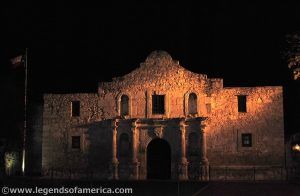
Alamo at Night, by Kathy Alexander.
The muffled drum’s sad roll has beat
The soldier’s last tattoo;
No more on life’s parade shall meet
That brave and fallen few.
On fame’s eternal camping-ground
Their silent tents are spread,
And glory guards with solemn round
The bivouac of the dead.
The neighing troop, the flashing blade,
The bugle’s stirring blast,
The charge, the dreadful cannonade,
The din and shout are past;
Nor war’s wild note, nor glory’s peal
Shall thrill with fierce delight
Those breasts that nevermore may feel
The rapture of the fight.
–Theodore O’Hara.
Built initially as the Mission San Antonio de Valero, the Alamo first served to Christianize and educate the resident Indians in the late 1700s. In later years, through the 1830s, the mission became home to various groups, including revolutionaries and rebels. During this time, the Alamo site was expanded to a fortress with high walls and numerous outbuildings. In 1836, self-proclaimed dictator General Santa Anna set out to conquer the rebellious Texans of San Antonio and marched toward the settlement with more than 1,000 troops. When they arrived on February 23, 1836, about 145 Texans took refuge upon the Alamo’s fortified grounds, determined to fight off the Mexican Army. For the next 13 days, a raging battle ensued between the Texans, under the joint command of William B. Travis for the regular army and Jim Bowie for the volunteers, and Santa Anna’s troops. Over these two weeks, the Mexicans continued to fortify their numbers until as many as 4,000 men were bombarding the Alamo. The Texans also struggled to reinforce, leaving about 189 men to defend the Alamo.
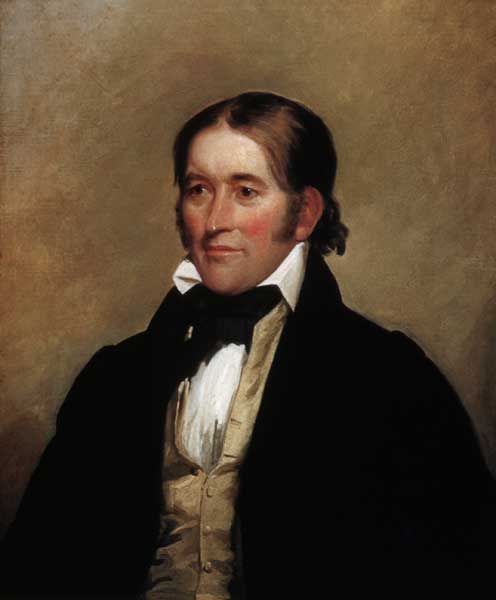
David “Davy” Crockett. Portrait by Chester Harding
Despite the defenders’ valiant battle, Santa Anna’s troops stormed the Alamo on the morning of March 6, 1836, killing every single one of the Texas defenders, including William Travis, Jim Bowie, and Davy Crockett. Though victorious, the cost to Mexican forces was enormous, as 1,600 Mexican soldiers lay dead. An aide to Santa Anna later noted privately, “One more such glorious victory, and we are finished.”
To reinforce the victory, several non-combatants were spared so that they might inform their fellow Texans of their potential fate should they continue to thwart the Mexican authorities. Afterward, the Alamo defenders’ bodies were looted, dismembered, buried in mass graves, dumped into the river, or burned.
Today, the Alamo is one of the best-known monuments in the United States. Its remaining buildings and the surrounding area are also among the nation’s most haunted places. Because of its long history and the many deaths at the site, people have reported tales of apparitions at the old mission for almost two centuries.
Before the Battle of the Alamo, the ground that takes up most of the Alamo Plaza today was utilized as a cemetery between 1724 and 1793. About 1,000 people were estimated to have been buried there during those years. In addition to those pre-Alamo bodies, most of the men fighting on both sides of the battle were also buried in the area. Even today, construction and utility workers often turn up skulls and other bones when excavating in the area.
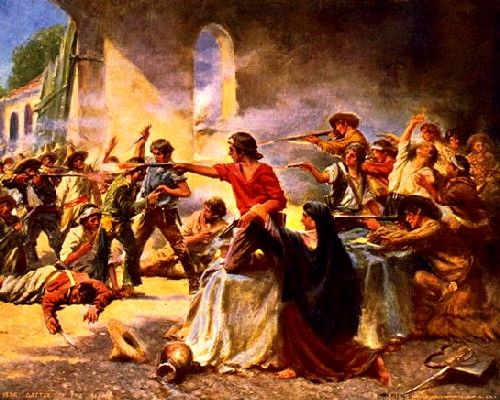
Alamo Battle.
The first reported sighting of the ghostly activity happened only weeks after the Battle of the Alamo. When Santa Anna left San Antonio, he moved about 1,500 troops to San Jacinto (near today’s Houston), leaving about 1,000 men in San Antonio to control the rebels. However, Sam Houston and his Texan freedom fighters captured Santa Anna at San Jacinto in April 1836. In retaliation, Santa Anna sent messengers to order the destruction of the Alamo.
However, his wish would not come true, as when the Mexican troops neared the church with flaming torches, six fully formed spirits suddenly appeared before the front doors of the mission, waving blazing sabers and yelling, “Do not touch the Alamo, do not touch these walls!” The Mexicans fled in fear and would not be persuaded to return regardless of their superiors’ threats. Some say these entities were Alamo defenders, while others say they were monks protecting the mission.
When Colonel Sanchez, tasked with destroying the mission, reported back to General Andrade, he recounted the tale of six Diablos (devils) coming out of the front doors. The general only scoffed, thinking the story ludicrous. Still, not one man from the first task force returned to the Alamo. Frustrated but undaunted, the general gathered another group of men and returned to the Alamo, determined to burn the Long House Barracks. However, again, the building was saved from destruction when a tall male spirit arose from the building’s roof. Standing above the Mexican soldiers, the entity was said to have held two flaming balls of fire in its outstretched hands. At the sight of the abnormality, the soldiers fell to their knees and covered their eyes. Fleeing once again, the Mexicans refused to return, and for the next ten years, the Alamo lay in ruins.
Erected in 1939, the Alamo Monument, called the Cenotaph, depicts this spirit upon its face, along with the fortress’s defenders. Legend has it that when the ethereal energy was released from the flames where the Alamo defenders’ bodies were burned, the spirit utilized the energy to make itself visible to frighten away the would-be destructionists.
In 1846, after Texas’ annexation into the United States, the U.S. Army began occupying the complex, making significant repairs to the church and the old barracks.
By the late 19th Century, tales of ghostly happenings at the Alamo were well-known in the area. However, this did not stop the City of San Antonio from utilizing the old mission as a police headquarters and the old barracks as a jail. Within no time, prisoners housed in the barracks started to complain of paranormal activities.
Between 1894 and 1897, several articles in the San Antonio Express-News described ghostly sentries pacing along the police station’s roof, shadows and moaning sounds heard by staff and prisoners, and other ghostly phenomena. Guards and watchmen began to refuse to patrol the building after hours. This, of course, caused an uproar among the politicians, and a short time later, the prisoners were moved to another location.
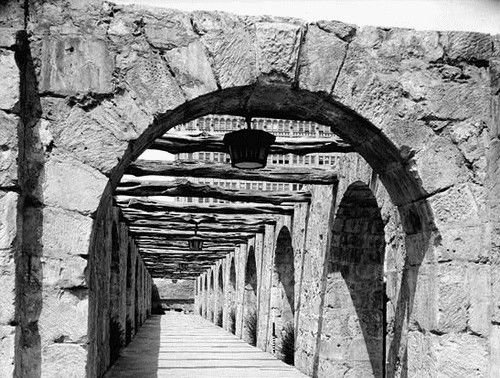
Alamo Arcade 1936.
Today, apparitions continue to appear on these historic grounds, as staff and tourists report ghostly happenings at all hours of the day and night. Guests at nearby hotels have reported grotesque apparitions coming from the wall of the old Alamo, as well as restless spirits walking back and forth on top of the buildings. Others have reported hearing screams, explosions, and the faint trumpet notes of “El Deguello,” the Spanish call of “no quarter” that Santa Anna ordered played during the final assault on the fort.
The lawn covers a portion of the old cemetery in front of the Alamo, and several Federal Marshals who have patrolled the grounds at night have quit their jobs after encountering some of these wandering entities.
Always spotted in the gardens next to the mission appears the fully formed spirit of a cowboy, complete with a black duster and cowboy hat. Dripping wet, he looks like he has ridden through a severe thunderstorm. Many Texas historians theorize that the spirit may have been one of the 22 dispatch riders that William Travis sent seeking assistance.
A second entity that makes his presence known is an Alamo defender, often reported to stick his head and shoulders out of the large rectangular window over the double doors at the church’s front. After leaning out and scoping the area, he leans back and disappears.
One of the most often sighted ghosts is a small blonde-haired boy, most often seen in the left upstairs window, which houses today’s gift shop. The forlorn-looking boy has been seen wandering the complex’s grounds almost continuously during the first few weeks of February. Some believe that the boy was evacuated during the siege and returns annually to search for his long-lost father, who died in the battle.
A woman is also reported to have been seen next to the water well on the other side of the church. Appearing only at night, reports allege that she materializes only as a vaporous torso-like spirit. No one knows who this restless apparition might have been.
In an area of the mission today utilized for storage and meetings, staff have often encountered a tall Indian who silently creeps up behind them. After feeling a presence, they turn to see the broad-chested Native American, who suddenly disappears or walks back through a solid wall that once held a tunnel doorway to the Menger Hotel across the street. Due to these many sightings, staff often report being afraid to enter the basement.
Yet others have reported seeing a tall, stately Mexican officer slowly wandering the historic site’s grounds and buildings. With a sorrowful face, the man is seen walking with his arms clasped behind his back and slowly shaking his head. Many believe the ghostly man is General Manuel Fernandez de Castrillon, one of Santa Anna’s regimental commanders. Castrillon was one of the few officers who had opposed the final assault on the Alamo, stating that it was bound to be a “bloodbath.” His opposition was ignored as the regiment continued to bombard the fortress. When the firing had finally ceased, six Alamo defenders surrendered and were brought to General Castrillon, who offered them his protection and petitioned Santa Anna for clemency. However, the embittered dictator refused and ordered the six men executed. Having given his word, Castrillon refused to carry out the order, but Santa Anna’s men soon fell on the surrendering Texans and hacked them to death with sabers.
Park rangers have often spotted the spirit of frontiersman and Alamo defender Davy Crockett in buckskin clothing and a coonskin cap. The transparent figure is described as standing at attention at various locations around the Alamo, holding a flintlock rifle.
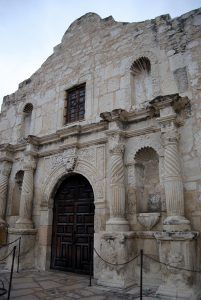
Alamo Mission Detail by Kathy Alexander.
Each March, a few days after the Alamo’s final demise, numerous people report being awakened in the early morning hours by the sound of a horse galloping on the pavement. Many believe the unseen rider is James Allen, the last courier to leave the Alamo the evening before its final battle. Wandering restlessly, he is thought to be attempting to return to the Alamo with his report to Colonel Travis.
Stories also tell of a tall, thin man and small child often seen on the roof of the Alamo mission at sunrise. In the final hours of the siege, Colonel Juan Andrade and several other Mexican officers stated that they were “horrified” when they saw a man with a small child in his arms leap to the ground at the rear of the Alamo church.
Two other small boys are also spied following tour groups on the property. These lads seemingly “appear” behind the group, then vanish just as quickly when the group reaches the sacristy room. Thought to be Alamo Artilleryman Anthony Wolfe’s sons, the boys, aged nine and twelve, were killed in the final assault. Hiding in the Alamo Mission, they were mistaken for Alamo defenders and killed by the advancing Mexicans.
Another ghost reportedly seen is John Wayne. When the “Duke “directed and acted in the 1960 movie “The Alamo,” he became obsessed with its history. Insisting on historical accuracy, he toured the Alamo several times. He consulted the fortress blueprints before spending $1.5 million to recreate a replica of the old mission in Brackettville, Texas. In addition to a replica of the mission, an entire village was constructed for the movie, which has since become a tourist attraction and has been used as the set for other films. Shortly after he died, staff and visitors began to report the “Duke” walking the grounds of the original Alamo. Some say he is often seen talking with the spirits of the original Alamo defenders.
Today, the Mission San Antonio de Valero and the Long Barracks are dwarfed by the many tall buildings surrounding the historic site. Though these two remaining compound buildings look very small by comparison, the fortress once covered about 5 ½ acres. Dominating the area North of the original San Antonio settlement, the fortress once housed numerous outbuildings and was surrounded by thick walls. Over the years, the fortress walls were dismantled, and buildings began to spring up around what remained of the Alamo compound. Many of these walls are now buried beneath San Antonio’s streets. However, the restless spirits don’t seem to understand this as they wander through the surrounding area in “newer” buildings that were never associated with the fortress.
Guides tell visitors that nearly every storefront building on Alamo Plaza facing the church is also haunted. Built directly over one of the old compound walls, the spirits of those who died defending the compound are said to roam the area.
Two locations where the bodies of those in the Battle of the Alamo were buried are also said to be haunted. Many of those who died defending the Alamo were burned near the spot where the River Center Marriott stands today. Here, a bookstore beneath the bridge allegedly experiences ghostly activity, including one corner of the store that stays very cold and books that frequently fly off the shelves of their own accord. The Mexican soldiers’ bodies were taken to a spot that today is a children’s park across from Market Square, nearly a mile away from the Alamo. Reportedly, the park is extremely haunted.
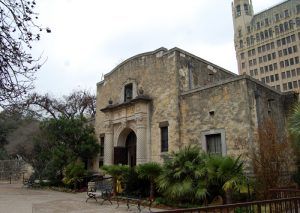
Alamo Museum and Visitor’s Center by Dave Alexander.
At Alamo Plaza, numerous reports describe a spectral woman walking across the plaza. Legend has it that the female apparition was one of two women walking across the mission grounds in the 1700s and were struck by lightning. One of the women died, and the other survived. Some speculate that the woman is the one who was killed on that fateful day so long ago.
Outside of town, on the road from Nacogdoches to San Antonio, dozens of reports describe a lone man in early 19th-century clothing, often seen walking along the highway. Carrying a long rifle, he tells passersby he is trying to “get back to the Alamo, where he belongs.” Many speculate that this lonely specter is that of Louis M. (Moses) Rose, the Alamo’s only “coward.” Rose was the only man who refused to join the defenders and chose to escape instead. Regretting his flight, he is riddled with guilt and tries repeatedly to regain his honor by returning to the battle.
There is no doubt that the Alamo and the surrounding area are extremely haunted. Tourists, rangers, and staff have reported phenomena such as grotesque man-shaped forms emanating from the Alamo’s walls, the screams of those who fought in the battle still heard today, and voices and whispers filtering through the walls. Invisible eyes seemingly watch the many people who work at and visit the historic site. Other phenomena also occur, such as eerie cold spots throughout the buildings, vanishing lights, and unexplained noises.
Contact Information:
The Alamo
300 Alamo Plaza
P.O. Box 2599
San Antonio, Texas 78299
(210) 255-1391
Note: The Alamo is a registered historical site and a Texas shrine. For these reasons, investigations are not allowed on the site. Additionally, no cameras or other electronic equipment, including EMF meters, are allowed inside the Alamo mission or the long barracks.
©Kathy Alexander/Legends of America, updated September 2026.
Also See:
San Antonio – A Mecca For History Buffs
See Sources.