

An aircraft similar to UA 629. Photo by Robert J. Boser.
By Drew Page.
On November 1, 1955, a routine two-hour flight from Denver, Colorado, to Portland, Oregon, would take off as usual, only to mysteriously crash 11 minutes later, killing all 39 passengers and five crew members.
After initial investigations, the FBI consulted the Civil Aeronautics Board (CAB) regarding the tail section, which had apparently been cleanly severed from the plane as if cut by a knife. Eyewitnesses in the area consistently described a fiery explosion in the air, with flares streaming down, and a second explosion on impact.
The wreckage would be recovered with the tail section damaged only by impact, but an obvious explosion severely damaged the fuselage.
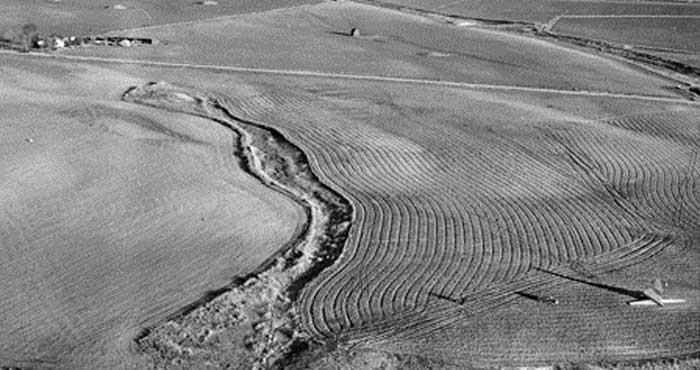
Investigators found the plane’s tail on a Colorado farm. Photo courtesy of the FBI, November 2, 1955
Criminal Investigation
On November 7, the CAB’s chief of investigations officially declared the crash was not an accident caused by structural or engineering malfunction and requested the FBI conduct a criminal investigation.

The wreckage of United Flight 629 was carefully laid out in a Denver warehouse after its bombing. Photo courtesy of the FBI
Engineers pinpointed the explosion to cargo hold number four, based on the size of shrapnel pieces from that section of the plane.
The investigation shifted from structural failure to social sabotage, tracking down and interviewing everyone involved in loading cargo, maintenance, airline operations, passengers, crew, and their networks.
Daisie King
Passenger Daisie E. King’s personal effects included traveler’s checks, two keys, a receipt for a safe deposit box, and newspaper clippings about her son’s legal troubles, raising moderate suspicion. It was determined that these effects were within her carry-on and not checked luggage.
These were the only items that could be connected to Mrs. King; only small pieces of what was believed to be her suitcase were ever recovered from cargo. The investigation quickly turned to her son, Jack Gilbert Graham, who had previously been charged with forgery and was on the local “most wanted” list.
It was discovered that Mrs. King was one of 17 passengers who had insurance policies on the trip, and upon searching Mr. Graham’s residence, a second policy for $37,500 was found hidden in a cedar chest — Jack Graham was named the policy’s beneficiary.
In addition to this striking revelation, acquaintances of the mother and son described friction between them as business partners in a small drive-in restaurant and criticized Jack’s overall character.
Jack Graham

Jack Gilbert Graham
After serving in — and being honorably discharged from — the National Guard (despite a 63-day AWOL period), Jack Graham enrolled at Denver University. Jack ran into legal trouble after working as a payroll clerk for a manufacturing company, where he stole 42 blank checks, forged their signatures, and cashed them for $100 each.
Using some of his $4,200 haul, Jack purchased a car and left Denver. Only six months later, Jack would be arrested in Lubbock, Texas, for illegally hauling whiskey and subsequently detained for 60 days.
After Jack and his wife, Gloria, were interviewed, their stories appeared to have discrepancies. Jack was made aware that he was officially an active suspect in the crime, and he agreed to submit to polygraph testing and search and seizure of his property.
At Jack’s residence, agents found copper wire with yellow insulation typically used in detonation devices, which Jack could not explain. The agents also uncovered the hidden insurance policy naming Jack the sole beneficiary. Under pressure from the interrogators, Jack Graham admitted to building and stowing a time bomb in Daisie King’s luggage, causing the explosion.
The bomb consisted of 25 sticks of dynamite, a timer, a six-volt battery, and two electric primer caps. Jack had worked briefly as an electrician, and before he quit, he asked how to combine a battery and timer that would not last more than two hours.
Jack attempted to plead innocent by temporary insanity, but no less than four medical professionals confirmed his sanity. Jack was notably calm and indifferent during court proceedings, despite a crowded, expectant courtroom. Spectators waited hours for a seat, and shortly before court began, the pilot’s young wife took one reserved seat in the front for UA 629.
Throughout the 15-day trial, 80 witnesses testified, and 174 exhibits were presented to prove guilt. The defense called only eight witnesses and then rested its case. The jury deliberated for a little more than an hour before finding Jack Graham guilty and recommending the death penalty.
On January 11, 1957, Jack Graham was put to death in a gas chamber, bringing the tragic flight of United Airlines Flight 629 to a cold and dark end. Although justice prevailed, the deaths of Graham’s innocent victims will never be justified.
Considering Jack’s insurance claim would have paid a maximum of $37,500, Jack essentially placed a price on the lives of his 44 victims at less than $1,000 each, including his mother.
©Drew Page, for Legends Of America, updated in October 2026.
About the Author: Drew is a writer, content creator, and voracious learner out of Walnut Creek, CA. His current passion is The Daily Dose, a project with his father, Tom, a documentary filmmaker and author. Together, they create and publish a three-minute history documentary every weekday.
Also See: