

Historic El Vado Motel Postcard
The newly reopened El Vado Auto Court is on Route 66 at Central and New York Streets in Albuquerque, New Mexico.
The motor court predates Route 66’s Central alignment by over a year. Daniel Murphy, an Irishman who had worked in New York City before moving to New Mexico, built the motel. Murphy was working as a manager at the Franciscan Hotel in downtown Albuquerque when word came that Route 66 would be realigned through Albuquerque. Murphy left his post at the Franciscan Hotel to open the El Vado in 1937. He chose the motel’s name, Vado, which means ‘ford’ in Spanish, for its location near the old Ford that crossed the Rio Grande where Bridge Street is today.
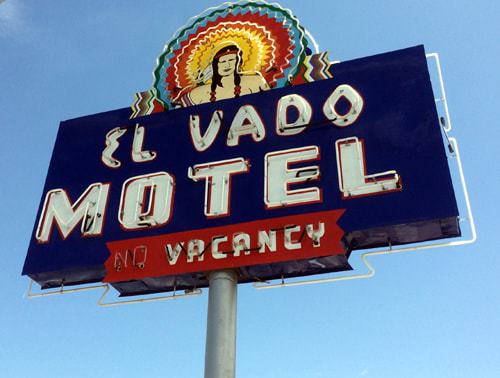
El Vado Motel Sign, Albuquerque, New Mexico
The motel had 32 units, some with covered carports, arranged in two parallel, one-story buildings facing a parking courtyard. When the motel opened, gas pumps were located along Central Avenue in front of the office. A flashy neon sign topped by an American Indian wearing a colorful headdress welcomed travelers on Route 66.
Murphy constructed the motel in the Spanish Pueblo Revival style. Purposely designed irregularities give the motel the look of the nearby Pueblos. These include curvilinear and straight parapets, irregular massing, varying buttresses, and exposed wooden roof beams. The motel office and lobby interior was ornately decorated in the Pueblo style. When the motel opened in 1937, the local business journal Albuquerque Progress described the units as “swanky tile cabin suites ready for the summer tourist trade.”
The El Vado retained a high degree of historical integrity for years because it was largely unaltered since its original construction. Route 66 historian David Kammer described the motel as “one of the best examples of a largely unaltered pre-World War II tourist court remaining along Route 66 in New Mexico.” Alterations over the years included removing the gas pumps in front of the motel office, adding a swimming pool, replacing original windows with metal double-hung windows, and painting Southwest Indian designs on the façade. The El Vado’s relatively unaltered appearance, spatial arrangement, remaining carports, and Spanish Pueblo Revival style conveyed a strong sense of the property’s era. The El Vado is historically significant for its association with automobile tourism along Route 66; its role as an auto court in shaping Albuquerque’s growth, appearance, and image; and its picturesque architectural style, designed to attract tourists and immerse travelers in the exoticism and mystique of the Southwest. It was listed in the National Register of Historic Places in 1993.
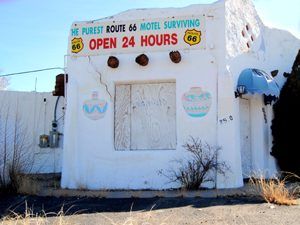
El Vado Motel before restoration, by Kathy Alexander.
Over the years, the motel changed hands a couple of times, and in 2005, with business dropping, the property was sold again, this time to a local developer who planned to tear the motel down and build luxury townhouses. However, Route 66 enthusiasts and historic preservationists lobbied to save the old auto court. The City of Albuquerque then stepped in and saved the El Vado. Plans called for refurbishing the site into a mixed-use development, including a community food court, amphitheater, boutique motel, and small events center.
For years, the old El Vado Motel sat behind a chain-link fence with peeling paint and a weed-choked courtyard.
However, after a 13-year hiatus, the historic El Vado Motel is again open to the traveling public. The 22-room motel features mid-century hand-made furnishings and one-of-a-kind local artwork. Part of an $18 million redevelopment, the motel is part of a complex that includes an events center, shops, restaurants, and a pub featuring local beers.
More Information:
El Vado Motel
2500 Central SW
Albuquerque, New Mexico 87104
(505) 361-1667
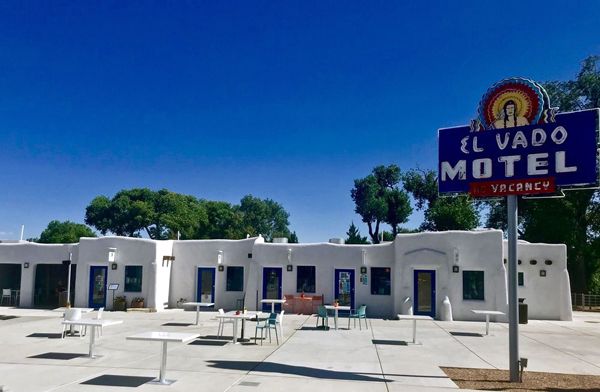
El Vado Motel today.
©Kathy Alexander/Legends of America, updated September 2026.
Also See:
Albuquerque – 300-Year-Old Duke City
See Sources.