
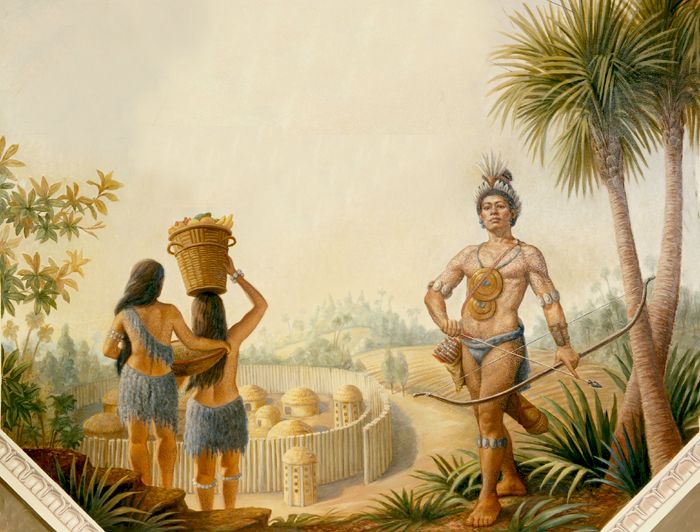
Timucuan People.
The Acuera tribe was part of the Timucuan linguistic division of the Muscogean Family. Located at the headwaters of the Ocklawaha River in Florida, the Spanish explorer Hernando de Soto first noted them in a letter written at Tampa Bay to the Civil Cabildo of Santiago de Cuba.
De Soto described where they lived as “a large town where with much convenience we might Winter.” Although the Spaniards did not pass through the village, they were sent to Acuera for corn while they were at Ocale. The name appears later in French explorer René Goulaine de Laudonnière’s narrative of the second French expedition to Florida in 1564-65 as a tribe allied with the Utina. Later, Spanish documents briefly noted them, and in 1604 they encountered Spanish troops.
By 1655, two Acuera missions—San Luis and Santa Lucia—had been established, but both disappeared by 1680. The Acuera’s inland position partly explains the few early descriptions of them. Later, the tribe was probably gathered into the “Pueblo de Timucua,” which stood near St. Augustine, Florida, in 1736 and was finally removed to the Mosquito Lagoon and Halifax River in Volusia County. The tribe is entirely extinct today.
Compiled by Kathy Alexander/Legends of America, updated September 2026.
Also See:
Native American Photo Galleries
Native Americans – First Owners of America
See Sources.