

Quapaw Indians.
The Quapaw people are a Siouan tribe closely related to the Kanza, Omaha, Osage, and Ponca. Their name translates to”Downstream People,” a name given because they went down the Missouri River while the rest of the Sioux went upriver.
The Quapaw people historically resided in four villages on the West side of the Mississippi River in what is now the state of Arkansas. They are the same as the Arkansas Nation. When they were encountered by the DeSoto expedition (1539-43), they were living in a fortified, walled city. Later, they were contacted by French explorers Jacques Marquette and Louis Jolliet in 1673.
In the larger villages, they saw well-crafted lodges, with most people living in longhouses with domed roofs covered in bark. Each longhouse held several families. The houses were arranged around an open area or plaza that included a roofed structure with open walls and a platform where public ceremonies were held and guests were received.
They practiced extensive agriculture, growing corn, beans, squash, pumpkins, gourds, and tobacco in fields near their villages. They also collected fruits, nuts, seeds, and roots; hunted deer, bears, buffalo, and smaller mammals; and fished seasonally. After contact with Europeans, melons, peaches, and chickens were raised.
In art, they were particularly noted for their red-on-white pottery designs.
The family was the basic unit of Quapaw social organization, with groups of families related through males joining clans. Clans were named for animals, heavenly bodies, or natural phenomena like thunder.
Each village had a leader who was advised by a council of male elders who managed their affairs independently from other villages. However, the village leaders would unite when matters concerned the entire tribe.
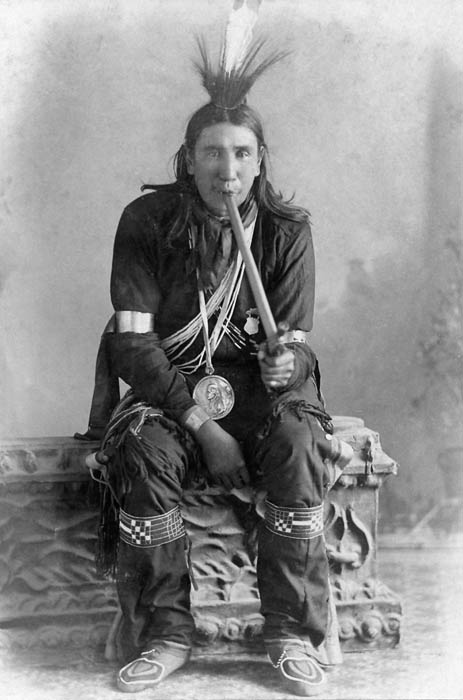
Tall Chief, also known as Louis Angel, was the last hereditary Quapaw chief. Photo 1892.
Quapaw population figures vary for the late 17th and 18th centuries, with estimates ranging from 3,500 to 7,500. However, after a smallpox epidemic in 1698, their population declined dramatically to about 800 to 1,200. Afterward, the numbers continued to decline due to epidemics and raids by other tribes, particularly the Chickasaw.
Ironically, the Quapaw and the French had an amicable relationship, as the French were usually at war with most other Native tribes. During the subsequent Spanish regime, the Quapaw helped defend the colony from invasion by Indians allied with the English.
The Quapaw tried to maintain their policy of peaceful coexistence when the United States purchased the Louisiana territory in 1803. At that time, about 555 people lived in three villages on the South bank of the Arkansas River. The tribe was forced to surrender their Arkansas lands to the U.S. government in 1818 and 1824. A Quapaw reservation was established in 1839 in northeastern Oklahoma.
During the Civil War, their land was so overrun by forces from both sides that tribal members fled en masse to Kansas to the Ottawa reservation. Later, most of the Quapaw returned to their Oklahoma land, which was allotted to them.
The Quapaw host cultural events throughout the year, primarily held at the tribal museum. These include Indian dice games, traditional singing, and classes in traditional arts, such as finger weaving, shawl making, and flute making. Each year, the tribe holds an annual dance and powwow during the Fourth of July weekend. Common features include dances, Indian football, hand games, traditional foot races, and dinners.
Their tribal headquarters are in northeastern Oklahoma in the town of Quapaw. They have more than 3,000 members today.
More Information:
Quapaw Nation
5681 South 630 Road
Quapaw, Oklahoma 74363
918-542-1853
©Kathy Alexander/Legends of America, updated October 2026.
Also See:
Native Americans – First Owners of America
Sources:
Arkansas Archaeological Survey
Encyclopedia of Arkansas
Encylopedia Britannica
Wikipedia