
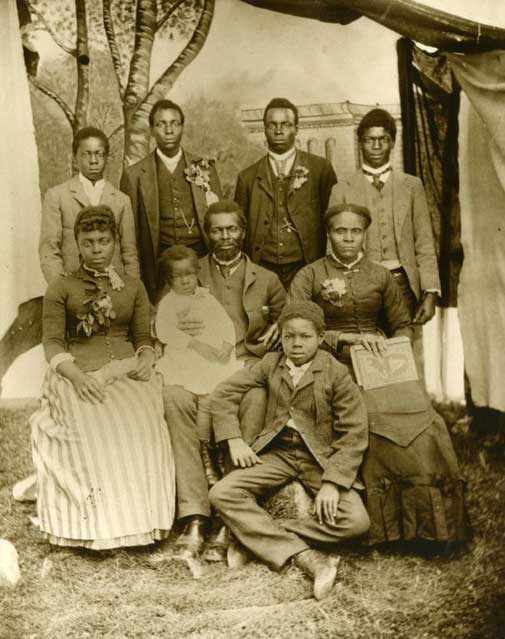
Former slave Nancy Gooch bought her son, Andrew Monroe, seated with a child on his lap at the center, and his family out of slavery and brought them to her farm in Coloma. Photo courtesy of the El Dorado County Historical Museum
By Anthony Belli.
During his lifetime, James W. Marshall became a living legend as the “discoverer of gold” in California. When Marshall died in 1885, a black man, his friend Andrew Monroe of Coloma, buried him. Andrew’s story begins with a slave woman named Nancy Gooch of Missouri; she was his mother.
In 1849, Nancy gave birth to Andrew, whom she left almost immediately behind in Missouri. She continued to California with her masters, arriving that same year amid the fervor of the Gold Rush. Nancy soon realized her freedom as the miners would not tolerate slave or peon labor in the diggings. California was admitted to the Union the following year, joining as a free state in 1850; by then, Gooch had been self-employed for nearly a year as a laundress and domestic for the miners.
She earned enough gold to return to Missouri and buy her son’s freedom; what year Andrew arrived in California is unclear, but he arrived as a young man married to his wife, Sarah Ellen.
In time, the Monroe family purchased 80 acres in Coloma and operated it as a fruit farm, which by the 1880s had expanded to 320 acres.
Sarah Ellen gave birth to nine children; two died at birth, and the family is buried in the Coloma Pioneer Cemetery. Beginning at the Marshall Monument in Coloma, the Monroe Ridge Trail honors this pioneer family.
Mrs. Ellen Mason arrived early in the diggings and was one of the first women on the Georgetown Divide. Born a slave, she became a free woman in 1849 and came West with thousands of others to man the California Gold Rush. Mrs. Mason worked long hours as a laundress for the miners, who always paid in gold. In time, she purchased her two sisters out of slavery, at which point all three settled in Georgetown. Mason remained a resident until she moved to Oakland in 1878, where she died in 1908 at age 96.
Settling along Weber Creek in 1870 were Addison and Florence Tiree. Addison was born a slave in Virginia, won his freedom, and moved to California, where he met his Indian wife, Florence Cadelia Tiree, who’d been raised and educated by a white Tulare County family. Although Addison is well remembered as a good man, neighbor, provider, and successful vintner, one year after arriving here, he would survive the first of many violent tragedies during his life.
While Addison was working in the vicinity of Morrill’s Bridge, Placerville resident James Riley had broken into the Tiree home and sadistically murdered Florence. The editor of the Mountain Democrat reported… “Addison Tiree found his wife dead, having been literally cut to pieces with a knife. The cuts entered below the knees to the throat and must have been a dozen in number.” Riley took $50, a revolver, a watch, and several items of his victim’s clothing. For the next twenty years, his identity would remain a secret.
Suspected by many in his wife’s slaying, Addison lived under a cloud of suspicion; two years after the death of Florence, he shot and killed a man on Main Street, Placerville, after being stabbed three times in an unprovoked attack. Although he was arrested, officers released him because they believed he acted in self-defense.
His own life came to a violent end on the 41st anniversary of Florence’s death when, returning home from Placerville one evening, his horses spooked. Tiree’s legs both became entangled in the runaway, dragging him for miles. He was found 20 hours later and transported to the County Hospital, where he died three days later at the age of 62.
During those 20 years from Florence’s death in 1871 until Riley confessed to the crime on his deathbed in 1891, Tiree relocated to Ringgold, where he married his second wife and developed a successful vineyard; he kept the school stocked with cut firewood. The couple attended all community social gatherings. His second wife frequently worked at the Governor’s Mansion for the First Lady and was a midwife in the Ringgold area.
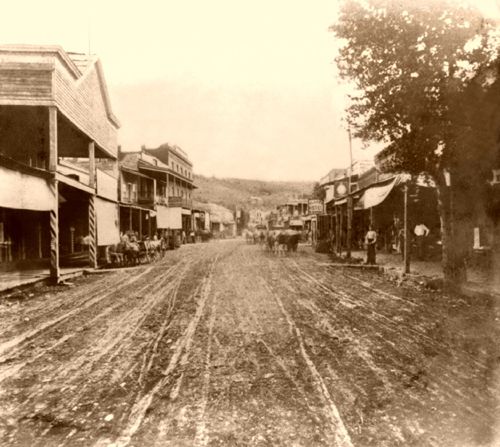
Placerville, California, 1866.
Born into slavery, Nelson Ray is thought to have been orphaned young and was raised by a white family, that of John and Velinda Ray of Missouri. Velinda died a widow in 1846 and freed Nelson in her will. In 1852, Nelson Ray arrived at Placerville, where he worked as a miner. His success in the mines was extraordinary; after one year, he had mined enough gold to buy his wife, Lucinda, and children out of slavery for $3,700.
The family settled in Placerville and owned the land where the Post Office stands today, along with several rental properties that provided income. He is also recognized for building a church in this same area with an all-Black congregation. From slavery to the frontier, Black men and women pioneers came to these Sierra foothills to build a better life for themselves and share in the American dream.
©Anthony Belli, 2004, updated September 2026.
*This story is dedicated to the memory of Andrew Jackson, a black miner who, in 1852, was lynched by a white mob at Negro Hill after it was alleged Jackson had stolen a $10 gold specimen. Without evidence or any hint of due process, Jackson was hanged in full view of the Negro quarter.
**Negro Hill, in its heyday, was a Gold Rush boomtown; although it took its name from the first four Black miners who discovered these diggings, the village was segregated into a white section, the Black quarter, and its own Chinatown.
Freedom is never given; it is won. — Asa Phillip Randolf
About the Author: Anthony M. Belli is a native of California currently living in the Sierras of El Dorado County. Having a background in law enforcement, he was the youngest police chief in Oregon history. Now, Belli is a recognized historian, writer, and lecturer on the California Gold Rush and serves on the research staff for the El Dorado County Museum. He has appeared on several television shows, writes for Lost Treasure Magazine, wrote the book Mysteries of Tahoe – Lost Treasure, and is currently working on a second book.
Also See: