

Stagecoach with a guard sitting on top, protecting whatever wealth it might have been carrying.
David C. Updyke was born near Cayuga Lake, New York, around 1830. Said to have been raised in an upstanding family that boasted some of the state’s leading citizens, Updyke was a black sheep.
In 1855, he went to California, where he worked for two years as a stage driver for the California Stage Company. Three years later, he sailed to British Columbia to look for other work, but finding nothing that suited him, he soon returned to California, spending two years in Yuba County and two years in Virginia City, Nevada.
By 1862, word was spreading of the rich gold finds in Idaho, and Updyke went first to Florence, then Warren. By the fall, he was in Boise County, where he worked a valuable claim on Ophir Mountain.
By 1864, he had saved more than $1,500 and went to Boise City, where he bought a livery stable in the center of town. Though Updyke had committed no known crimes up to this point, he had begun consorting with several criminals. Before long, the livery stable became the rendezvous site for some of the Old West’s most reckless bands of robbers and road agents.
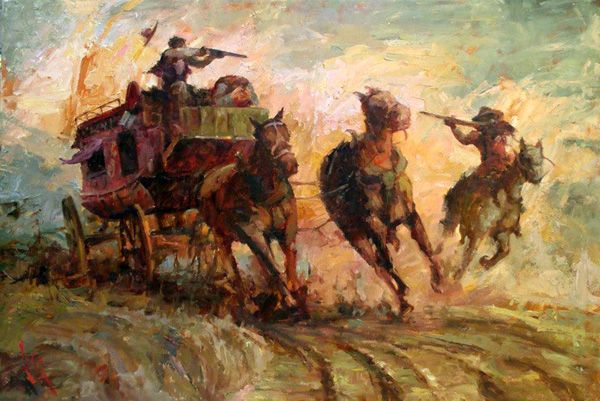
Stagecoach Robbery by Phil Lear.
However, this did not stop David Updyke from being elected Sheriff of Ada County in March 1864. Though many of his cohorts were ruffians, they were a strong force in the Democratic Party, and Updyke won the election by a small margin.
Before long, Updyke was suspected of aiding in the circulation of stolen gold dust and participating in a stage robbery near Boise City. So many rough characters began to hang about Updyke’s stable that many citizens began to refer to them as “Updyke’s Gang.” However, he and his outlaw friends covered their tracks so well that nothing could be proven.
Soon after his election, he vowed to break up a vigilante organization of about 30 men, which had been formed in the Payette River settlement, some 30 miles from Boise City. This enraged many law-abiding citizens who felt the vigilante committees were their only protection from thieving and murdering road agents in the area.
But Updyke cared little about what those law-abiding citizens thought and somehow obtained all the names of the men in the vigilante group, procuring warrants for their arrests. While the proceedings and warrants were all perfectly within the law, Updyke and his “posse” secretly planned to shoot the vigilante leaders and maintain that they had resisted arrest.
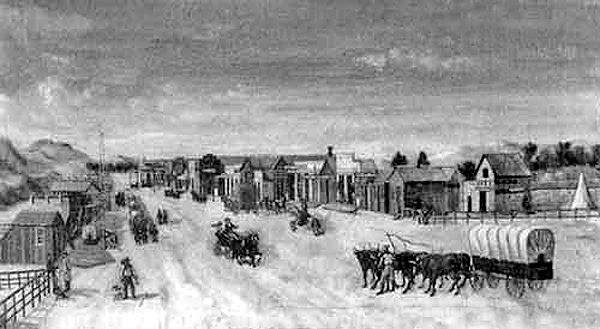
Boise City, Idaho, 1864.
The plan was for 15 to 20 armed men to leave Boise City, meet up with more road agents at Horseshoe Bend, and then proceed with their warrants to the Payette River settlement. However, word of the plan leaked to the citizens of Boise City, and they secretly dispatched a messenger to the Payette Vigilantes.
As Updyke’s “posse” left Boise City around 4:00 p.m. to carry out the arrests, the 30 members of the vigilante group assembled in self-defense. When Updyke and his men reached Horse Shoe Bend, they failed to connect with the county road agents and went on without them.
When the “posse” arrived at Payette River, they were surprised to find themselves outnumbered two to one. Forced to negotiate with the vigilantes, Updyke complied with their demands. The vigilantes agreed to go to Boise City to answer the warrants, but they would not allow Updyke or his men to disarm them. After arriving in Boise City and obtaining an attorney, the complaints against the vigilantes were dismissed, and they were discharged.
Afterward, the humiliated vigilantes were clearly bitter toward Updyke and began watching his every move closely. The public soon began to believe the “Updyke Gang” was behind nearly every theft, murder, and robbery that occurred anywhere in the area.
The next murderous outrage, in which the “Updyke Gang” was concerned, was the stage robbery in Portneuf Canyon, where four passengers were killed.
On July 26, 1865, Updyke and three other outlaws robbed a gold-laden stagecoach of some $86,000 in gold. Four stage passengers were killed in the melee, and the stage driver and another passenger were wounded.
The vigilante committee immediately went after the three other outlaws, but David Updyke was different. Having duly elected him Ada County Sheriff, the vigilantes were more cautious and waited for the opportune time to punish him for his suspected wrongdoings. On September 28, 1865, the Payette River Vigilance Committee arrested him for defrauding the revenue and failing to arrest a hard case outlaw named West Jenkins.
However, when Updyke made bail and learned of the Vigilance Committee’s reputation, he immediately left town and fled to Boise City, where he had more influence. However, citizens there, too, were fed up with the criminal elements and began forming groups to clean up the county. By the following spring, Updyke feared for his safety, and accompanied by another outlaw named John Dixon, the two departed Boise on the Rocky Bar Road on April 12, 1866. Unaware that a vigilante party was following them, the two spent the night in an abandoned cabin about 30 miles from town.
During the night, the vigilantes captured the unsuspecting pair and led them some ten miles farther down the road to Sirup Creek. The following day, as the vigilantes prepared to hang the men, they questioned Updyke about the whereabouts of the stolen cache. The crooked sheriff glared at them in contempt and refused to respond. The vigilantes then hanged both men under a shed between two vacant cabins. Updyke had only $50.00 on his person when he died.
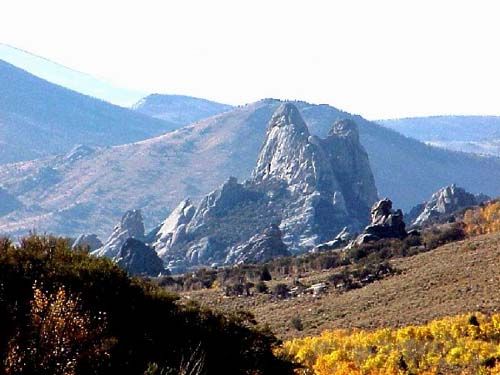
City of Rocks, Idaho.
On April 14, the bodies were found with a note pinned to Updyke’s chest accusing him of being “an aider of murderers and thieves.” The next day, an anonymous note appeared in Boise that further explained the committee’s actions. “Dave Updyke: Accessory after the fact to the Portneuf stage robbery, accessory and accomplice to the robbery of the stage near Boise City in 1864, a chief conspirator in burning property on the overland stage line, guilty of aiding and assisting the escape of West Jenkins, and the murderer of others while sheriff, and threatening the lives and property of an already outraged and long-suffering community.”
The gold taken in July 1865 has never been found, and many think it is buried somewhere in the City of Rocks.
©Kathy Alexander/Legends of America, updated October 2026.
Also See:
Portneuf Canyon, Idaho Stage Robbery
See Sources.