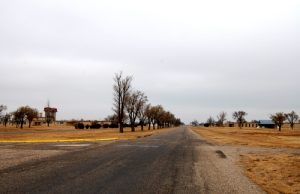
Amarillo Air Force Base by Kathy Alexander.
Route 66 passed right by Amarillo’s old English Field Airport and later through the Amarillo Air Force Base in its earliest days. This old segment is blocked by one of the country’s longest runways at what is now known as Rick Husband Amarillo International Airport.
In those early days of Route 66, the old road was still gravel and ran northwest from Conway, passing by English Field, established in 1929 by Harold English. Before English’s involvement, the area was used as early as 1920 by the Panhandle Aerial Service, which operated charters and performed air stunts at various events. When Harold English got involved in 1929, the airport was named English Airport and began to grow.
Soon, TWA’s forerunner, Transcontinental & Western Air, began the first commercial airline service through Amarillo. Later, Braniff International, Continental Airlines, and Trans-Texas Airways (later known as Texas International) provided additional flights to Lubbock and Dallas. TWA and other carriers expanded flights to various destinations as the airport grew.
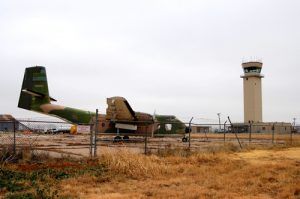
Old plane on English Field.
Adjacent to English Field, the Amarillo Army Air Field was established in April 1942. Under Colonel Edward C. Black’s command, the first troops arrived and began constructing several buildings. Before they were complete, the first classes began in September to train pilots and ground mechanics to service B-17 aircraft. For the next several years, classes continued and expanded to train for B-29 aircraft. However, the operation was closed on September 15, 1946, and its buildings were converted to peacetime uses or destroyed.
In March 1951, the post reactivated and was renamed Amarillo Air Force Base, becoming the first Air Force all-jet mechanic-training base, which also trained U.S. soldiers and trainees from foreign countries. Within just a year, the program had reached its planned maximum of 3,500 students and expanded; the installation grew to 5,000 by 1955. The base continued to develop, adding more technical training courses, including a missile-training department in 1957. The base relocated a supply and administration school from Wyoming the following year. In 1959, the base was re-designated as the Amarillo Technical Training Center when the 4128th Strategic Air Wing agreed with the Air Training Command. By May 1960, the jet-mechanic school had graduated about 100,000 students and trained thousands of others in administrative tasks, procurement, and supply.
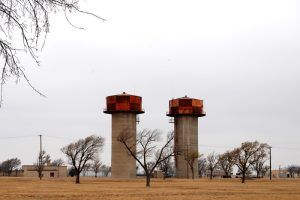
Old Amarillo, Texas Air Force Base by Kathy Alexander.
Things began to change when the U.S. Department of Defense began planning to close the base in 1964. In February 1966, it became the 3330th Basic Military School and graduated its last troops in December 1968. At the end of the month, the base closed forever, much to the chagrin of Amarillo-area businesses.
During its heyday, the base covered more than 5,000 acres and included a full-service hospital, a church, numerous training buildings, and housing for troops and officers.
Meanwhile, adjacent English Field also expanded, and by 1952, the name changed to Amarillo Air Terminal. After the base was closed, the land was converted to civilian use, and much of it became part of the Amarillo Air Terminal. The primary runway, built by the Strategic Air Command base at 13,502 feet, was for years the longest commercial runway in the United States, and it is still used by military pilots today. Today, only JFK International Airport in New York surpasses its length.
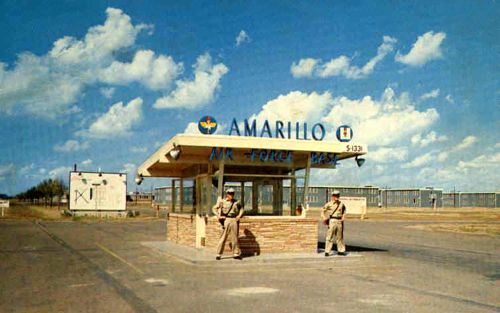
Amarillo Air Force Base while active.
In September 1970, the Amarillo branch of Texas State Technical Institute took over other facilities of the former base, which later became the East campus of Amarillo College. Individuals bought housing units, many of which remain in use today.
In 1976, the airport changed its name to Amarillo International Airport upon opening a U.S. Customs facility. In 2003, it was renamed again after fallen NASA astronaut and Amarillo native Richard Douglas Husband, who died in the Space Shuttle Columbia disaster in February 2003.
The extended runway, built for the Air Force base, bisected the original Route 66, which was rerouted into Amarillo. This old alignment is one of the few in Texas that cannot be traveled today. Mother Road enthusiasts must detour around the airport by traveling North to Highway 60 to join Amarillo Boulevard or return to I-40.
Old Route 66 ends at a high fence with restriction warnings. The best way to continue the journey is to head north to Highway 60, where you can see a couple of old service areas before the highway merges with Amarillo Boulevard, which still features numerous old travel stops along its East end.
The original English Field terminal building was converted into an Air Museum in 1997, but after a decade, it closed in 2007, and its exhibits were sold. Today, a tour through the old Air Force base shows several buildings in various states of disrepair. However, Amarillo College still uses many of them, though they’ve seen better days. The old base church is the best-kept building and still serves parishioners today.
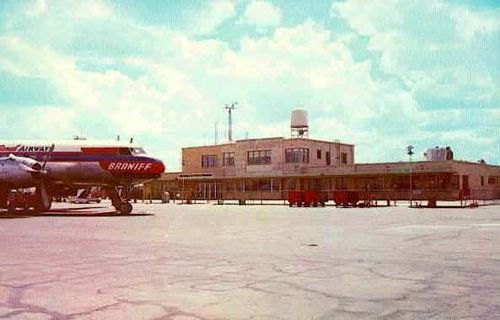
English Field in its heyday
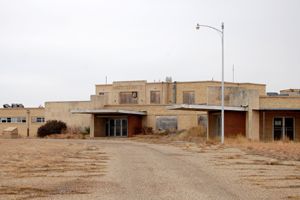
English Field today sits deteriorating on the Texas Plains, by Kathy Alexander.
©Kathy Alexander/Legends of America, updated September 2026.
Also See:
About Texas Route 66 – Info & History
See Sources.