|
 
Legends Home
Site Map
What's New!!
Content Categories:
American History
Destinations-States
Ghost Towns
Ghostly Legends
Historic People
Native Americans
Old West
Route 66
Travel Center
Treasure Tales
About Us
Advertising
Article/Photo
Use
Copyright
Information
Blog
Forum
Guestbook
Links
Newsletter
Privacy Policy
Writing Credits
We welcome corrections
and feedback!
Contact Us
Legends Of America's

Old West Mercantile
Route 66 Emporium
TeePee Trading Post
Book Shelf
History Tech
Postcard Rack
Wall Art
and
Much More!

Legends' Photo Prints

Ghost Town Prints
Native American
Prints
Old West Prints
Route 66 Prints
and
Much More!!

| |
| |
|
NEW
MEXICO LEGENDS
New Mexico Forts of the Old West |
|

|
|
<< Previous 1
2 Next >>
|
|
North Mexico Forts
Fort Bascom
Fort Bayard
Fort Burgwin
Fort Craig
Fort Cummings
Fort Fillmore
Fort Marcy
Fort Seldon
Fort Stanton
Fort Sumner
Fort Union
Fort Wingate
|

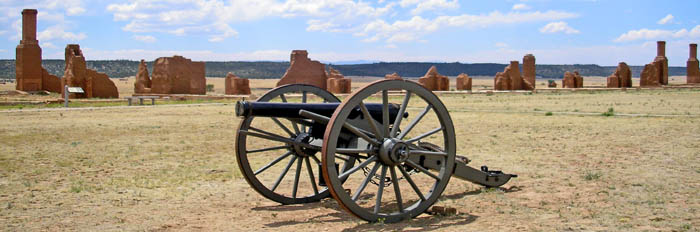
Fort Union today, June, 2006, Kathy
Weiser.
This image available for
photographic prints and downloads
HERE!
|
|
Fort
Bascom (1863-70) - Founded on the south bank of
the Canadian River in eastern
New Mexico during the
Civil War,
Fort Bascom has a short but distinguished history. It helped
control the Kiowa,
Comanche, and other tribes inhabiting the
Red and Canadian River region; watched over the
Goodnight-Loving Cattle Trail, as well as the
Santa Fe
Trail;
and policed the activities of the "Comancheros," American
and Mexican renegades who traded illegally with the
Indians.
The fort fielded several expeditions against the southern
Plains tribes.
Colonel Kit Carson led one of them, dispatched in
1864 by General Carleton, because of harassment of the
Santa Fe
Trail.
Carson clashed with a
village of Kiowa
in the Battle of Adobe Walls,
Texas.
Located on the Canadian River just
west of the Texas border in San Miguel County, it was one of a
series of forts established by General James Henry Carleton,
then acting commander of the military Department of
New Mexico, to control the
Comanche and
Kiowa
Indians who
frequented the Staked Plains of
Texas and the Rio Grande River
Valley. It was built on land leased from the owners of old
Pablo Montoya Grant and named for Captain George Bascom, who
died heroically at the
Battle of Valverde in February, 1862.
Though the post played an important role, it never was very
large, consisting of a sandstone officers' quarters and a few
adobe buildings.
Fort Bascom was also the base of
one of the three columns deployed by
General Philip Sheridan in his
1868-69 Indian campaign. In November and December, 1868 troops
moved down the Canadian River before turning northward to win
a resounding victory in the Battle of Soldier Spring,
Oklahoma
on Christmas Day.
The post was abandoned by the
military in 1870 and the land reverted back to the owner, John
S. Watts, from whom the government had leased the site. The
soldiers were then moved to
Fort Union. The poorly constructed
post was never fully finished and today, no remains have
survived. It is located on private land in a horseshoe bend on
the south side of the Canadian River, 12 miles north of
Tucumcari. Though it is accessible via unimproved roads from
Logan and New Mexico Highway 39, permission must be obtained
from the ranch owner to visit the site.

What was left of Fort Bascom in 1907. Over the
next century, the old post continued to deteriorate and
there is nothing left today.
|
|
|
|
Fort Bayard -
See full article
HERE.
Fort Burgwin -
See full article
HERE.
Fort Cummings
-
See full article
HERE.
|
|
Fort Fillmore (1851-1862) -
Located along the Rio Grande River not far from the Mexican
border and about six miles southeast of the town of Mesilla,
this tiny adobe fort was founded to control local
Apache and
protect the traders and settlers traveling to
California. It
was established by Colonel Edwin Vose Sumner in September,
1851 and named for President Millard Fillmore. During this
time, a number of forts were established by the Federal
Government to protect and encourage westward expansion. Fort
Fillmore specifically protected several migration routes that
converged between El Paso,
Texas and Tucson, Arizona.
By the end of the 1850's the post
had declined and fallen into serious disrepair. In 1861;
however, spurred by rumors of Confederate invasion of
New Mexico, the Army reinforced it with Major Isaac Lynde at the
command.
|

Fort Fillmore by Carl Schuchard, 1854 |
|
On July, 24, 1861, 250 troops of
the 2nd Texas Mounted Rifles, led by Lieutenant Colonel John
R. Baylor, crossed the Rio Grande River into Mesilla, which
had already declared itself a Confederate city. The Texas
soldiers were quickly joined by a company of
Arizona
Confederates.
Hearing of their arrival, Major
Lynde planned an attack upon the city the next day, resulting
in the First Battle of Mesilla, which resulted in a
Confederate victory. Failing in their attempt to take Mesilla,
the Federal garrison abandoned the fort and marched toward
Fort Stanton, New Mexico, but were captured east of Las
Cruces. Fort Fillmore was then claimed by the Confederates and
there was no attempt by the Union to reoccupy it. The
next summer,
California Volunteers temporarily occupied the
post before moving into Mesilla.
The fort was officially closed by the Union in October, 1862,
but, the site remained a way point along several major routes
throughout the period of western expansion. Over the years,
the small fort continued to deteriorate and fell into ruins.
Decades later, the owner of the land made an attempt to sell,
trade, or possibly donate the site to the State of
New Mexico,
if they would make it a park. However, the Parks Department
was budget strapped and other projects had more visible ruins
and higher historic profiles. In the end, the site was leveled
and planted with pecan trees. The site of the fort, is
situated on Fort Fillmore Road, about
1 ¼
miles east of
New Mexico
Highway 478. A State marker is located in the vicinity but not
at the actual site.
Continued Next Page
|
|
<< Previous 1
2 Next >>
|
|
From the Rocky Mountain General Store
Photo
Print Shop - Travel the trails of the
American
West with our many photographs! Just take a look at our
galleries or purchase prints at very reasonable prices! Here you'll
see photographs of
Route 66,
ghost towns,
scenic and historic views, and
roadside stops.
 |
| |
|