
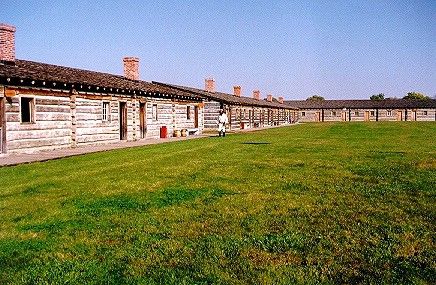
Fort Atkinson, Nebraska, Parade Grounds. Photo by Kathy Alexander.
By Addison Erwin Sheldon, 1913.
On the site of the Council Bluff, where Lewis and Clark first held council with the Indians, once stood Old Fort Atkinson, built in 1819, the first United States fort in Nebraska. The Rifle Regiment and the Sixth Infantry were here. It was a large, strong fort with 15 cannons and several hundred soldiers. Besides, the soldiers were teamsters, laborers, traders, hunters, trappers, and Indians, making a town of nearly a thousand people. They had a brickyard and a lime kiln. Rock was quarried from the ledges along the river. A sawmill and a grist mill were kept busy. Hundreds of acres of rich Nebraska land were farmed, and thousands of bushels of grain were raised. Roads ran in all directions from this fort on the Council Bluff.
Indians came to it from all parts of the West, for it was the most western army post in the United States. From far-off Santa Fe, Mexicans came here to meet the Pawnee Indians and make peace with them. White women were here.
Marriages and births occurred. Children played about the bluff, and the first school in Nebraska was taught here. Fort Atkinson was the largest town in early Nebraska and the only town in Nebraska at the time.
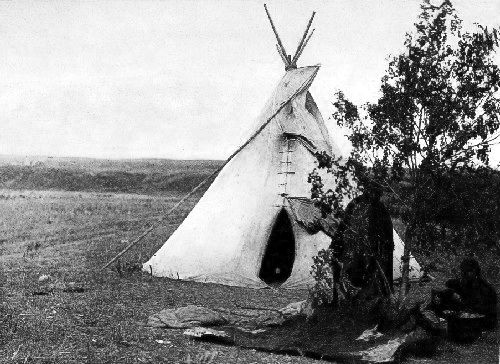
Arikara tipi, 1908, photo by Edward S. Curtis
In the summer of 1823, to this fort came the news that the Arikara Indians had fired upon a party of American trappers, and about 20 of them were killed. The Arikara were related to the Pawnee. They lived on the Missouri River in South Dakota, 500 miles above Fort Atkinson. They were different from the wild Indians on the plains, for they lived in villages surrounded by walls of dirt and fenced with timbers set on end in the ground. An Arikara had stolen horses from the trappers. They horsewhipped him. This led to the attack on the trappers.
When the news came, there were very busy times in the old fort on the Council Bluff. The bugles rang out, calling the soldiers to their colors. Cannon, powder, and shot were loaded into keelboats. The hunters and trappers at the fort seized their rifles. General Leavenworth started with over 200 soldiers. He was joined by 400 Sioux warriors, who were enemies of the Arikara, and by several parties of hunters and rivermen. It was a month’s march along the shores of the Missouri River to reach the Arikara villages. The keelboats with the cannon, powder, and food were pulled up the river with ropes. Never before had such an army been seen on the North Nebraska prairies. On August 8, they arrived at the Arikara villages.
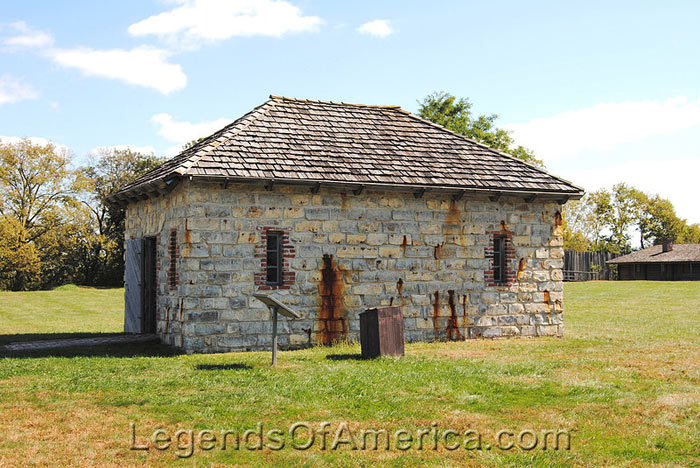
Fort Atkinson, NE, powder magazine. Photo by Kathy Alexander.
The cannons were placed on a hill, and their heavy balls fired into the village while the Sioux, under their chief White Bear, fought with the Arikara warriors outside the walls. Gray Eyes, chief of the Arikara, and about forty of his people were killed. The tribe sued for peace, and a treaty was made while the white soldiers and the Sioux feasted on roasting ears from the Arikara cornfields. No white soldiers were killed, and the army returned to Fort Atkinson. This is known as the Arikara War of 1823, the first war on the Nebraska frontier.
There was quiet for a long time at Fort Atkinson. We know that the fur traders came up the river in the summer, and keelboats from St. Louis, Missouri, brought stores and news from the world below. In the winter, sleds traveled across the snow to other posts. Hunting parties from the fort went out to kill the game for the soldiers. So many elk and deer were killed this way that the Omaha tribe could find no food on their old hunting grounds. Big Elk, chief of the tribe, came to the fort for help, saying that his people were starving while the soldiers killed and drove away the game.
In 1827, Fort Atkinson was abandoned by the United States. All the soldiers were sent down the Missouri River. They drove away a great herd of cattle that supplied them with beef. They left the cultivated fields to grow up with grass and weeds. All that was of use and could be carried was taken away. The buildings were left. The traders and hunters went to Bellevue and other posts down the river. It was said that the Indians burned the buildings after the soldiers were gone.
Fort Atkinson, NE, Quartermaster building. Photo by Kathy Alexander.
Six years later, Maximilian, the great German traveler, found the fort in ruins. The great stone chimneys stood, and a brick storehouse was still under the roof. Rattlesnakes made the place their home.
When the early settlers came to this part of Nebraska in 1854 and 1855, they were glad to find that the United States had provided them with a supply of brick and stone ready to use for their chimneys and cellars. They tore down the ruins and carried them away to their farms.
Today, the little village of Fort Calhoun, 16 miles north of Omaha, adjoins the site of Old Fort Atkinson. The summit of the Council Bluff may still be traced to the parade ground, where the flagstaff stood, the rows of cellars where once were the officers’ quarters, and the barracks where the soldiers lived. The ashes and broken brick where the grand fireplaces were may still be found, as well as the powder vault and the road running down Hook’s Hollow to the boat landing on the river.
When the people make gardens every spring, they plow up bullets and buttons named “Rifles” or the figure “6” for the Sixth Infantry. Gold and silver coins are also found. Most of them are Spanish coins with faraway dates, telling of the time when Spain ruled the greater part of America, and her coins were in commerce everywhere.
Such is the story of the Council Bluff and Old Fort Atkinson, the scene of the first council with Nebraska Indians, the site of the first fort, and the first important town in the state. It was the center of a busy life 100 years ago. Today, the Missouri River is three miles from the old landing beneath the bluff. The fort and its soldiers are gone. The Indian trader and hunter come no more. The Mexicans no longer cross the plains to make peace with the Pawnee. The very name of the old fort is forgotten. Yet here is one of the historical spots of early Nebraska whose memories should be cherished and whose story deserves to be told.
Today, this old fort has been rebuilt, and the area has been restored as Fort Atkinson State Historical Park.
Contact information:
Fort Atkinson State Historical Park
PO Box 240
Fort Calhoun, Nebraska 68023-0240
402-468-5611
By Addison Erwin Sheldon, 1913. Compiled and edited by Kathy Alexander/Legends of America, updated April 2026.
Also See:
Nebraska – The Cornhusker State
About the Article & Author: Excerpted from the book History and Stories of Nebraska by Addison Erwin Sheldon, 1913. Addison Erwin Sheldon (1861-1943) was the director of the Nebraska Historical Society and wrote numerous books devoted to the history of Nebraska. Sheldon also took and drew many of the photographs and illustrations in his many texts.