
This war was brought upon us by the children of the Great Father who came to take our land from us without price.”
— Spotted Tail
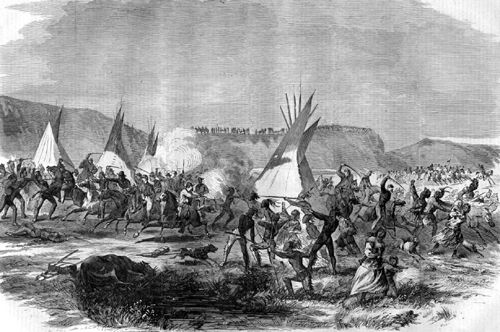
Sioux War, Harper’s Weekly, October 1863.
The exploration and settlement of the western United States by Americans and Europeans wreaked havoc on the Native Americans, whose history dates back thousands of years. In the 19th century, the western expansion of the United States clashed violently with the Native Americans who wished to preserve their lands, sovereignty, and ways of life. The struggle over frontier land erupted in numerous Indian Wars and skirmishes in the 1860s and 1870s.
In 1865, a congressional committee began a study of the Indian uprisings and wars in the West, resulting in a “Report on the Condition of the Indian Tribes,” which was released in 1867. This study led to the establishment of an Indian Peace Commission to end the wars and prevent future Indian conflicts. The United States government set out to establish a series of Indian treaties that would force the Indians to give up their lands and move further west onto reservations.
In the spring of 1868, a conference was held at Fort Laramie, Wyoming, which resulted in a treaty with the Sioux. The treaty brought peace between the whites and the Sioux, who agreed to settle within the Black Hills reservation in Dakota Territory.
The Black Hills are sacred to the Sioux. In the 1868 Fort Laramie Treaty, the United States recognized the Black Hills as part of the Great Sioux Reservation, and the land was set aside for exclusive use by the Sioux people.
In 1874, however, General George A. Custer led an expedition into the Black Hills, accompanied by miners who were seeking gold. Once gold was found in the Black Hills, prospectors quickly moved on to the Sioux’s sacred land by the thousands. Before long, the miners and settlers began to demand protection from the United States Army, which was ordered to move against wandering bands of Sioux hunting on the range by their treaty rights. In 1876, Custer, leading an army detachment, encountered the encampment of Sioux and Cheyenne at the Little Bighorn River. Custer’s detachment was annihilated, but the United States would continue its battle against the Sioux in the Black Hills until the government confiscated the land in 1877. To this day, ownership of the Black Hills remains the subject of a legal dispute between the U.S. Government and the Sioux.
Fort Laramie Treaty of 1868
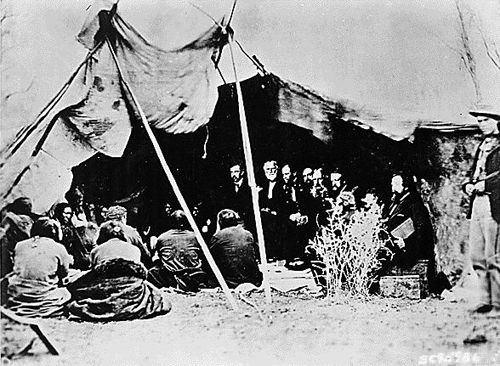
General William T. Sherman and Commissioners in Council with Indian Chiefs at Fort Laramie, Wyoming, 1868.
Articles of a treaty made and concluded by and between Lieutenant General William T. Sherman, General William S. Harney, General Alfred H. Terry, General C. C. Augur, J. B. Henderson, Nathaniel G. Taylor, John B. Sanborn, and Samuel F. Tappan, duly appointed commissioners on the part of the United States, and the different bands of the Sioux Nation of Indians, by their chiefs and headmen, whose names are hereto subscribed, they being duly authorized to act in the premises.
Article 1
From this day forward, all war between the parties to this agreement shall forever cease. The Government of the United States desires peace, and its honor is hereby pledged to keep it. The Indians desire peace and pledge their honor to maintain it. Suppose bad men among the whites, or other people subject to the authority of the United States, shall commit any wrong upon the person or property of the Indians. In that case, the United States will, upon proof made to the agent and forwarded to the Commissioner of Indian Affairs at Washington City, proceed at once to cause the offender to be arrested and punished according to the laws of the United States and also reimburse the injured person for the loss sustained.
Suppose bad men among the Indians shall commit a wrong or depredation upon the person or property of anyone, white, black, or Indian, subject to the authority of the United States and at peace, in addition to that. In that case, the Indians herein named solemnly agree that they will, upon proof made to their agent and notice by him, deliver up the wrong-doer to the United States, to be tried and punished according to its laws and in case they willfully refuse so to do, the person injured shall be reimbursed for his loss from the annuities or other money due or to become due to them under this or other treaties made with the United States.
And the President, on advising with the Commissioner of Indian Affairs, shall prescribe such rules and regulations for ascertaining damages under the provisions of this Article as in his judgment may be proper. However, no one sustaining loss while violating the provisions of this treaty or the laws of the United States shall be reimbursed.
Article 2
The United States agrees that the following district of country, to wit, viz: commencing on the east bank of the Missouri River where the 46th parallel of north latitude crosses the same, thence along low-water mark down said east bank to a point opposite where the northern line of the State of Nebraska strikes the river, thence west across said river, and along the northern line of Nebraska to the 104th degree of longitude west from Greenwich, thence north on said meridian to a point where the 46th parallel of north latitude intercepts the same, thence due east along said parallel to the place of beginning; and in addition thereto, all existing reservations on the east bank of said river shall be, and the same is, set apart for the absolute and undisturbed use and occupation of the Indians herein named, and for such other friendly tribes or individual Indians as from time to time they may be willing, with the consent of the United States, to admit amongst them; and the United States now solemnly agrees that no persons except those herein designated and authorized so to do, and except such officers, agents, and employees of the Government as may be authorized to enter upon Indian reservations in discharge of duties enjoined by law, shall ever be permitted to pass over, settle upon, or reside in the territory described in this Article, or in such territory as may be added to this reservation for the use of said Indians, and henceforth they will and do hereby relinquish all claims or right in and to any portion of the United States or Territories, except such as is embraced within the limits aforesaid, and except as hereinafter provided.
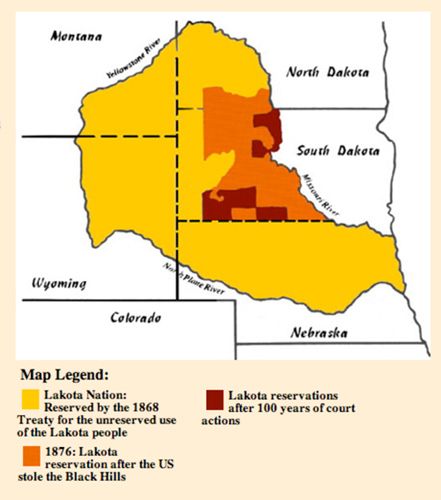
Sioux (Lakotah) Nation, courtesy Republic of Lakotah.
Article 3
Suppose it should appear from an actual survey or other satisfactory examination of said tract of land that it contains less than 160 acres of tillable land for each person who, at the time, may be authorized to reside on it under the provisions of this treaty, and a very considerable number of such persons shall be disposed to commence cultivating the soil as farmers. In that case, the United States agrees to set apart, for the use of said Indians, as herein provided, such additional quantity of arable land adjoining to the said reservation or as near to the same as it can be obtained, as may be required to provide the necessary amount.
Article 4
The United States agrees, at its own proper expense, to construct at someplace on the Missouri River, near the center of said reservation, where timber and water may be convenient, the following buildings, to wit: a warehouse, a store-room for the use of the agent in storing goods belonging to the Indians, to cost not less than $2,500; an agency-building for the residence of the agent, to cost not exceeding $3,000; a residence for the physician, to cost not more than $3,000; and five other buildings, for a carpenter, farmer, blacksmith, miller, and engineer, each to cost not exceeding $2,000; also a schoolhouse or mission-building, so soon as a sufficient number of children can be induced by the agent to attend school, which shall not cost exceeding $5,000.
The United States agrees further to cause to be erected on said reservation, near the other buildings herein authorized, a good steam circular sawmill, with a grist mill and shingle machine attached to the same, to cost not exceeding $8,000.
Article 5
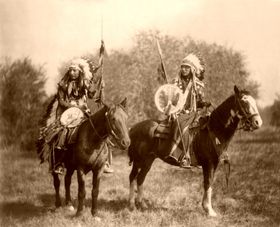
Sioux Indians on horseback, by Heyn, 1899.
The United States agrees that the agent for said Indians shall in the future make his home at the agency-building; that he shall reside among them, and keep an office open at all times for the purpose of prompt and diligent inquiry into such matters of complaint by and against the Indians as may be presented for investigation under the provisions of their treaty stipulations, as also for the faithful discharge of other duties enjoined on him by law. In all cases of depredation on person or property, he shall cause the evidence to be taken in writing and forwarded, together with his findings, to the Commissioner of Indian Affairs, whose decision, subject to the revision of the Secretary of the Interior, shall be binding on the parties to this treaty.
Article 6
If any individual belonging to said tribes of Indians, or legally incorporated with them, being the head of a family, shall desire to commence farming, he shall have the privilege to select, in the presence and with the assistance of the agent, then in charge, a tract of land within said reservation, not exceeding 320 acres in extent, which tract, when so selected, certified, and recorded in the “land-book,” as herein directed, shall cease to be held in common, but the same may be occupied and held in the exclusive possession of the person selecting it, and of his family, so long as he or they may continue to cultivate it.
Any person over 18 years of age, not being the head of a family, may, in like manner, select and cause to be certified to him or her, for purposes of cultivation, a quantity of land not exceeding 80 acres in extent, and thereupon be entitled to the exclusive possession of the same as above directed.
For each tract of land so selected a certificate, containing a description thereof and the name of the person selecting it, with a certificate endorsed thereon that the same has been recorded, shall be delivered to the party entitled to it, by the agent, after the same shall have been recorded by him in a book to be kept in his office, subject to inspection, which said book shall be known as the “Sioux Land-Book.”
The President may, at any time, order a survey of the reservation, and when so surveyed, Congress shall provide for protecting the rights of said settlers in their improvements and may fix the character of the title held by each. The United States may pass such laws on the subject of alienation and descent of property between the Indians and their descendants as may be thought proper. And it is further stipulated that any male Indians, over 18 years of age, of any band or tribe that is or shall hereafter become a party to this treaty, who now is or who shall hereafter become a resident or occupant of any reservation or Territory not included in the tract of country designated and described in this treaty for the permanent home of the Indians, which is not mineral land, nor reserved by the United States for special purposes other than Indian occupation, and who shall have made improvements thereon of the value of $200 or more, and continuously occupied the same as a homestead for the term of three years, shall be entitled to receive from the United States a patent for 160 acres of land including his said improve-meats, the same to be in the form of the legal subdivisions of the surveys of the public lands.
Upon application in writing, sustained by the proof of two disinterested witnesses, made to the register of the local land office when the land sought to be entered is within a land district and when the tract sought to be entered is not in any land district, then upon said application and proof being made to the Commissioner of the General Land Office. The right of such Indian or Indians to enter such tract or tracts of land shall accrue and be perfect from the date of his first improvements thereon and shall continue as long as he continues his residence and improvements, and no longer. And any Indian or Indians receiving a patent for land under the foregoing provisions shall thereby and from thenceforth become and be a citizen of the United States, and be entitled to all the privileges and immunities of such citizens, and shall, at the same time, retain all his rights to benefits accruing to Indians under this treaty.
Article 7
To ensure the civilization of the Indians entering into this treaty, the necessity of education is admitted, especially of such of them as are or may be settled on said agricultural reservations, and they therefore pledge themselves to compel their children, male and female, between the ages of six and 16 years, to attend school; and it is hereby made the duty of the agent for said Indians to see that this stipulation is strictly complied with; and the United States agrees that for every 30 children between said ages who can be induced or compelled to attend school, a house shall be provided and a teacher competent to teach the elementary branches of an English education shall be furnished, who will reside among said Indians, and faithfully discharge his or her duties as a teacher. The provisions of this Article shall continue for not less than 20 years.
Article 8
When the head of a family or lodge shall have selected lands and received his certificate as above directed, and the agent shall be satisfied that he intends in good faith to commence cultivating the soil for a living, he shall be entitled to receive seeds and agricultural implements for the first year, not exceeding in value $100. For each succeeding year, he shall continue to farm, for a period of three years more, he shall be entitled to receive seeds and implements as aforesaid, not exceeding in value $25.
And it is further stipulated that such persons as commence farming shall receive instruction from the farmer herein provided for. Whenever more than 100 persons shall enter upon the cultivation of the soil, a second blacksmith shall be provided with such iron, steel, and other material as may be needed.
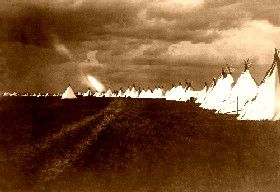
Sioux Tipis, 1902.
Article 9
At any time after ten years from the making of this treaty, the United States shall have the privilege of withdrawing the physician, farmer, blacksmith, carpenter, engineer, and miller herein provided for, but in case of such withdrawal, an additional sum thereafter of $10,000 per annum shall be devoted to the education of said Indians, and the Commissioner of Indian Affairs shall, upon careful inquiry into their condition, make such rules and regulations for the expenditure of said sum as will best promote the educational and moral improvement of said tribes.
Article 10
In lieu of all sums of money or other annuities provided to be paid to the Indians herein named, under any treaty or treaties heretofore made, the United States agrees to deliver at the agency-house on the reservation herein named, on or before the first day of August of each year, for 30 years, the following Articles, to wit:
For each male person over 14 years of age, a suit of good, substantial woolen clothing, consisting of a coat, pantaloons, a flannel shirt, a hat, and a pair of home-made socks.
For each female over twelve years of age, a flannel skirt or the goods necessary to make it, a pair of woolen hose, twelve yards of calico, and twelve yards of cotton domestics.
For the boys and girls under the ages named, such flannel and cotton goods may be needed to make each a suit as aforesaid, together with a pair of woolen hoses.
And so that the Commissioner of Indian Affairs may be able to estimate properly for the articles herein named, it shall be the duty of the agent each year to forward to him a full and exact census of the Indians, on which the estimate from year to year can be based.
And in addition to the clothing herein named, the sum of $10 for each person entitled to the beneficial effects of this treaty shall be annually appropriated for a period of 30 years while such persons roam and hunt, and $26 for each person who engages in farming, to be used by the Secretary of the Interior in the purchase of such Articles as from time to time the condition and necessities of the Indians may indicate to be proper. And if within the 30 years, at any time, it shall appear that the amount of money needed for clothing under this Article can be appropriated to better uses for the Indians named herein, Congress may, by law, change the appropriation to other purposes; but in no event shall the amount of this appropriation be withdrawn or discontinued for the period named.
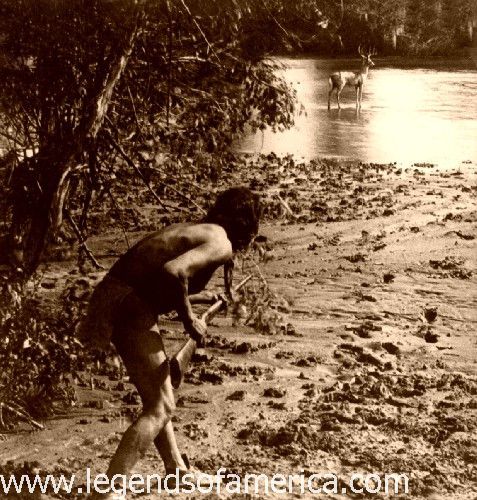
Sioux Hunter 1908.
And the President shall annually detail an officer of the Army to be present and attest the delivery of all the goods herein named to the Indians, and he shall inspect and report on the quantity and quality of the goods and the manner of their delivery. And it is hereby expressly stipulated that each Indian over the age of four years, who shall have removed to and settled permanently upon said reservation and complied with the stipulations of this treaty, shall be entitled to receive from the United States, for the period of four years after he shall have settled upon said reservation, one pound of meat and one pound of flour per day, provided the Indians cannot furnish their own subsistence at an earlier date. And it is further stipulated that the United States will furnish and deliver to each lodge of Indians or family of persons legally incorporated with them, who shall remove to the reservation herein described and commence farming, one good American cow and one good well-broken pair of American oxen within 60 days after such lodge or family shall have so settled upon said reservation.
In consideration of the advantages and benefits conferred by this treaty and the many pledges of friendship by the United States, the tribes who are parties to this agreement hereby stipulate that they will relinquish all right to occupy permanently the territory outside their reservation as herein defined, but yet reserve the right to hunt on any lands north of North Platte, and on the Republican Fork of the Smoky Hill River, so long as the buffalo may range thereon in such numbers as to justify the chase. And they, the said Indians, further expressly agree:
1st – That they will withdraw all opposition to the construction of the railroads now being built on the plains.
2d – That they will permit the peaceful construction of any railroad not passing over their reservation as herein defined.
3d – That they will not attack any persons at home, or traveling, nor molest or disturb any wagon trains, coaches, mules, or cattle belonging to the people of the United States, or to persons friendly therewith.
4th – They will never capture, or carry off from the settlements, white women or children.
5th – They will never kill or scalp white men, nor attempt to do them harm.
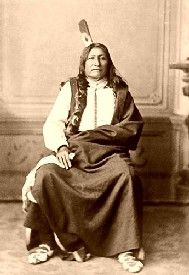
Brule Sioux Chief Spotted Tail.
6th – They withdraw all pretense of opposition to the construction of the railroad now being built along the Platte River and westward to the Pacific Ocean. They will not in future object to the construction of railroads, wagon roads, mail-stations, or other works of utility or necessity, which may be ordered or permitted by the laws of the United States. But should such roads or other works be constructed on the lands of their reservation, the Government will pay the tribe whatever amount of damage may be assessed by three disinterested commissioners to be appointed by the President for that purpose, one of said commissioners to be a chief or headman of the tribe.
7th – They agree to withdraw all opposition to the military posts or roads now established south of the North Platte River, or that may be established, not in violation of treaties heretofore made or hereafter to be made with any of the Indian tribes.
Article 12
No treaty for the cession of any portion or part of the reservation herein described which may be held in common shall be of any validity or force as against the said Indians, unless executed and signed by at least three-fourths of all the adult male Indians, occupying or interested in the same; and no cession by the tribe shall be understood or construed in such manner as to deprive, without his consent, any individual member of the tribe of his rights to any tract of land selected by him, as provided in Article 6 of this treaty.
Article 13
The United States hereby agrees to furnish annually to the Indians the physician, teachers, carpenter, miller, engineer, farmer, and blacksmiths as herein contemplated, and that such appropriations shall be made from time to time, on the estimates of the Secretary of the Interior, as will be sufficient to employ such persons.
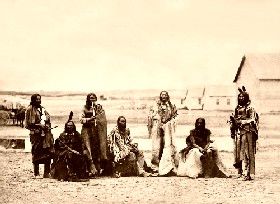
Spotted Tail, Roman Nose, Old Man Afraid of His Horses, Lone Horn, Whistling Elk, Pipe, and Slow Bull at Fort Laramie, Wyoming in 1868.
Article 14
It is agreed that the sum of $500 annually, for three years from the date, shall be expended in presents to the ten persons of said tribe who, in the judgment of the agent, may grow the most valuable crops for the respective year.
Article 15
The Indians herein named agree that when the agency-house or other buildings shall be constructed on the reservation named, they will regard said reservation as their permanent home, and they will make no permanent settlement elsewhere, but they shall have the right, subject to the conditions and modifications of this treaty, to hunt, as stipulated in Article 11 hereof.
Article 16
The United States hereby agrees and stipulates that the country north of the North Platte River and east of the summits of the Big Horn Mountains shall be held and considered to be unceded Indian territory, and also stipulates and agrees that no white person or persons shall be permitted to settle upon or occupy any portion of the same; or without the consent of the Indians first had and obtained, to pass through the same; and it is further agreed by the United States that within 90 days after the conclusion of peace with all the bands of the Sioux Nation, the military posts now established in the territory in this Article named shall be abandoned and that the road leading to them and by them to the settlements in the Territory of Montana shall be closed.
Article 17
It is hereby expressly understood and agreed by and between the respective parties to this treaty that the execution of this treaty and its ratification by the United States Senate shall have the effect and shall be construed as abrogating and annulling all treaties and agreements heretofore entered into between the respective parties hereto, so far as such treaties and agreements obligate the United States to furnish and provide money, clothing, or other Articles of property to such Indians and bands of Indians as become parties to this treaty, but no further.
In testimony of all which, we, the said commissioners, and we, the chiefs and headmen of the Brulé band of the Sioux Nation, have hereunto set our hands and seals at Fort Laramie, Dakota Territory, this 29th day of April, in the year 1868.
Compiled by Kathy Alexander/Legends of America, updated April 2026.
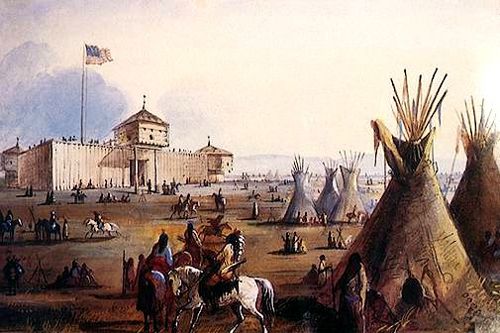
Fort Laramie, Wyoming, painting by Alfred Jacob Miller. Walters Art Gallery.
Also See:
Fort Laramie – Crossroads to the West
Source: National Archives