
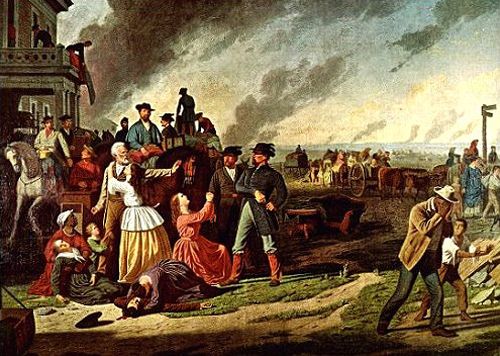
Evacuation of Missouri Counties under General Order No. 11, by George Caleb Bingham, 1870. The original painting is held in the Cincinnati Art Museum, Cincinnati, Ohio
During the early years of the Civil War, bands of guerrillas and bushwhackers were harbored and supported by the people of some of the western counties of Missouri, from which they would make frequent raids across the border into Kansas. The notorious William Quantrill made the most destructive of these raids upon the City of Lawrence, Kansas, on August 21, 1863. The raid was devastating, leaving most of the town burned and about 180 men and boys dead. The attack was allegedly in retaliation for a civilian attack made on Osceola, Missouri, by James H. Lane and Union forces two years earlier.
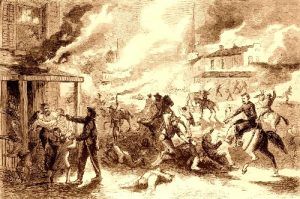
Lawrence, Kansas Massacre.
As the ruins of the Lawrence Massacre were still smoldering, General Thomas Ewing, who was in command of the District of the Border and was in charge of repelling guerrilla raids, was severely criticized by the citizens of Kansas for his dereliction.
Whether or not Ewing and those under his command were negligent in performing their duties, Ewing undoubtedly felt the effects of this criticism and anger. On August 25, 1863, just four days after the Lawrence Massacre, he issued his famous “General Order No. 11,” which was as follows:
“I — All persons living in Jackson, Cass, and Bates Counties, Missouri, and in that part of Vernon included in this district, except those living within one mile of the limits of Independence, Hickman Mills, Pleasant Hill, and Harrisonville, and except those in that part of Kaw Township, Jackson County, north of Brush Creek and west of the Big Blue River, are hereby ordered to remove from their present places of residence within fifteen days from the date hereof.
“Those who, within that time, establish their loyalty to the satisfaction of the commanding officer of the military station nearest their present places of residence will receive from him certificates stating the fact of their loyalty and the names of the witnesses by whom it can be shown. All who receive such certificates will be permitted to remove to any military station in this district or to any part of the State of Kansas except the counties on the eastern border of the state. All others shall remove from this district. Officers commanding companies and detachments in the counties named will see that this paragraph is promptly obeyed.
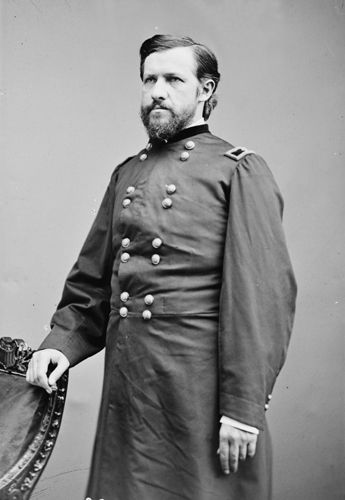
General Thomas Ewing during the Civil War.
“II — All grain and hay in the field or under shelter, in the districts from which the inhabitants are required to remove, within reach of military stations, after the 9th day of September next, will be taken to such stations and turned over to the proper officers there; and report of the amount so turned over made to district headquarters, specifying the names of all loyal owners, and the amount of such produce taken from them. All grain and hay found in such district after the 9th day of September next, not convenient to such stations, will be destroyed.
“III — The provisions of General Orders No. 10 from these headquarters will be at once vigorously executed by officers commanding in the parts of districts, and at the stations, not subject to the operation of Paragraph I of this order — and especially in the towns of Independence, Westport, and Kansas City.
“IV — Paragraph 3, General Orders No. 10, is revoked as to all who have borne arms against the government since the 20th day of August 1863.”
General Order No. 10 provided for an escort to all loyal persons desiring to remove to a military post in the district; ordered the arrest of all persons, except women, who as heads of families, gave aid to guerrillas; wives and children of known guerrillas, women, who as heads of families willfully engaged in assisting guerrillas, were to remove out of the district unmolested, and if they refused to remove they were to be taken to Kansas City for shipment to some point within the Confederate lines.
The clause rescinded by Paragraph 4 of General Order No. 11 provided that persons who laid down their arms and surrendered themselves to be banished with their families were sent to such point as the commanding officer might direct.
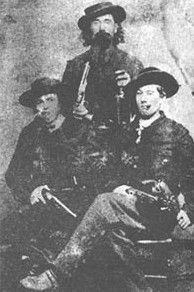
Missouri Border Ruffians, also called Bushwhackers.
General Order No. 11 aimed to prevent guerrillas, particularly Quantrill’s Raiders, from finding lodging, food, and supplies among the Confederate sympathizers in western Missouri. The order served a good purpose by breaking up the guerrillas’ rendezvous and checking their forays into Kansas. Loyal men in both states applauded General Thomas Ewing for his courage and foresight in issuing it.
In enforcing the order, Ewing commanded his men to avoid looting or depredations. However, he could not control his troops, many of whom were Kansans eager to exact any revenge upon their Missouri neighbors. The soldiers wasted no time wreaking havoc on the area, stealing property, and burning homes and outbuildings. As the Missouri residents fled, all that was left of many once-fertile farms were charred chimneys and burned fields.
Ironically, Ewing’s order failed miserably, having the opposite effect. Though Missouri had always held numerous Confederate sympathizers, those who would not have aided the guerrillas in the past were so angered by the destruction by the soldiers that they began to assist them. Those who had helped went out of their way to assist even more.
Although the Federal Government upheld the order, Ewing also faced considerable criticism from both politicians and his military superiors. Some months later, he issued General Order No. 20, which permitted loyal citizens to return home and for the men to organize companies for defense.
After the Civil War, Ewing would continue to feel the effects of his order when, at the Democratic National Convention in New York City on July 6, 1868, he was defeated for the Vice Presidential nomination.
Compiled by Kathy Alexander/Legends of America, updated June 2026.
About the Article: Some of this historic text was published in Kansas: A Cyclopedia of State History, Volume I; edited by Frank W. Blackmar, A.M. Ph. D.; Standard Publishing Company, Chicago, IL 1912. However, the text on this page has been heavily edited, with many additions.
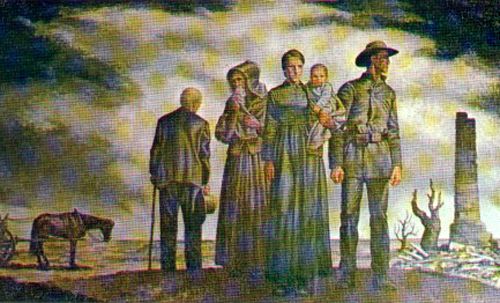
The devastation left by General Order 11
Also See:
Bleeding Kansas and the Missouri Border War
Civil War (Main Page)
Legends Of Kansas (Website dedicated to the state where Legends Of America was founded)