
Life would be infinitely happier if we could only be born at the age of 80 and gradually approach 18.
— Mark Twain

Fountain of Youth historic depiction.
For centuries, the search for eternal youth or extended life has been a frequent theme in myths and legends from around the world. One of the earliest accounts is from the Greek historian Herodotus in the 5th century BC, who wrote of a fountain of youth in the land of the Macrobians that gave the people of the region exceptionally long lifespans. Alexander the Great searched for the fountain of youth in the 4th century BC. He was said to have come across a healing “river of paradise,” and the legendary King Prester John claimed to rule a land with a fountain of youth during the early Crusades of the 11th and 12th centuries AD. In Japan, stories of hot springs that could heal wounds and restore youth were also common, and still are today. Similar stories were prominent among the Caribbean people during the early 16th century, who spoke of the restorative powers of the water in the mythical land of Bimini. Similar legends have been found in the Canary Islands, Polynesia, and England.
Based on these many legends, explorers and adventurers have long sought the elusive Fountain of Youth or, at least, some remedy for aging, which was most often associated with magical waters. These waters were not necessarily a fountain but might have been a river, a spring, or another water source, said to reverse the aging process and cure sickness when drunk or bathed in.
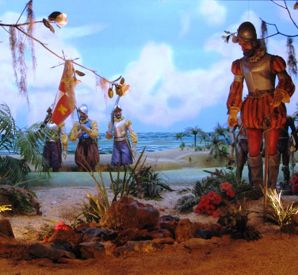
Juan Ponce de Leon.
The name most closely linked to the search for a fountain of youth is that of 16th-century Spanish explorer Juan Ponce de Leon, who allegedly believed it would be found in Florida.
In 1493, Ponce de Leon sailed with Christopher Columbus on Columbus’ second voyage to the Americas. He and his family settled on an island in the Caribbean called Hispaniola (the Dominican Republic). He became a military commander at this post and was appointed deputy governor. In 1505, he helped crush a Taino rebellion on Hispaniola and, as a reward, was granted a provincial governorship and hundreds of acres of land, on which he used forced Indian labor to raise crops and livestock.
In 1506, he discovered a nearby island named Borinquen, where he found large deposits of gold. He returned to the island in 1508 on orders from the king of Spain to explore and colonize it. He renamed the island Puerto Rico and served as its governor for two years, until the king replaced him with Columbus’ son, Diego.
Hurt by the King’s action, Ponce de Leon sailed again, this time north through the Bahamas heading towards Florida. He was in search of new lands and treasures. He had also heard of a mythical fountain of youth. Indians spoke of a legendary, magical spring whose water was believed to make older people young again. Ponce de León explored many areas, including the Bahamas and Bimini, in search of both gold and the mythical fountain, but he found neither. In early April 1513, his ships landed on Florida’s East coast near present-day St. Augustine. He claimed the area for Spain and named it La Florida or “the place of flowers.” Afterward, he continued his exploration of the coast, making his way down through the Florida Keys and up the western coast, where he skirmished with Indians. He then began to journey to Puerto Rico, where he purportedly discovered the Gulf Stream.
He returned to Spain and was named a Captain-General by the King on September 27, 1514. His last expedition was in search of the island of Bimini in 1521. His force of 200 men landed on the West coast of Florida but were met by Native American warriors, who wounded many of the men with arrows, including Ponce de Leon. He later died in Havana, Cuba, from this wound in July 1521. He is buried in San Juan, Puerto Rico.
Though the legend persists that these journeys were undertaken in an effort to find the Fountain of Youth, de Leon’s documents and letters make no mention of such a fountain or a search for magical waters. It was only later that writers began to connect Juan Ponce de Leon to the elusive Fountain of Youth. Instead, the documentation focuses on colonization, the spread of Christianity, and determining whether Florida was an island or a peninsula. Historians believe that de Leon was much more interested in searching for islands to gain another profitable governorship.
Although no evidence exists, historians have long linked Ponce de León to the Fountain of Youth, a link that began shortly after his death. In 1535, Gonzalo Fernández de Oviedo y Valdes, a Spanish historian and writer, accused Ponce de León of seeking the fountain to cure his sexual impotence. This, however, was highly unlikely, as de Leon had fathered several children and was under 40 at the time of his first expedition. While a few historians of the time disputed his search for the Fountain of Youth, others quickly picked up on de Leon’s alleged search and perpetuated the legend.
When the Spanish ceded Florida to the United States in 1819, American writers joined in continuing the legend and building Ponce de León’s name. By the early 20th century, a statue of de Leon was placed in the central plaza of St. Augustine, and a nearby tourist attraction pretended to be the actual Fountain of Youth. To this day, numerous sources still state that de Leon’s primary objective was to find the magical waters.
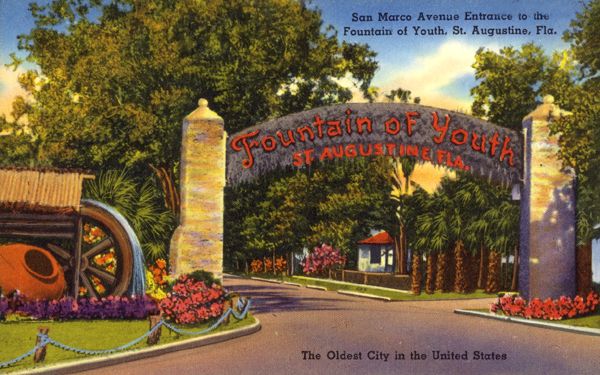
Fountain of Youth, Florida.
Today, legends meet history at the Fountain of Youth Archaeological Park, where thousands of visitors come each year to sample the sulfur-smelling water. Located in the area first explored by Juan Ponce de Leon in 1513 and settled by Pedro Menendez de Aviles in 1565, a coquina building houses a spring first recorded in a 17th-century Spanish Land Grant. With signed guest books stretching back to 1868, the Fountain of Youth is the oldest attraction in Florida. The spring issues forth directly from the Floridian aquifer, which lies below ground under much of North Florida. The water contains over 30 minerals, and many believe that it has healthful properties.
The Smithsonian Institution conducted the first archaeological digs at the Fountain of Youth in 1934, which uncovered numerous Christianized Timucua Indian burials. These burials eventually identified the Park as the site of the first Christian Mission in the United States, the Mission of Nombre de Dios, established by Franciscan friars in 1587. Subsequent decades have seen the unearthing of artifacts that positively identify the Park as the site of Pedro Menendez de Aviles’ 1565 settlement of St. Augustine, the oldest continuously inhabited European settlement in North America. The park currently exhibits native and colonial artifacts to celebrate St. Augustine’s Timucua and Spanish heritage.
©Kathy Alexander/Legends of America, updated June 2026.
Also See:
Folklore & Superstition in America
Juan Ponce de Leon – Spanish Explorer
St. Augustine, Florida – Oldest U.S. City
Sources:
Fountain of Youth
History.com
National Geographic
Wikipedia