
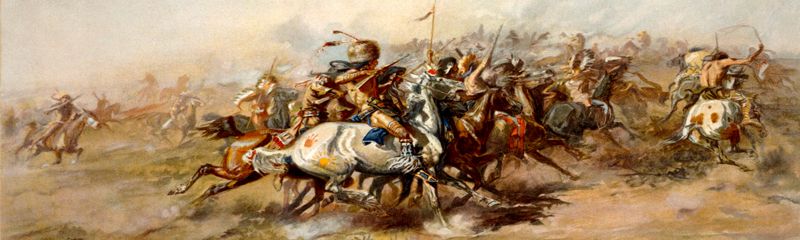
Battle of the Little Bighorn by Charles M. Russell, 1903.
The Battle of the Little Bighorn, also known as Custer’s Last Stand, was an engagement between the combined forces of the Lakota and Northern Cheyenne tribes and the 7th Cavalry of the United States Army. The most famous of the Indian Wars, the remarkable victory for the Lakota and Northern Cheyenne, occurred over two days on June 25-26, 1876, near the Little Bighorn River in eastern Montana Territory. The U.S. cavalry detachment, commanded by Lieutenant Colonel George Armstrong Custer, lost every soldier in his unit.
In late 1875, the Sioux and Cheyenne Indians defiantly left their reservations, outraged over the continued intrusions of whites into their sacred lands in the Black Hills. Soon, the recalcitrant Indians gathered in Montana with the great warrior Sitting Bull to fight for their lands. The following spring, two victories over the U.S. Cavalry emboldened them to fight in the summer of 1876.
On November 9, 1875, U.S. forces were sent to attack the Indians based on a report by an Indian Inspector that stated hundreds of Lakota and Northern Cheyenne, associated with Sitting Bull and Crazy Horse, were hostile to the U.S. interest in Indian lands. The gold-rich Black Hills also played an important role in the attack.
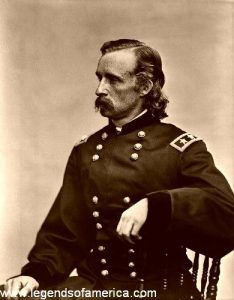
George A. Custer.
As the largest contingent under General Alfred Terry, Lieutenant Colonel Custer’s force arrived at an overlook 14 miles east of the Little Bighorn River on the night of June 24, 1876. The rest of the column was marching toward the mouth of the Little Bighorn to provide a blocking action. In the meantime, two Crow Indian scouts were sent ahead to survey the situation. Returning with a warning that a vast Indian encampment was situated at the Little Bighorn River, Custer ignored this news, dividing his regiment into four commands with plans to continue the attack. Expecting the Indians to flee at the first sign of assault, Custer moved his men forward on June 25.
Without sufficient knowledge of the village’s size, the first battalion, commanded by Major Marcus Reno, was ordered to attack. Soon, Reno’s squadron of 175 soldiers prepared an assault at the southern end of the Indian village. However, they quickly realized that the Lakota and Northern Cheyenne force was much larger than they had anticipated and showed no signs of fleeing upon seeing the soldiers. He soon sent a message to Custer, but Reno launched his offensive northward when he received no response.
Fearing they might be trapped, Reno halted his charging men, dismounted, and fired upon the village at a distance. After some 20 minutes, the group had taken only one casualty, and Custer’s promised reinforcements had not shown up. Ordering a retreat into the timber and brush along the river, the soldiers were quickly pursued by a mix of Cheyenne and Sioux Indians, who took several casualties, and the battalion fled.
Continuing to retreat uphill to the bluffs east of the river, Reno’s force was met by a squadron commanded by Captain Frederick Benteen. Custer had sent Benteen’s force to prevent Indian escape through the upper valley of the Little Bighorn River. His arrival on the bluffs was just in time to save Reno’s men from being completely wiped out. Though the combined force was reinforced by a smaller command escorting Benteen’s pack train, the troops did not continue towards Custer’s men for at least an hour, even though heavy gunfire was heard from the north. This failure to move would later prompt criticism that Benteen had failed to follow orders to “march to the sound of the guns.”
In the meantime, Custer planned to strike the northern end of the encampment, simultaneously with Reno’s attack from the south. However, Custer underestimated the terrain he would have to traverse before launching his assault, negotiating bluffs and ravines before reaching a position where the soldiers could attack.
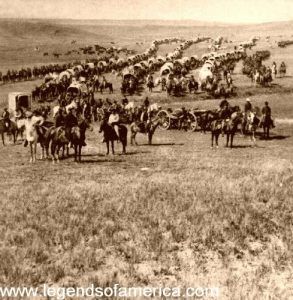
General George Custer’s Camp.
By the time he arrived, Reno had already been driven back by the Indians, who soon discovered Custer and his men coming toward the other end of the village. The Cheyenne and Sioux crossed the river and pushed into the advancing soldiers, forcing them back to a long, high ridge to the north. Meanwhile, another force of Sioux under Crazy Horse’s command swiftly moved downstream and doubled back in a sweeping arc, enveloping Custer and his men.
As the Indians closed in on Custer, some 3.5 miles north of Reno and Benteen, Custer ordered his men to shoot their horses and stack the carcasses to form a wall. However, the horses provided little protection against the onslaught of bullets and arrows raining upon Custer and his 210 men. Custer and his men were killed in the worst American military disaster of the time in less than an hour.
While exact numbers are difficult to determine, it is clear that the Northern Cheyenne and Lakota outnumbered U.S. forces by approximately 3:1.
After the Indians had annihilated Custer’s troops, the Lakota and Cheyenne advanced on the remaining U.S. troops under Benteen and Reno, who had finally ventured toward the audible firing of the Custer troops. For the next 24 hours, the Indians and soldiers fought a hard battle until the U.S. lines were finally secured when additional troops under General Terry began to approach from the north. As the troops were fortified, the Indians began a retreat to the south.
By the time Terry arrived, the Indians had removed their own dead and wounded from the field. However, the bodies of the soldiers remained lying where they died, many having been stripped of their clothing and mutilated. For some, identifying the bodies was impossible. Though the wounded were given treatment, six more would later die of their injuries.
Custer was found near the top of the hill, where today stands a memorial inscribed with the names of the U.S. soldiers who fought in the battle. He had been shot in the temple and the left chest, but his body was left unmutilated, some believe because he was dressed in buckskins rather than a uniform. Two hundred ten men died with Custer, while another 52 served under Reno. All were given hasty burials. Only an estimated 60 Indian warriors died in the battle.
Having occurred right before the nation’s centennial birthday, the massacre substantially changed the mood against the Indians. The U.S. Army responded by increasing the number of soldiers in the area to “crush the Indians” and take revenge for those who died in the Battle of the Little Bighorn.
It was to be three years before the battle became the subject of an army court inquiry in 1879. Reno’s, Benteen’s, Terry’s, and Custer’s actions were carefully scrutinized during the investigation. Testimony suggested that Reno was a drunk and a coward, while Benteen was criticized for disobeying Custer’s orders. Another contributing factor was General Terry’s late arrival on the scene. However, the primary cause of the U.S. defeat is attributed to faulty intelligence and poor communication. Both Reno’s and Benteen’s subsequent military careers were cut short.
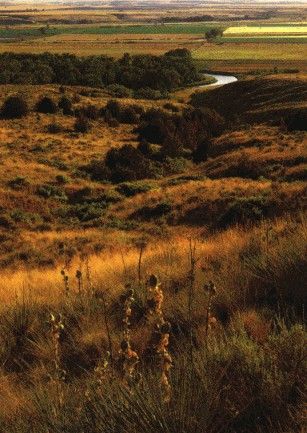
Little Bighorn River.
In the same year as the military investigation, the Little Bighorn Battlefield was designated a national cemetery administered by the War Department. Two years later, in 1881, a memorial was erected over the mass grave of the Seventh Cavalry soldiers, U.S. Indian Scouts, and other personnel killed in battle. In 1940, the battlefield’s jurisdiction was transferred to the National Park Service.
Over the years, the American Public’s sentiment towards Custer’s image and the Battle of the Little Bighorn has changed as the recognition of the general mistreatment of Native Americans during America’s westward expansion has increased.
In 1991, the U.S. Congress changed the battlefield’s name from Custer Battlefield National Monument to Little Bighorn Battlefield National Monument and ordered the construction of an Indian Memorial.
Today, additional red granite memorials have been erected to commemorate the Indians who fought there, including Cheyenne warriors Lame White Man and Noisy Walking, Lakota warriors Long Road and Dog’s Back Bone.
The Little Bighorn Battlefield National Monument is located in southeastern Montana near Crow Agency and is administered by the National Park Service.
©Kathy Alexander/Legends of America, updated December 2025.
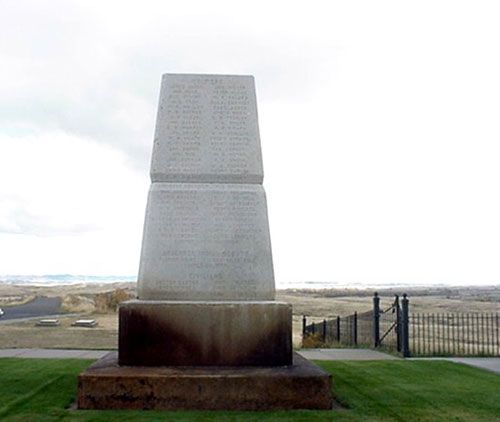
Little Bighorn Memorial.
Contact Information:
Little Bighorn Battlefield National Monument
P.O. Box 39
Exit 510 Off I-90 Hwy 212
Crow Agency, Montana 59022-0039
406-638-3204
* Legends of America Reader Steve Busch wrote an article in October 2012, which we think is also worth sharing. Read about the varying accounts of General Custer’s death, the possible love affair and child with a Cheyenne woman, and more in History Revisited – Digging for the Truth.
Also See:
Rain-In-The-Face (Strategic Sioux Warrior)
Sitting Bull – Lakota Chief & Holy Man
See Sources.