
By Phred Tinseth © 1999-2002
Editor’s Note: Although this was written years ago, most of this information still applies.
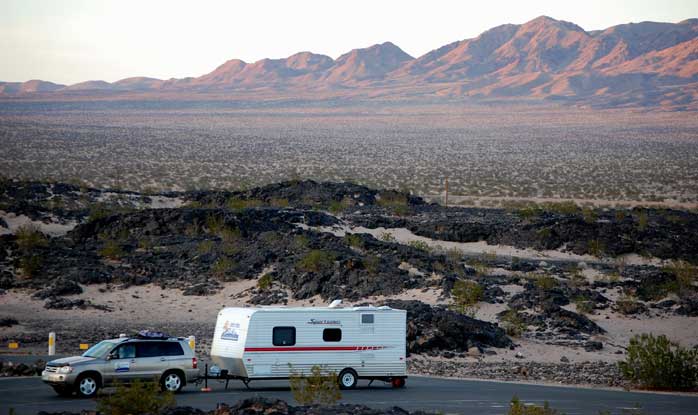
We boondocked at Amboy Crater in 2015.
Boondocking is not really a good term but has somehow come into common use. Dry Camping (parking anywhere, with or without amenities) is more accurate. Independent Parking is the preferred term. It means that you are prepared to dry camp but make use of amenities when they’re available. Being prepared to live independently is what it’s all about; then you’re free to do what you want.
There’s boondocking, and then there’s boondocking. Overnight stops or a few days at a rally are one thing. Long-term independent parking is another. Here are some tips on both:
In general, the secret is to do it with Discretion. This is Rule #1 to successful boondocking no matter where you do it. This means, when overnighting, you blend in and don’t call attention to yourself. No awnings, lawn chairs, and such in rest areas and malls. Sometimes you need to be sneaky; sometimes you don’t.
When just going from point A to B and not playing tourist, Rest Areas can be fine (it helps if you’re partially deaf). Some states encourage overnights and even have designated areas for RVs. Some restrict parking. I’ve never seen it enforced if RoVers are discreet. I’ve talked to cops nationwide. All say they’ve better things to do than roust RoVers unless there’s something else wrong. Restrictions are mainly to keep drug dealers, prostitutes, and local riff-raff from setting up shop, homeless people from setting up camp, etc. If you don’t act like riff-raff or a homeless person, you won’t be treated like one.
Truck stops, malls, restaurants, etc., can be OK. In the big ones, blend in with the crowd. In smaller ones, ask permission. Buy something. Always be discreet! (There’s an old RV story about “permission.” RoVer asks the security guard at the mall if it’s OK to park overnight. Guard says no. RoVer asks, “How about all the other RVs parked there?” Guard says they didn’t ask.)
- Camping World and similar lots can be OK (they’ll assume you’re waiting for an early appointment).
- Some motels are OK (not big ones with security force and not dinky mom ‘n pops). Some boat ramps allow parking (but don’t hog the whole lot). City/County parks can be great! Be leery of parks that close at dark (if they can’t keep the loonies out, you don’t want to be there).
- Wal-Mart is a preferred parking place for many RVers. Wal-Mart intends that you park overnight only, but is a little more generous—up to a point. Do NOT, though, set up camp for over two weeks (as some chintzy campers have done). You’ll ruin it for others.
- Gambling casinos are almost always OK. Tip: Don’t park in RV sites at casinos until you first go inside to check whether a “coupon” or similar is required for cheap or free use.
- Some tourist attractions (museums, etc.) are OK, but read the signs about day use only and such.
- Out West, where roads go off to nowhere, you can find nice byways. Make sure you don’t block access to farm fields (and have to move out of the way of migrant worker convoys at 4 AM).
- Out West, especially, check out Federal and State “Wildlife Refuges” (as opposed to “Wilderness Areas” where you can’t take vehicles anyway). Some allow overnight parking. Tip: When asking a ranger, have binoculars and a camera, a notebook, and all that other “birder” stuff on you and mention how you want to see the “flaming boobie hatch” or similar real bird’s name at sunrise.
Places to avoid: Downtown and many other areas that are fine by day can come alive with druggies and thugs after dark. Church lots used to be OK, but now they often host activities at all hours. Any place off the road that’s littered with lots of beer bottles (unless you like to visit with drunken high-school kids and weirdos).
Long Term Independent Parking: Bureau of Land Management (BLM), National Forests, Corps of Engineers, State Parks, etc., information is available in great quantity from any number of sources, and I’m not going to repeat all that here. Current addresses for obtaining such info appear constantly (with frequent changes) in all RV publications. The important thing is to take the time to gather this material so you know where to go (or not go) and what to expect when you get there. Do a web search for this government info.
Some Points: Paid permits are often required. They’re usually worth it. Some State Park systems have annual permits. The cost keeps increasing, but they’re often well worth it. (New Mexico has one of the best. You could literally spend your life there.) Arizona, Arkansas, and Texas are also favorites. In the East, camping parks are always crowded, and sites are often unavailable. In the West, except near urban areas and famous tourist attractions, the best sites abound. You don’t want to park in crowded places anyway. (We refer to them, with screaming children, loud music, drunken fights, and off-road vehicle noise, as ” RV Hell.”) Many places have time limits (at the ranger’s discretion). If you’re discreet (Rule #1 again) and keep a tidy site, don’t raise hell or beat your spouse, you can often stay longer.

At the Panhandle Plains Historical Museum, Canyon, Texas. Photo by Dave Alexander.
The very best parking is on private property. Here are some things we’ve done: House/farm/commercial sitting/caretaking. Ads in newspapers, RV pubs, etc. The first time, I just checked with real estate agents and ended up on 5 acres, feeding absentee owners’ horses and dogs, maintaining the pool, keeping an eye on the house. Got paid well for it and had free electricity. Have done similar in several places.
The selling point is: You’re providing security. You will take care of the property and won’t be sleeping in their bed, using their toilet, getting their stove greasy, etc. Just being on a property (especially with a cell phone) makes you most valuable.
If watching property and not doing chores, I’ve only asked for parking plus water and electricity. In some cases, I have paid a dollar a day for each if I felt it was worth it. I’ve also parked in schoolyards, on construction sites, at businesses (auto dealers and repair shops—anyplace easily ripped off—are good), private game preserves, and shooting clubs. Some security firms (rent-a-cop outfits) will take you on.
There are lots of broke farmers and just ordinary folks, especially in the Midwest and West. You’re paying $2 a day for parking, and water will help feed their kids. I’m well outfitted for dry camping with solar panels and such, so I don’t need electricity. Usually, tell farmer/rancher I prefer to park out on “back 40” for privacy. Find them by going to smallish towns and asking at diners and similar gossip hangouts.
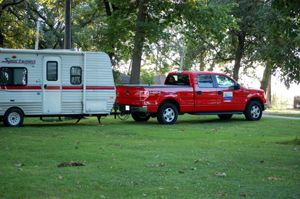
Legends of America camped in Dayton, IA.
Large commercial farms and ranches in the West have allowed me to park free at wells, stables, feeding stations, etc., to have someone who can alert them to problems. I have made good friends doing the above. I often volunteer to help when a “third hand” is needed to fix a gate, or whatever. A bit of help in the garden, which is fun anyway, results in more goodies.
Expect to be quizzed and prove your bona fides. People, especially with small children, are leery of possible screwballs or perverts. Having retired military, law enforcement, paramedic, or similar ID is great. A clean (not necessarily new) RV is important. So is being properly groomed. NO raggedy-ass beards (tidy is OK), male earrings (let alone nutty stuff like nose rings), funky clothes (leave cammies in a closet, or they’ll think you’re a fugitive nut). Keep a tidy campsite! No crap piled up under RV. Pick up trash, even if not yours. It’s easier without a pet. Too bad, but that’s the way it goes. Farmers don’t want your yapping dog upsetting their animals, chasing chickens, or biting kids.
Membership Camps can be a good deal, but you have to shop carefully. You can really get ripped off at some. Many are nothing more than affiliations of overcrowded RV parks (RV Hell, again). A few like Camper Ranch Club do have large primitive areas with inexpensive dry camping at some locations.
Check out applicable “BOF” (Birds Of a Feather) or similar Special Interest Groups affiliated with RV clubs. Boondockers or similar (obviously), but also hunters, fishermen, nudists (their camps are usually clothes-optional), treasure hunters, etc. All seek the privacy you’re looking for as well.

While visiting the ghost town of Vicksburg, Colorado, one of the locals photobombs our shot of a skull on a fence by Dave Alexander.
WARNING! There are commercial outfits advertising in RV publications that offer to arrange site-sitting/caretaking jobs. Some promise high pay, etc. Be skeptical! Some will charge you a listing fee and never contact you; that’s a Rip-U-Off, and you should complain to the magazine that published the ad. The best agencies will charge a fee to the guy who wants a caretaker. They will not charge a fee (or not much of one) to the guy who wants to be a caretaker.
Many RoVers have an urban home base or rural property that they invite people to visit through club publications. These can be quite nice. Sometimes free (but see TANSTAAFL later). Also note that if you’re on the way from point A to B, you might not want to: spend the time it takes to call in advance, negotiate strange streets, socialize when you need sleep, take them to dinner, etc., just for one night.
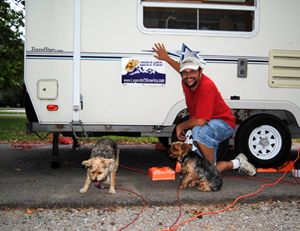
Legends’ first adventure in a trailer and our first night of camping. Boy, was Dave excited! The dogs, maybe not so much yet.
Security is the main concern to RoVers, especially at overnights. – But it shouldn’t spoil your fun if you take a few precautions. Get your outside business, like walking the dog and checking the engine, done in daylight. Don’t use Rest Area toilets. You can’t avoid talking to other RoVers, and probably don’t want to, but be cautious. Don’t invite strangers into the RV. Be alert! Watch for people coming up behind you. A tactic suggested by a RoVer, reportedly told to him by a police officer, seems to work well. When someone approaches you, don’t retreat into your RV or stand there looking stupid. Instead, take just a step or two toward the person, then stop and wait. This indicates you’re alert and not just a wimpy coward, yet not overly aggressive.
If there are two of you, don’t just crap out on the sofa while your partner is outside. Keep an eye on them. Some people feel safer (and are) in a two-RV caravan. (But three or more can be a logistical nightmare when fueling or finding overnight parking.) Spending an hour waiting for some jerk to find the cheapest filling station in town gets old in a hurry.
Caravanning, not just for security but also for mutual assistance and companionship, works well for some people, and many singles do it routinely. However, you need to be careful in selecting your companions. If nobody in the group has a sense of direction, tools, or mechanical skills, the whole gang can end up sitting alongside the road with their finger stuck in their ear—or somewhere else.
Pathetic people will approach you at some stops, such as rest areas and malls. You can’t take them to raise, but you can be compassionate. Never give one a ride! You could be robbed or maybe worse. Some will ask for “some change.” Give them a dollar. Not from your wallet; keep a few singles in your pocket. Don’t abuse them (it’s no fun waking up with a flat tire). Some will have some pretty creative scams (on the way to a job in L.A. and need $20 for gas, here’s my business card, I’ll repay you). I went along with one of these once just for the hell of it; the guy’s wife and kid looked pathetic. But I also gave him my card so he could repay. Most unlikely, thought I, tossed his card and forgot about it. I was quite surprised, many weeks later, to receive the $20, plus a bit more. You never can tell…
Some people need a favor (and would do it for you). But be cautious. Maybe they did forget their lug wrench. But maybe they want to borrow yours and beat your brains out. Again, keep an eye on each other. If alone, park near other RoVers or a truck (even if you don’t want to be seen as a lemming). Truckers dislike RoVers but won’t stand idly by while someone pounds on you. When morning comes, if you and the trucker are getting ready to go at the same time, offering them a cup of “real” coffee and a hot roll (pun) is a nice touch.
Incidentally, I’ve never had a trucker deliberately screw around with me in 20 years of FT. Indeed, many truckers are also RoVers (or wannabes) and will hear your thoughts about tips. Learn the trucker’s road signals, and give them some slack. They’re trying to make a living.
Guns? Aside from a (very) few military and law enforcement types, most people have never shot anyone and won’t know if they’re capable of doing it until the time comes. (And that’s a tough time to find out if you can really do it. Because if you can’t, the bad guy is likely to take your gun and do you in.) If you decide to carry a gun, take a gun handling and safety course! Practice! — so you won’t shoot yourself (or somebody else) accidentally. Don’t do anything stupid. People have snuck out for a smoke at night without waking their spouse and come back in, only to be blown away as a robber. Often, bullets (even if you don’t miss) can penetrate vehicles and people other than the intended. Also, you can get in serious trouble if you can’t prove your case and are charged with manslaughter (or worse).
Small but important stuff: Signs or tire covers with your name and hometown on them can help bad guys take advantage of you. Save them for when you’re in a safe place. Stickers with “Home Is Where You Park It,” “I Get My Electricity From The Sun,” or similar mean all your good stuff is in there and make you a target. Various club emblems, on the other hand, mark you as an experienced traveler — and a less attractive target. “Elks Club” and similar stickers indicate to cops you’re a “solid” citizen. “Protected by Smith and Wesson” and “NRA” stickers can, in some places, be a legally sufficient reason for police to search your RV and, in many places now, confiscate weapons, booze, and the whole damn RV. The side of the road is no place to argue the Constitution with a cop (who may have no idea what’s even in the Constitution). Be Discreet! Don’t “deal with” problems you could have avoided in the first place.
Keep your vehicles in “tip-top” condition. That does NOT mean polishing them (unless you have nothing better to do). It DOES mean maintaining them. The “clicking” noise you’ve heard for three days might be a bad “U” joint or driveshaft or?, but it definitely means “fix me.” Almost all tire blowouts are because the RoVer screwed up (and bought cheap crap, didn’t check weights or tire pressures, etc.) and are not from punctures. And remember: 4-wheel drive lets you get twice as far from help as 2-wheel drive. Spending the night on the road (or atop a highway overpass at the junction of two Interstates) under these conditions is not fun boondocking.
Once you get to a place where you can stay awhile, you can relax — somewhat. At least as much as at “home.” Just because you’re with other RVs doesn’t mean there’s not a thief among them. Scout the place out a bit, maybe get acquainted, before you buzz off in the car to see the sights. You don’t need to be paranoid, just cautious. The vast majority of your fellow RoVers will be nice people.
 So, how do you find the really swell places you’ve seen on magazine covers? With great difficulty because so many pristine places have been screwed up by thoughtless campers. Nice places are usually found by word of mouth from people who think you’re OK. If you’re not a slob, a combative drunk, a spouse abuser, don’t run a generator for endless hours, don’t have an annoying dog, or otherwise disturb people, you’ll be recognized as OK. If you’re reasonably friendly and helpful (just a good neighbor), you’ll soon be invited to join in. Someone will say, for example, “After the rally, a few of us are going to xyz. Would you like to come along?” Nothing wrong with going where the “common herd” goes. (Everybody ought to experience “Quartzite” and “Death Valley” at least once.)
Blue Highways are where you find good places. You won’t find them on the Interstate, but you can sometimes find them near it. If you have a giant 5W or monster MH, your pickings will be pretty slim. Even with small rigs, you can get in trouble if you don’t know where you’re going and follow your nose. It pays to stop and ask the locals (and even then, some fun-loving yokel might misguide you just for laughs). Smart RoVers often make day trips from campgrounds in cars or trucks to find good places for later. Some, with reasonably sized RVs and in no hurry, just tool around, checking out interesting places. Some of us don’t tow a toad, but one drives it as one might use a “scout” car to seek out good places. (You can often offset the cost of driving two vehicles by not having to purchase all the towing equipment costs.)
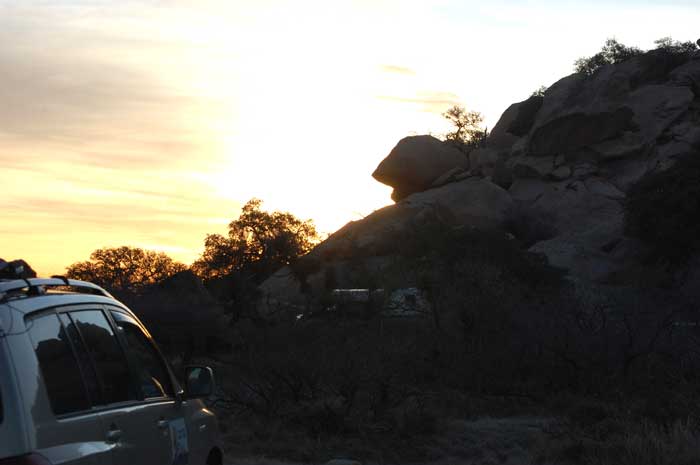
We shared some space at Indian Bread Crumb in Arizona in 2015.
You can still screw up. I have driven down a narrow road atop a levee to a good place at the other end of it. What I neglected to check on was whether the levee was still in place all the way. It wasn’t. I had to back up a trailer almost 5 miles. In Arizona, I attempted to cross a deep wash and couldn’t get up the opposite side. I backed up as far as I could and tried again and again until I was firmly settled at the bottom. A guy eventually pulled me out with a road grader. How humiliating!
Locals can tip you off to some great places to park. A typical example: In a small town in the Midwest, I asked if I could park behind a service station. The guy said OK, but said I’d be more comfortable parking at what he called “The Tree.” At the edge of town was a giant oak tree and a small, free, unlisted park with water sponsored by some civic group. Most pleasant. Some, few, RV publications regularly list places to park.
Day’s End in the “Escapees Magazine” is particularly good. Listings run the gamut from overnight stops to places where extended stays are possible. Some are in very scenic places. Computer disks, printouts, and companion maps for comprehensive listings of archival stuff are also available at a reasonable cost. The “Exit Authority” book is most helpful for advising what’s really available at interchanges — but soon becomes outdated.
Books on places to park (advertised as “park free every night, etc.”) are usually a disappointment, as most of the listings are National and State Parks and such places that you should have already found out about on your own. But look for books and magazine articles (use the library) to search for titles in areas like Alternative Life Styles, Nomadics, Hidden Places, and the like. The Fed Gov’t has a pamphlet about “lesser-known parks” or some such title that is pretty good. It’s intended, I think, to encourage people to go to neglected parks –just what you’re looking for. (I wouldn’t go to Yellowstone on a bet.)
Here are some places you can park at no or minimal cost—and have fun, too: Flea Markets, Gun Shows, Art Festivals, Race tracks, ethnic gatherings (where you can watch Scots toss telephone poles, pipers pipe, and Polish folk polka is amusing), anything else that appeals. Fraternal organizations can be great and don’t always require that you be a member.
Here’s a great source: Timber/lumber/paper private corporations have many thousands of acres of pretty nice country. They’re so often criticized by tree huggers that they often (as a goodwill gesture) have parking (and sometimes services) for RoVers. Most are in the northwest, but also in Texas and other southern states and, surprisingly, in places like Ohio (where RV parking is scarce and expensive).
Hard-to-find (old) RV parts dealers can be good places to look. It’ll usually take at least a day to go through the junkyard and find cheap stuff that you really need. Also, at some metal/electronic/etc., surplus/salvage places, you can take a day or more to scrounge through all the piles of electric motors, pumps, and all the other stuff they carry. Caution: Some of these aren’t safe at night due to their locations. Use your smarts.
Use Your Imagination! Here’s just one example that’s pretty extreme but makes the point: A friend used to spend the night at radio and TV tower sites. Generally, nobody ever questioned him (they seldom check these things unless something goes wrong). When they did, he had the official FAA color charts that towers must comply with. He’d tell them he intended to contact the station and offer a bid for repainting, replacing lights, etc. Key point was that if they called him on it, he was prepared to do the job. (He’d once earned a living that way.) If you’re going to fake it, make sure you can back it up.
RV Campground
Getting Along. Many boondockers are experts at keeping an RV running and get a lot of enjoyment out of helping others. Less talented folk are expected to learn from this, not just take advantage of it. Feel free to ask someone to help you with a problem. Watch. Take notes. Don’t be a beggar. You’ve probably got a talent of your own you might offer. Even if you’re inept, you can help or play “gofer.” When many RVs are assembled in the boonie, there’s always a need for campfire wood, a watchman to keep the fire from burning the place up, and someone to haul water, trash, etc.
Things aren’t always going to go as planned. Boondock Rule #2: Stay flexible.
Boondock Rule #3: Conservation of resources.
How long can you boondock? A week, easily, even with the substandard heaps sold today. Indefinitely with better equipment (more on that later). Conservation is the key. You do NOT waste water, electricity, or fuel. It’s easy to learn how. Read the literature. Talk to “them that’s doin’ it.” Practice the tricks at home so you can plug back in when you screw up. (As when you find out running a furnace all night will kill your battery before dawn if you don’t know what you’re doing.) Go to rallies and Escapades, attend the seminars, TALK to people, pick their brains. (Boondockers love to show off their tricks.)
A Sampling of Some Simple Tricks:
- You travel with a full fresh water tank and empty holding tanks (insofar as possible). You dump often (so when you find a good place, you can stay a while). You keep the fresh tank full for the same reason and so you can put out a fire or fill a radiator after a hose bursts. You have an exterior water outlet or at least a garden hose adapter at the indoor faucet.
- Faucets have handles for a reason. It’s not to leave them open/running while you screw around.
- You only need about a half-cup of water to brush your teeth (not much more to shave).
- You do NOT need to have a water heater running constantly. A quart of hot water heated on a stove will wash dishes, and they can be rinsed in cold water. You only need a few suds in a bowl, not a sink full.
- Toilet Paper is the RoVers’ friend. You use it for small spills, wiping pots and dishes before washing, napkins, blowing noses, etc. (On a boat, we kept a roll on the dining table — crude, but effective.)
- Do not fall asleep with the TV on. Outdoor lights are turned on only when needed, rarely. Interior lights are used as needed, not for decoration. Patio lights take up space, attract insects, and use electricity. Vent fans are used only when needed; opening windows isn’t difficult. Stinky toilets mean you have a sewage vent problem or are using the wrong stuff in the tank.
- Human waste is something we all produce and not shameful. Flushing a toilet doesn’t require copious amounts of water (if you use a spray hose or spray bottle with just a bit of detergent mixed in). Dishwater saved in a gallon jug works well also. Toilet paper is biodegradable and will break down into nothing if you use small amounts of the “right stuff.” (No scented household stuff, but RV type — which is nothing more than cheap, generic single ply at a higher price — “Scotts” is even better.)
- Used TP can, if used properly and in quantity, be wadded into a plastic sandwich bag, twist-tied, and put in the trash. Don’t just put used TP in a big bag or coffee can. Opening it to put in more is anything but “air freshening.” Don’t try (especially with a blackwater tank) to save so much water that you end up with a solid mass of “UNOWAT” in the tank. Many RVing men go wee-wee in one-liter soft drink bottles (as do truck drivers). Truck drivers usually toss them out the window. RoVers usually put them in trash receptacles.
- Trash is put in small kitchen garbage bags or supermarket plastic bags. It’s easily (frequently) stuffed into receptacles at rest areas, shopping centers, service stations, etc. Large bags make you look stupid as you try to cram them in. In some states, large trash bags are considered “household” trash, and the authorities will search them for an address. Then they’ll issue you a ticket with a fine up to about $500. Please do not put anything in the trash that has your address on it (especially credit card receipts). People who collect aluminum cans often do dumpster and trash can “diving” — ripping open trash bags — and there’s your “stuff” all over the place. One old RV trick is to place trash in a cardboard box, wrap it in gift wrap, and leave it in the back of the truck when going to a mall. Someone almost always steals it.
- Fresh Water is a really dicey proposition. Most commercial campgrounds have the water tested regularly per local ordinances & regulations. Other places don’t have to, and you can get some nasty stuff. Your own hose and freshwater tank can easily be the cause. Lots of RoVers with a case of the trots or the toss-ups attribute it to a “bug I must have picked up” and don’t realize it’s from their own water.
Alternative Parking at $ Places
 Even die-hard “boonie rats” sometimes use RV parks. Flush the tanks well. Do laundry. Do RV maintenance, on and on. The secret is to find cheap parks, not $ 25-a-night resorts. Many of them are without dance halls and such for less than $15. There are many that date back to the ’50s and ’60s, usually behind service stations or el-cheapo motels. They have primitive electricity, water, and sometimes a dump. Some are quite charming. Some, believe it or not, only charge $3 to $5.
Off-season at RV parks can be cheap. A typical park in CO charges big bucks but closes much of the place down in Winter (no water and no sewer unless you move the RV). Electricity, however, is left on. Parking on such a site (in this “storage” mode) is possible for about $1 a day. No snow removal, so you have to be careful about selecting when to get stuff done. Electricity is about $1 a day, plus an extra $1 if you’re running an electric heater. Not bad. Especially since simple RV storage lots sometimes charge about the same with no electricity and won’t let you stay in the RV or work on it.
In some places, especially in the East, there is no such thing as “inexpensive,” and the campgrounds are usually booked solid anyway ( RV hell). Go elsewhere is the easy answer. But if you can’t (working or selling a house or ?) check the Mobile Home Parks. County fairgrounds can be nice. Many (but not all) charge far less than campgrounds for electricity, water, and dump — sometimes have full hookups. They can be a really fun place to park. If you’ll be there a while, check for paid work or free camping in exchange for minimal work with management, or jobs with vendors at special events. Parking amidst a bunch of carnival people can be a real treat (like the night the guy with all the lizards left the cage door open).
Military people (active and retired) can park at “Fam[ily] Camps” on many bases. This used to be a good deal (cheap or free) but isn’t anymore in most places. The Gov’t decided that recreational stuff had to pay its own way — no more taxpayer subsidies (which is fair enough). You’ll see this same thing at Corps of Engineers places, National Forests, and Parks, etc. However, some military bases have rod and gun clubs and similar recreational facilities out in the maneuver (boonies) areas where you can park. These are usually not publicized. Some National Guard training bases also have recreational facilities. They can be VERY nice.
Native American [Indian] Lands can be great places. Some have full-fledged RV parks with reasonable fees, entertaining cultural programs, and tours. It’s possible, if you know what you’re doing, to park on a Native American’s private turf. This can be complicated but can be a great experience.
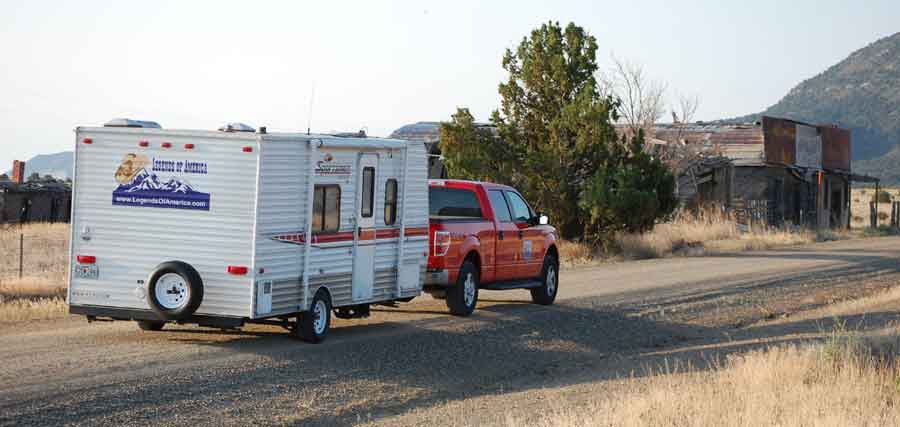
Legends On The Road – Ludlow, Colorado.
Equipment for Long-Term Parking—the big difference between that and overnights, weekends, or rallies. Some of us have elaborate setups that cost so much we could pay campground fees for many years. But there’s more to it than that. There’s freedom! We decide where we’ll go and for how long.
You can boondock for extended periods with little more than standard RV equipment. Ways to transport water, dispose of sewage, beef up the battery bank, and charge batteries can be simple or elaborate. Below are some simple ones.
- Water can be transported in simple jugs. But an extra water tank in your toad, along with an inexpensive pump, is easy to add and much more convenient.
- Sewage can be transferred in many ways, like the common blue tote tank on wheels (called “Blue Thunder” because of the peculiar noise it makes). But this can be quite inconvenient, as can carrying poop about in a bucket to sneak it into a pit toilet when the ranger’s not looking. Serious boondockers usually invest in a macerator pump and install a sewage transfer tank.
- Pump the sewage out of the RV before going to town or wherever you’re going. Get rid of it… someplace.
- Fill the fresh tank before returning.
- Don’t get the hoses mixed up.
- Adding more batteries is relatively easy. But you’ve got to have a way of keeping them charged, or they’ll die. Some people put the extra batteries in tow/toad, and they get charged while driving. A simple cable allows them to be connected to the RV when back “home.” Not a swell solution, but it can work. Best is to install “proper” batteries in the RV.
- Generators are another way to charge batteries. It’s the most inefficient method of all. Most RV generators charge batteries through the RV converter. All you get that way is 3 to 4 amps of actual charge going to the batteries (NOT the huge capacity the generator is really capable of — contrary to what most people think). And the generator will need to run for long hours and thoroughly piss off your neighbors.
- Some generators have a DC output that can charge batteries directly at over 30 amps, getting the job done much faster. This is better, but the maintenance, fuel, etc., make it less than an attractive solution.
- If you have a generator, keep it, because nobody will pay you much. It’s a good backup.
- Using your automotive engine to charge batteries when parked isn’t smart. The military does it all the time, but they can get new vehicles when they wear out prematurely; you can’t.
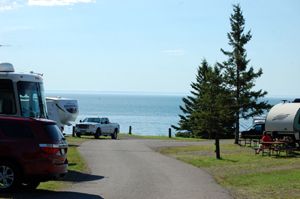
Our stay at an RV campground on Lake Superior
Sophisticated Long Term Parking — The High-Priced (sometimes) Spread
Some of this stuff doesn’t cost much. Some of it can cost a bunch. Keep in mind that this ain’t like buying a pick-up truck — where you have to buy the whole thing at one time.
- Electricity—Solar Photovoltaic Panels are the best solution. They’re expensive, but even one full-sized module can get you through a rally or a power outage. Some people, who are VERY conservative (or who don’t use very much electricity), find only one is OK all the time. Most people find one per battery is adequate. It goes on from there. You’ll need a regulator (the best—and NOT the most expensive—is the “Solar Boost” Model 2000 or Model 50 from “RV Power Products”). The panels will need to be properly mounted and connected.
- High-output alternators are available that allow quick charging from your vehicle engine. Most are high-priced junk with puny innards that soon crap out. “Wrangler Power Products” makes the best.
- You need a quality battery bank, not just the cheap junk that comes with most RVs.
- You need a good “digital” multimeter. They can be quite expensive, but what you need for an RV is available for only $40.
- Converters, Inverters and Independent Battery Chargers. Standard RV converters are, in almost all cases, absolute crap. Few serious boondockers use them.
- You really need to install an independent battery charger (for use from commercial electricity or a generator). Inverters are VERY confusing because most RoVers don’t know how to evaluate them. Many RoVers grab a piece of junk off the RV store shelf. A good inverter isn’t likely to be found in an RV store. The quality independent battery charger will cost you about $425. Quality Inverters will cost big bucks also, but will include an independent battery charger that’s worth over $425. (Do the math, it’s simple.)
- Water and treating/filtering it can be expensive or inexpensive. It depends on where you get your water, how you store it, etc. Water is one of the LEAST understood aspects of RoVing and one that is treated most casually by boobs.
- Sewage is another of the least understood aspects. Most RoVers dump anything and everything in the tanks, toss in some toxic, RV big-name, “no smell” stuff, and suffer a lot. It’s pathetic!
- Water heaters and Space heaters (furnaces) that come with RVs aren’t very good. Serious RoVers either replace them altogether or augment them with better equipment. One heater not mentioned (it will be) is the so-called “Mexican” water heater. It looks like the typical tall, round household water heater. But it has a firebox at the bottom and will burn anything from charcoal to wood to corn cobs. Some serious boondockers use these, and those who know a bit about plumbing have sometimes connected them to circulating pumps and heat exchangers (from industrial surplus places) for radiator-style space heating as well.
- Refrigeration and cooling can be done better than with standard RV junk.
- Cell Phones work (most places but not all) and can be inexpensive.
Tools. Many of us carry an abundance of tools. Some boonie rats can weld things and rebuild engines in the middle of nowhere. You don’t need to do this, but you do need to do simple repairs, and you need the tools to do it. Start with a simple set of sockets, and a combination open-end/box-end wrench (“metwrench”) is good and fits both U.S. and metric. Get a second set of standard U.S. combo wrenches up to about an inch. Get really good screwdrivers (as well as wrenches above) from Sears or similar and get offset and close-quarter types as well. Get some decent pliers, a hammer, etc.
- Get a half dozen or so “vice grip” type pliers (those new ones Sears sells that can be used as wrenches are superb, and if something like your air conditioner compressor ever decides to fall off, you’ll need them).
Examine your vehicle. There will be at least one nut or bolt that you’ll need to remove someday that’s huge (maybe 1¼ or 1½”). Buy those wrenches as singles. You might need a “crazy” offset wrench to reach bolts in odd places. - Learn how to use a vacuum gauge. Get a simple troubleshooting book.
- Two tools most RoVers never consider are a suitable wheel-lug wrench and a good hydraulic jack (not the pieces of crap that came with the vehicle). Get a quality 12-ton hydraulic jack from an auto store. Get a ¾” socket handle/driver (they call them “breakaway bars”) from a good auto store and about a 6″ extension bar so the breakaway bar won’t be at an angle when you [try to] remove a lug nut. Buy a good socket (at the same store) that fits your wheel lug nuts (you might need more than one size if you also tow a trailer or toad). Buy a slip-on extension handle for the breakaway bar (or get a piece of common galvanized pipe about 4 feet long that will fit over it from a hardware store, much cheaper). Yes, you can buy special RV lug nut wrenches (for about $200- $400). Yikes!
Ideally, you’ll never use the tire changing tools. You’ll subscribe to a top-of-the-line Emergency Road Service (NO, not AAA, or some gasoline company — that’s just silly) as furnished by Escapees Club (same one — but a bit cheaper — as used by Good Sam — and both are now Camping World affiliates). However, if you’re a serious boondocker, even the best road service might not be able to find you (or you be able to call it). You really do need to be able to take care of yourself sometimes.
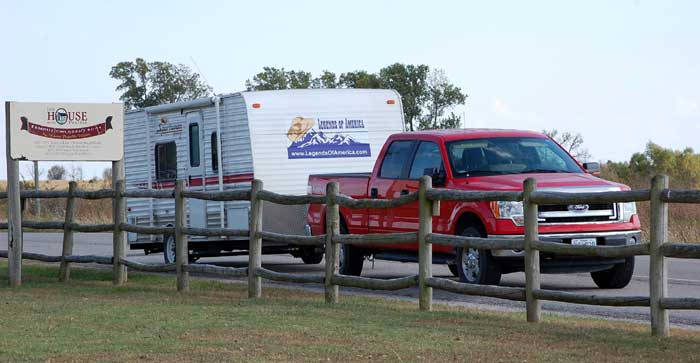
On the road in Kansas
Spare Parts — and Other Parts. As a minimum, experienced boondockers carry an ignition module. Spark Plug and Coil wire set. Spark plugs. Ignition coil. Alternator. Voltage Regulator (see Wrangler, mentioned earlier, for external regulators for GM and such which are far superior to the OEM junk on your RV). Starter. Fuel, oil, and air filters. Full set of fan-type belts. Full set of pre-formed engine water hoses. 10′ of ½” common water system (vehicle engine) hose. 10′ of appropriate sizes (for your engine) fuel and vacuum hose. An abundant supply of stainless-steel hose clamps in various sizes. Rolls of #10, #12, #14 wire and an abundant variety of connectors and a butane soldering iron. At least 12 quarts of engine oil and 12 quarts of transmission fluid (you’ll seldom use a qt of tranny fluid in a year, but if you ever blow a line, you’ll need at least 12 to refill). Power steering fluid. Brake fluid. Why carry all this stuff that you can buy anywhere? Because you might be in nowhere! If you want to park in the boonies, you’d best know how to survive in the boonies.
Miscellaneous. Aluminum duct tape, not the gray stuff, will cover holes and hold stuff together. “Kool Seal” makes a really gummy butyl tape that WILL seal leaks. Stainless-steel pot scrubbers, not ordinary steel wool, will keep critters out of holes.
NOTES: I often refer to replacing standard RV junk with better stuff, but if your appliances are working OK, use them if necessary. Get info on the better things so you’ll know what to get when the time comes.
Circuit boards on appliances are one of the “things that can drive you nutz.” Get them now, not when something craps out.
Working on the Road. The BEST source for info is Workers on Wheels. Coleen Sykora. 3213 West Main # 306. Rapid City, SD 57702 http://www.workersonwheels.com
There’s great boondocking in Canada and Mexico.
TANSTAAFL (There Ain’t No Such Thing As A Free Lunch). Boondocking isn’t “free.” You’ll pay for it by helping and sharing, be it with money, by picking up trash, or in any number of other ways — not the least of which is political activism to ensure we don’t lose it all. When your RV club or other organization requests that you write your congressman, DO IT! Don’t assume that other people will. They won’t.
One RoVer recently remarked that this lifestyle entails a lot of personal responsibility. We need to take care of ourselves, our rigs, and watch out for others as well. Sometimes we need to be our brother’s keeper because anyone can have a momentary “brain phart” and be headed for trouble.
What price freedom?
Phred Tinseth © 1999-2002 Reproduction Permitted, updated August 2026.
Also See:
RV Tips, Tricks, Travel Information & More