
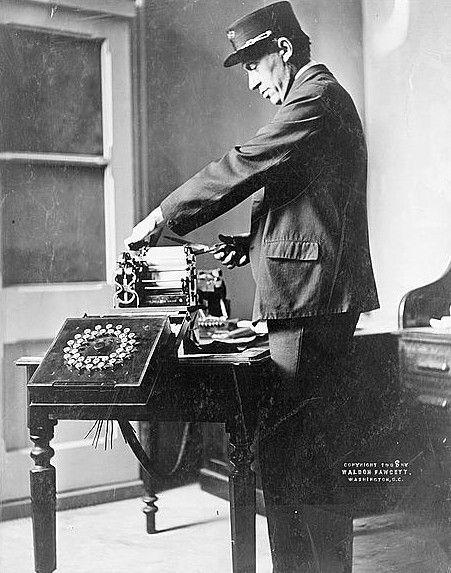
Telegraph Operator, 1908.
After 145 years, one of the last remaining vestiges of the Old West finally ended on January 27, 2006, when Western Union sent its final telegram. A sad day, I think, as one more history-filled era is forever finished. And why should this be sad, you might ask? We must move forward; technology is changing, and ones and zeros have long replaced dots and dashes. Be that as it may, this writer thinks it is sad, but it can also be heartbreaking to say goodbye to a loyal employee who has retired after decades of service.
Without fanfare, the telegrams were “just gone” – no retirement party, no chance to bid our sad farewell, no last chance to send one more singing telegram at the last minute before the press announced the news. Nothing but a small announcement on Western Union’s website before the end. Last time we checked, their website says no word about this death of an American tradition – not even a notation in the company’s Historic Timeline.
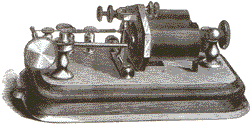
Early Telegraph
Still, why is it sad? I’ve never sent or received a telegram in my life, even in more than 60 years. Most young people of today probably don’t even know what the term “telegram” means. But for me, a self-described “old soul,” it is poignant in the same way some buildings make you yearn to know their history and the people they once housed within their walls. Sadly, the telegram didn’t get a retirement party, or a funeral, or even a wake!
It’s sad, in a nostalgic way, that so often, when the world moves forward, it leaves behind the very institutions that brought us where we are today. After all, the telegraph put the Pony Express out of business, the railroad eliminated the Santa Fe and Oregon Trails, and the automobile has all but made railroad passenger service a thing of the past.
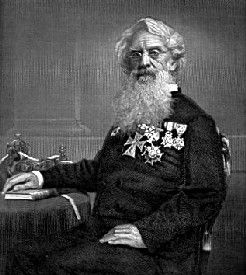
Samuel Morse
Think of it – messages of joy, sorrow, and success came in those hand-delivered yellow envelopes for almost a century and a half. The telegraph changed the world when its first message was sent on May 24, 1844, proclaiming, “What hath God wrought!” Those first words, sent by telegraph inventor Samuel Morse, sped communication across the land like never before.
However, getting the public to believe the idea after Morse invented the telegraph in 1831 was a difficult row to hoe. At first, the telegraph was considered little more than a curiosity, and most people couldn’t believe the idea was even possible. In 1835, while a professor of arts and design at New York University, Samuel Morse proved that signals could be transmitted by wire and produce written codes on a strip of paper. The following year, Morse modified the device to write dots and dashes. However, the public remained skeptical.
In 1837, Morse applied for government assistance to develop the telegraph; however, the nation suffered an economic disaster known as the Panic of 1837, and nothing was done with the application. Meanwhile, Morse began giving public demonstrations of his device, finally gaining some credibility.
Finally, when the nation had begun to recover economically, Morse again asked Congress for an appropriation to help build a telegraph line from Washington, D.C., to Baltimore, forty miles away. This time, the legislators were “sold” on the idea, and on February 23, 1843, they granted Morse $30,000 to build his line.
More than a year later, on May 24, 1844, the first message was sent, and the country was convinced. In a partnership with several other men, Morse began building more lines, expanding the availability of the new-fangled invention.
But it was still slow going. The government rejected the idea of purchasing Morse’s invention, so private enterprise alone drove expansion. By 1856, thirty or forty rival companies working on different telegraph patents covered the most populated areas of the eastern part of the nation.
Into this melee walked a company called The New York and Mississippi Valley Printing Telegraph Company. Formed in 1851, the company had been buying several of its rivals, and in 1856 it changed its name to the Western Union Telegraph Company, signifying the union of “western” telegraph lines with eastern lines into one system. Five years later, on October 24, 1861, Western Union completed the first transcontinental telegraph line, effectively putting the Pony Express out of business. During the Civil War, the coast-to-coast communication system played a vital role.
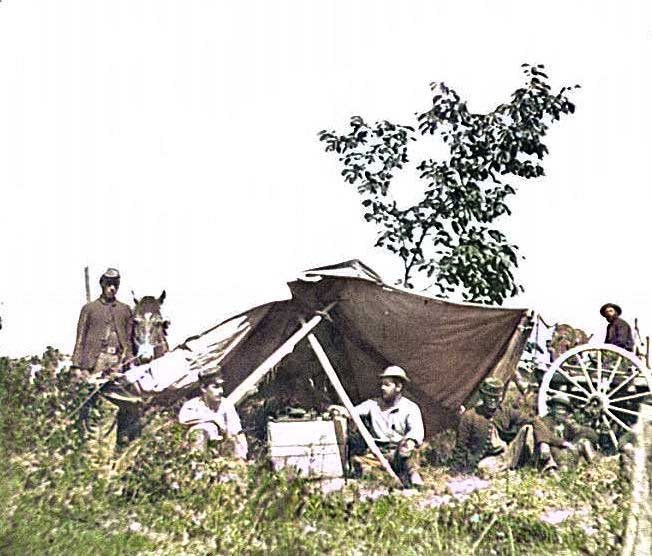
Field Telegraph Station, Vicinity of Charles City Court House, Wilcox’s Landing, Virginia, 1864.
Meanwhile, other technologies advanced rapidly, including the telephone. However, long-distance calls were expensive, and telegrams peaked during the 1920s and 1930s, when it was much cheaper to send a telegram than to place a long-distance call.
During the next decade, the Western Union courier became a feared sight. During World War II, the War Department used Western Union to notify families of deaths and injuries of armed forces personnel.
But as technology evolved, the telegram’s success didn’t last. As long-distance rates dropped, Western Union phased out its couriers in the late 1960s and early 1970s. Then came faxes, email, and even cheaper long-distance rates. The telegram was doomed. By 2005, only about 20,000 telegrams were sent worldwide.
Though the telegram is gone forever, Western Union continues to thrive as it has diversified into financial services over the years.
©Kathy Alexander/Legends of America, updated October 2026.
Also See:
The Overland Stage & Telegraph Lines (written 1922)
Pony Express – Fastest Mail Across the West
John Butterfield & the Overland Mail Company
Telegraph and Telephone Film Library (DVD – Legends’ General Store)
See Sources.