
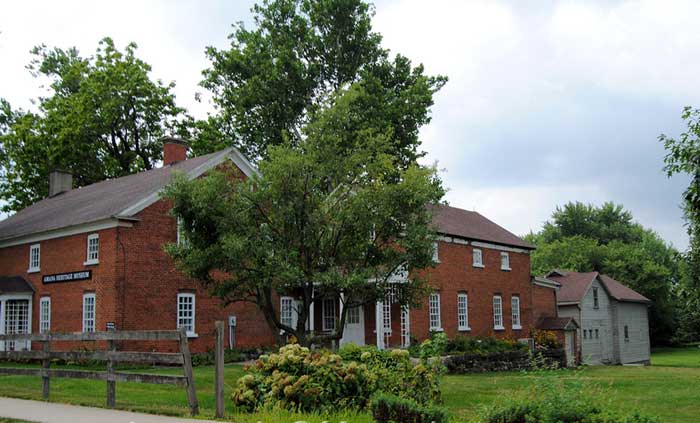
Amana Colonies Heritage Museum, Iowa, by Kathy Alexander.
The Amana Colony, a historic utopian society located in the rolling hills of Iowa’s River Valley, was established shortly before the Civil War by a group of German-speaking European settlers who belonged to a religious group known as the Community of True Inspiration. Here, they began a communal system of living in seven villages, encompassing over 20,000 acres of land.
These various villages originally comprised 40 to 100 buildings, many of which remain today. Among the colonies are dozens of elegantly simple buildings that reflect the distinctive architecture of communal Amana, a period that lasted from 1855 to 1932.
The first Community of True Inspiration originated from Heimbach, Germany, in 1714. Community founders J.F. Rock (1678-1749) and E.L. Gruber (1665-1728) were among many Europeans seeking a more meaningful religious experience than they felt the established churches provided. Like many others, Rock and Gruber argued that the Lutheran Church had become bogged down in intellectual debate and formalized worship, neglecting the congregation’s spiritual needs. An increasing desire to return to biblical doctrine emphasizing individual piety gained popularity. The Community of True Inspiration was one of several groups that emerged from Pietism.
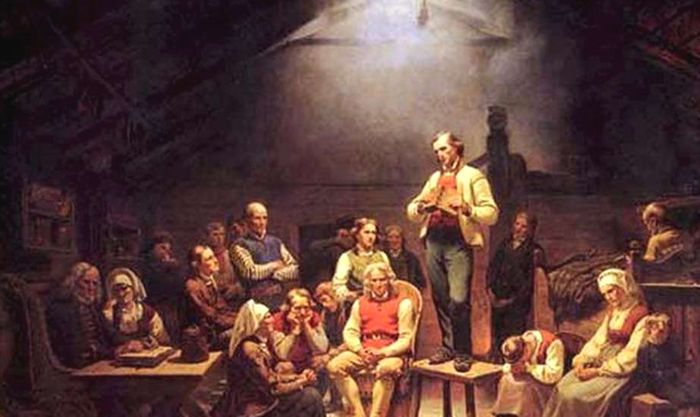
Pietism
Inspirationist beliefs attracted many followers, and congregations formed throughout Germany and surrounding regions. Because Inspirationists declined to perform military duty, take state-required oaths, or send their children to church-run schools, the congregations often conflicted with church and governmental authorities. Authorities punished many members of the Community of True Inspiration with fines, imprisonment, and public beatings. Nevertheless, the Inspirationist movement flourished through the mid-18th Century. However, by 1750, both Rock and Gruber were dead, and the movement declined and faded amid European wars and economic depression.
War and famine, compounded by sweeping social and economic changes, devastated Germany in the early 1800s. Farmers and craftspeople suffered from high rents, taxes, and a new wave of industrialization. Many people, including a tailor named Michael Krausert, took comfort in religion. After studying J.F. Rock’s words in 1817, Krausert revitalized the Community of True Inspiration. Two others soon joined him: Barbara Heinemann and Christian Metz. Metz became the community’s guiding force during its crucial years of growth and relocation to America.
Peasant’s Cottage
During the 1820s and 1830s, Metz consolidated the community in the relatively liberal province of Hesse-Darmstadt in Germany. Congregations from Germany, Switzerland, and France moved to join the new communities in Hesse. The community leased large estates and castles within a few miles of each other. Rich and poor lived together and shared in the group’s social and economic life. Although not communal, this arrangement helped predispose the Inspirationists to the formal communal system established in America and Amana.
By 1840, nearly 1000 members of the Community of True Inspiration lived on estates in Hesse. This growth occurred despite persecution from German officials. The government, closely tied to the Lutheran church, viewed the Community’s theology as a political threat. Even in Hesse, Inspirationists were fined for their refusal to send children to state schools. Rising costs and several years of drought worsened conditions on the estates, leading Metz and other leaders to realize they must seek a new home for the community.
In September 1842, a committee led by Christian Metz traveled to America to find land on which to relocate the Community of True Inspiration. They purchased a 5,000-acre site near Buffalo, New York. By the end of 1843, nearly 350 Inspirationists had immigrated to the new settlement, which they named “Ebenezer,” meaning “hitherto hath the Lord helped us.”
Immigration
From the start, to help all community members come to America and live together, all property in Ebenezer was held in common. The initial plan was that after some time, the land would be divided among the people according to their contribution of money and labor. However, leaders saw that disparities in wealth, skills, and age would make it difficult for everyone to purchase a portion of land, and the community would fall apart as a result. Therefore, in 1846, they adopted a constitution that established a permanent communal system. Any debate was resolved when Metz delivered a divine pronouncement endorsing the communal system.
Ebenezer flourished. By 1854, the population reached 1,200 people. Six villages were established, each with mills, shops, homes, communal kitchens, schools, and churches. To accommodate this growth, they purchased additional land, but they still needed more. However, the booming growth of nearby Buffalo put land prices at a premium. In addition, community leaders saw a threat in the economic development around them. They felt capitalist and worldly influences were fueling a growing interest in materialism and threatening the spiritual focus of the Inspirationist community. The leadership decided it was time to move the community again – this time to the unsettled West.
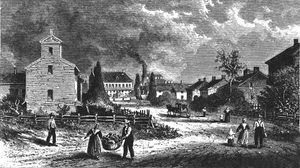
Historic Amana, Iowa.
After investigating sites in Kansas and Iowa, the True Inspirationists selected a location along the Iowa River Valley about 20 miles West of Iowa City, Iowa, to relocate their community. This site offered extensive timberland, quarries for limestone and sandstone, and long stretches of prairie filled with rich, black soil. Construction of the first village began in the summer of 1855, and the new settlement was named “Amana,” meaning “believe faithfully.” Community members moved to Amana over the next ten years as they gradually sold parcels of the Ebenezer property. The Community of True Inspiration adopted a new constitution as it took on the legal identity of the Amana Society. This new constitution essentially retained the communal system developed in Ebenezer.
All members of the community shared in its economic success. The community provided each family with a home and all necessities of life. No one received a cash income. Instead, everyone received an annual purchase allowance at the general store, where goods were priced at cost. The community provided medical care for free. In return, each person was expected to work and was assigned a job by the community Elders based on the community’s needs and the individual’s talents. Nearly all women, starting at about age 14, worked in the communal kitchens and gardens. Women also tended to laundry, sewing, and knitting, and a few worked at the woolen mills. Men’s jobs were far more varied. Young men might learn to work in one of the many craft shops, in the mills, or on the farms. Some men were sent outside the community to be educated as doctors or pharmacists.
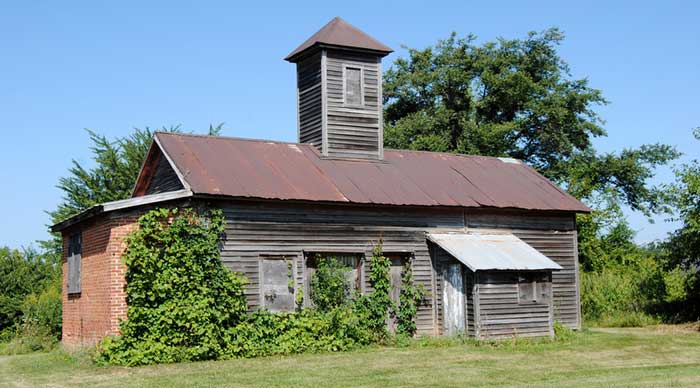
Homestead in the Amana Colonies of Iowa by Kathy Alexander.
By the 1860s, the Amana Colony, as it came to be known, consisted of over 20,000 acres of land on which seven villages had been established. The villages were spaced just a few miles apart, roughly in a rectangle, and were named for their location: West Amana, South Amana, High Amana, East Amana, and Middle Amana, in addition to the original village of Amana. The town of Homestead, little more than a few buildings, was purchased by the Inspirationists so that they could have a depot on the new railroad line.
Each Amana village consisted of 40 to 100 buildings. The barns and agricultural buildings were always clustered at the village edge. Orchards, vineyards, and gardens encircled the villages. Typical houses were rectangular two-story buildings of wood post-and-beam construction, brick, or sandstone. Each village had its own church, school, bakery, dairy, wine cellar, craft shops, and general store. Each village also had several communal kitchens where groups of about 30-40 people ate their meals.
Although all Amana villages are similar, each has its distinctive aspects. The original village of Amana, for example, resembles a German town with its meandering main street and side streets. In contrast, the last village built—Middle Amana—displays a very American square-block layout. South Amana is known for its predominance of brick construction —hosting even a brick granary and chicken house; in West Amana and High Amana, sandstone buildings prevail. Tiny East Amana was not much more than an agricultural outpost, while Amana hummed with industry. The railroads’ influence on the villages is evident in Homestead’s single street and the split in South Amana—upper and lower.
The Amana settlement pattern of seven villages allowed the Inspirationists to access all their farmland easily. Just as importantly, it avoided a large urban setting which they felt encouraged immorality. Still, the network of small villages maintained an overall unity and kept everyone close to spiritual leadership.
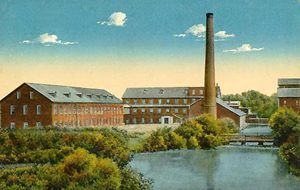
Amana, Iowa Woolen Mill
The Inspirationists established mills and shops according to their old-world skills. Amana’s woolen and calico factories were among the first in Iowa and quickly gained a national reputation for superior quality goods. The Inspirationists did not avoid new technologies and, in fact, contributed innovations of their own to the textile industry. By 1908, the two woolen mills (in Amana and Middle Amana) produced about half a million yards of fabric a year, and the calico factory printed 4,500 yards of its famous cloth each day. Two flour mills (in West Amana and Amana) processed the community’s own small grains and those of neighboring farmers. They shipped potatoes and onions to Midwest markets. They used profits from the mills and farms to buy goods from outside the community.
Of course, for the Inspirationists, all this economic activity was subordinate to their religious purpose, to live a godly and pious life. To support this, they held church services 11 times a week: every evening, Wednesday, Saturday, Sunday mornings, and Sunday afternoons. The Community also observed Easter, Christmas, and other Christian holidays. In addition, the Inspirationists in Amana held several special services during the year. Of these, the annual renewal of the covenant between each member and the community and Holy Communion were the most important. Holy Communion was held at times determined through inspiration until Metz died in 1867 and thereafter, usually every other year. A yearly spiritual examination was held over several months, with the Elders visiting each village in turn. Each community member came before the Elders and was questioned regarding their spiritual condition and admonished to lead a more pious life.
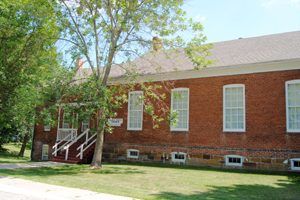
Middle Amana, Iowa Church by Kathy Alexander.
The church Elders, always men, led the community and conducted church services in each village. Some Elders were chosen as Trustees who managed the economic aspects and daily life of the villages. Up to this level, each village functioned independently. Collectively, a Board of Trustees governed the villages, with 13 Elders elected by adult community members. This board directed the community’s overall affairs. After the death of Barbara Heinemann Landmann, the last Werkzeug, in 1883, the elders and Trustees functioned for nearly 50 years without divine authority. They showed remarkable flexibility, allowing communal Amana to become one of America’s longest-lived communal societies.
Though The Community of True Inspiration is more than 300 years old, the Amana of today differs from that of a century before. By the 1930s, the communal system in Amana had generated stresses which it could not resolve. Many community members found the rules of communal living petty and overly restrictive. Regulations governed most aspects of daily life, including dining, dress, and leisure activities. Many young people wanted the freedom to play baseball, own musical instruments, or bob their hair in the new style. Families wanted to eat together at home rather than in the communal kitchen dining rooms. Although members received an annual spending allowance, many people felt theirs was inadequate and were frustrated by their inability to enjoy more material goods. Increasingly, the elders could not enforce the rules.
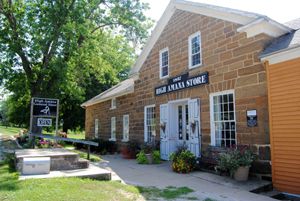
General Store in High Amana, Iowa, by Kathy Alexander.
In 1931, the community faced a crisis. In addition to the social strains of communal living, the community had suffered several economic setbacks in the previous decade. The Amana Society lost an important source of revenue when its calico print works closed after World War I. A fire in 1923 extensively damaged the woolen mill and destroyed the Amana flour mill. The national economic depression also shrank the market for the Society’s agricultural products.
The Elders presented community members with a choice: return to a more austere, disciplined life, or abandon the communal system. Significantly, the church’s dissolution was not considered an alternative. But most members also recognized that their community had changed and that they were probably incapable of returning to the strict life of early communalism. Many people no longer equated their faith with the social mores dictated by the Community. Furthermore, many members felt that communalism itself was no longer a necessary tenet of the church’s faith. On June 1, 1932, the members elected to retain the traditional church as it was and to create a joint-stock company (Amana Society, Inc.) to operate business enterprises for profit under a Board of Directors [Use of American currency began January 15, 1933]. This separation of the church from the economic functions of the community — the abandonment of communalism — is referred to by Amana residents still today as “the Great Change.”
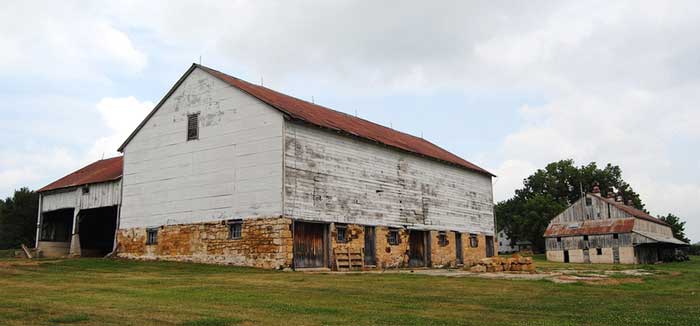
East Amana, Iowa barns by Kathy Alexander.
Today, the Amana Society, Inc., corporate heir to the land and economic assets of communal Amana, continues to own and manage some 26,000 acres of farm, pasture, and forest land. Agriculture remains an important economic base today, just as it was in communal times. Because the land was not divided up when communalism ended, the landscape of Amana still reflects its communal heritage. In addition, over 450 communal-era buildings stand in the seven villages as vivid reminders of the past.
The most widely known business to emerge from the Amana Society is Amana Refrigeration, Inc., founded by Amana native George C. Foerstner as a national leader in refrigerator production at the time of the Great Change. Skilled craftsmen at the Middle Amana woolen mill built the first beverage cooler, designed for a businessman in nearby Iowa City, in 1934. In the following decades, the mill became the site of this large, now private, plant-producing refrigerators, freezers, and air conditioners, and in 1967 introduced a new product — the Amana Radarange Microwave Oven. Today, the 19th-century woolen mill smokestack still rises over the modern plant.
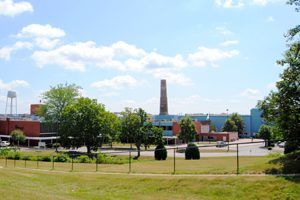
Middle Amana Whirlpool Plant by Kathy Alexander
The Amana Church remains a vital part of the Amana community. These churches are much as they were when built more than 125 years ago. The building exteriors are unpretentious, with no steeples or stained-glass windows.
The interiors continue to feature unfinished wood floors, plain pine benches, and unadorned walls that have long echoed the tradition of humility and piety. Men still enter and sit on one side of a central aisle, women on the other.
English language services were introduced in 1960, but, in both German and English services, the order of worship has changed little over the years, which includes a reading from Scripture; a reading of testimony from Rock, Metz, or Landmann; and hymns that would be recognized by a congregation of a century earlier.
Today, heritage tourism has become important to the Amana area economy. Historic preservation efforts by several local nonprofit organizations, as well as the Amana Society, Inc., along with land-use and historic preservation ordinances, aim to preserve Amana’s natural and built environment.
Visitors can stroll through Amana, the largest of the seven villages, and visit the Amana Woolen Mill and Amana Furniture Shop, which was originally a calico mill. Touring the other villages by car, visitors will pass through historic farmland and see the imprint the colonists made on the landscape at places such as the Mill Race, a canal dug to provide waterpower for the mills, Lily Lake, and groves of trees called Schulwalds. Barns and agricultural buildings clustered at the edge of each village; examples include West Amana, South Amana, and High Amana.

South Amana, Iowa Buildings
Each village contained numerous dwellings, such as those in Homestead. Groups of about 30-40 people ate meals at one of several village kitchens, such as the one in Middle Amana, now the Communal Kitchen Museum. Adjacent to this building is Hahn’s Hearth Oven Bakery, one of several village bakeries that supplied fresh bread to the kitchens daily, and the Coopershop Museum, an example of the many trade buildings vital to daily life in Amana.
Every village also had a general store, such as those in High Amana and West Amana, and a school for children ages 7-14. But of course, the colonists’ lives centered on religion, and a church was essential in each village, where services were held 11 times a week. The Amana Colonies have long been a popular destination for tourists who were interested in learning about communal life. Several of these historic hotels and other communal buildings still offer lodging today, including the Die Heimat Country Inn, Lower South Hotel, and the Baeckerei Bed and Breakfast.
©Kathy Alexander/Legends of America, updated September 2026.
Also See:
Sources: