
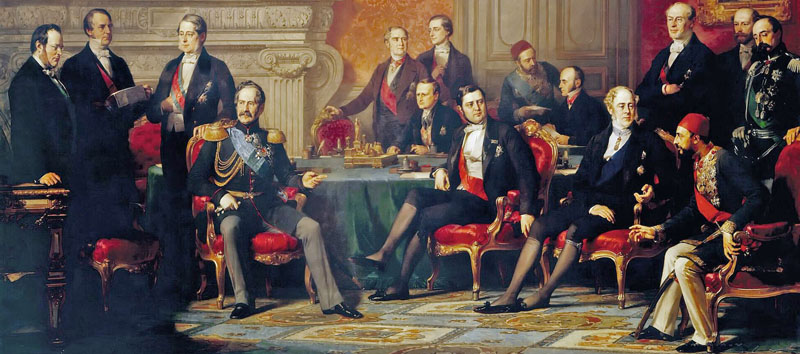
Treaty of Paris.
The Treaty of Paris, signed by representatives of King George III of Great Britain and the United States on September 3, 1783, officially ended the American Revolution and established the United States as an independent nation.
The American Revolution, which took place between 1775 and 1783, was a world conflict involving not only the United States and Great Britain but also France, Spain, and the Netherlands. The peace process brought a budding United States into international diplomacy, pitting it against the world’s largest and most established powers.
Peace negotiations began in Paris in April 1782, after the Yorktown surrender in 1781 and George Washington and the Continental Army’s victory in the American Revolutionary War. That year, Benjamin Franklin rejected informal peace overtures from Great Britain in favor of a settlement that would give the 13 states some autonomy within the British Empire. Franklin insisted on British recognition of American independence and refused to consider a peace separate from France, America’s staunch ally. Franklin did, however, agree to negotiate with the British to end the war. The negotiations continued through the summer of 1782. David Hartley and Richard Oswald represented the Kingdom of Great Britain and King George III.
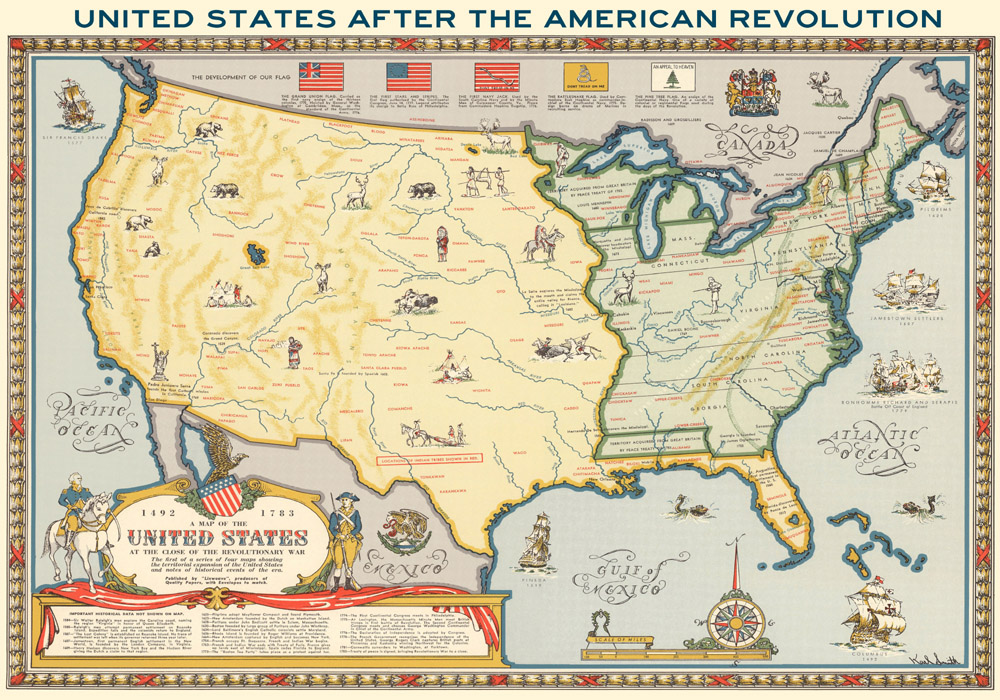
The United States after the American Revolution by Linweave Paper Company, 1957.
Franklin was joined by peace commissioners John Adams and John Jay; Franklin began formal negotiations with the British on September 27, 1782. These three men proved themselves ready for the world stage, playing a crucial role in establishing the United States as an independent nation and achieving many of the objectives the new United States sought. Two crucial provisions of the treaty were British recognition of U.S. independence and the delineation of boundaries that would enable American westward expansion.
After two months of hard bargaining, the negotiations resulted in a preliminary articles of peace in which the British accepted American independence and boundaries, resolved the difficult issues of fishing rights on the Newfoundland banks and prewar debts owed to British creditors, promised restitution of property lost during the war by Americans loyal to the British cause, and provided for the evacuation of British forces from the 13 states.
The treaty was drafted on November 30, 1782, and signed on September 3, 1783, at the Hôtel d’York, now 56 Rue Jacob in Paris, by Adams, Franklin, Jay, and Hartley.
It set the boundaries between Canada and the United States along lines the British labeled “exceedingly generous.” However, exact boundary definitions in the far Northwest and to the South continued to be subject to some controversy. Details included fishing rights, property restoration, and the treatment of prisoners of war.
This treaty and the separate peace treaties between Great Britain and the nations that supported the American cause, including France, Spain, and the Dutch Republic, are known collectively as the Peace of Paris. Only Article 1 of the treaty, which acknowledges the United States’ existence as a free, sovereign, and independent state, remains in force.
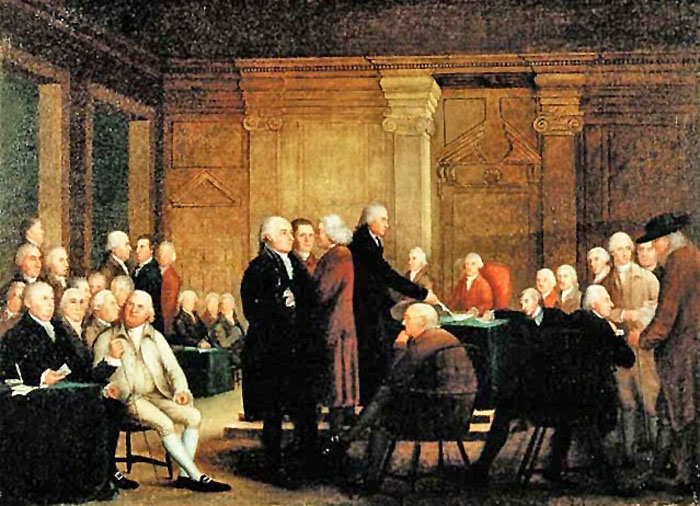
Continental Congress.
The Congress of the Confederation, operating as the legislative body of the newly established United States, ratified the Treaty of Paris on January 14, 1784, in Annapolis, Maryland, in the Old Senate Chamber of the Maryland State House. The U.S. sent copies to Europe for ratification by the other parties, with the first reaching France in March 1784. Britain ratified on April 9, 1784, and the parties exchanged the ratified versions in Paris on May 12, 1784.
©Kathy Alexander/Legends of America, September 2026.
Also See:
American History Photo Galleries
Sources: