

Misión San Luis Rey de Francia, California.
The San Luis Rey Mission in Oceanside, California, was the 18th of the 21 original missions the Spanish established throughout California during the 18th and early 19th centuries. Today, the mission church is among the state’s finest examples of Spanish-Colonial architecture.
By the late 1700s, the Spanish government in New Spain (modern-day Mexico) had already authorized the establishment of 17 Catholic missions throughout Alta California. The vast northern territory offered valuable resources for the Spanish and a long coastline dotted with protected bays. The systematic establishment of missions was an inexpensive, strategic move to bring religious and political ideologies to the native people who populated the area. One hope for the missions was to mitigate potential native aggression as the Spanish moved North to colonize these areas themselves.
Padre Fermín de Francisco Lasuén founded the 18th Spanish mission, San Luis Rey de Francia, in 1798. It was named after St. Louis IX, King of France, who lived during the 13th Century. He chose the original site, just East of modern-day Oceanside, for its protected location within a valley, the availability of building materials and water, and its proximity to a large tribe of Luiseño Indians. Constructed in 1798 at the mission’s founding, the original church was a small, simple adobe building. However, by 1802, early success and increased Catholic conversions required a larger church with adobe walls and a tiled roof.

San Luis Rey Band of Luiseño Indians in 1895.
The third church, which remains on the site today, dates from the peak of the mission’s success. Construction began in 1811, but because of its impressive scale and intricacy, the church was not finished until four years later, in 1815. Antonio Ramirez, a master stonemason, oversaw native converts who did most of the labor. The main walls of the new church rose 30 feet high and stood five feet thick, with an adobe interior and a baked-brick exterior. White lime plaster coated the walls, and the church’s main facade featured a mix of Baroque and Classical styles, including a 75-foot-tall bell tower at its eastern corner. The tower rang a chorus of eight bells in the 1800s, but only four hang within its belfry today.
The mission church’s original floor and roof were made of terra cotta tile, and by 1829, a wooden dome sat atop the building. The octagonal dome had an eight-windowed lantern that filtered light down into the nave and crossing below. The restored dome remains unique among all of California’s Spanish missions. The building is one of only two cruciform (cross-shaped) churches the Spanish ever built in the region.

San Luis Rey Mission, California, about 1935.
By the mid-19th Century, the San Luis Rey de Francia Mission was expansive, with landholdings covering approximately 950,400 acres. Over 3,000 converted native people lived at the mission and helped tend the land and care for the 50,000 head of livestock. The property produced grapes, oranges, olives, wheat, and corn, among other crops. The primary mission buildings, including the church, ringed a large central plaza, 500 feet square. At the height of its glory, the mission included irrigation channels and an outdoor lavanderia (laundry), a convento for housing the friars, officers’ barracks, dormitories for residents, workshops of various types, a long decorative colonnade, and an extensive gated cemetery.
Mexico gained independence in 1821, cutting short the San Luis Rey Mission’s period of prosperity. Under a new Mexican law, all California missions were secularized within a decade. Many, including San Luis Rey de Francia, went through periods of divided ownership and neglect. As nearby Indian towns grew, people stripped much of the mission church’s quality materials for new construction.

Father Joseph Jeremias O’Keefe and two young priests at Mission San Luis Rey, by George P. Thresher, 1900.
Between 1847 and 1857, the mission church served as an operational base for the United States military. California became the 31st state in the Union in 1850. The men were not greatly concerned with the church’s upkeep, even housing livestock within its walls. President Lincoln officially returned the mission to the Catholic Church in the 1860s, but the property was so dilapidated that the church abandoned it.
Mission San Luis Rey de Francia might have vanished entirely from the landscape if not for a group of Mexican Franciscans who reoccupied the church in 1892. Under the guidance of Father Joseph Jeremias O’Keefe, massive rebuilding and restoration began. Despite years of deterioration, much of the original mission remained, along with original drawings, plans, and designs. After O’Keefe’s death, the restoration continued.
Today, San Luis Rey Mission Church is a part of the restored mission complex on 56 acres of its original land. Franciscan friars still study, worship, and live at the mission, and it is highly regarded as both a religious and heritage site. The church is among the most stunning Spanish mission churches and is a popular tourist attraction in Southern California. Original patterns from the church’s old documents and remnant textiles decorate the interior. Outside, the church is believed to look much as it did when it was originally constructed.
In addition to the church, visitors can view the other impressive features of the site. One of the most fascinating ruins left at the mission is the old lavanderia. Just south of the mission church, this structure featured a tiled irrigation system in which water spouted from the mouths of carved gargoyles. The water was diverted from the nearby San Luis Rey River and used for bathing and laundering garments. The water capturing and retention system was advanced, even by modern standards. The lavanderia has been an archeological site since its unearthing in 1955, and today, visitors can see its tiled stairs, channels, and stone pools. The gargoyles remain intact and are believed to be the only known examples of carved Luiseño sculpture.

San Luis Rey Mission by Bernard Gagnon, Wikipedia.
Ruins of the original convento arches, colonnade, officers’ barracks, and lime kiln are still on the grounds, as is the original mission cemetery – the oldest in North San Diego County. A massive tree stands in the middle of the original central square. Planted in 1830, it remains California’s oldest and first pepper tree.
The mission’s museum interprets the San Luis Rey Mission Church and its surrounding structures for the public. Housed in the former convento, the museum oversees the church’s preservation and conservation efforts and extensive historical collections. Exhibits cover the mission’s history and include objects and artifacts from both the Spanish Colonial and Mexican periods.
Today, the San Luis Rey Mission Church is a National Historic Landmark open daily to visitors with an admission charge.
More Information:
San Luis Rey Mission
4050 Mission Avenue
Oceanside, California 92057
760-757-3651
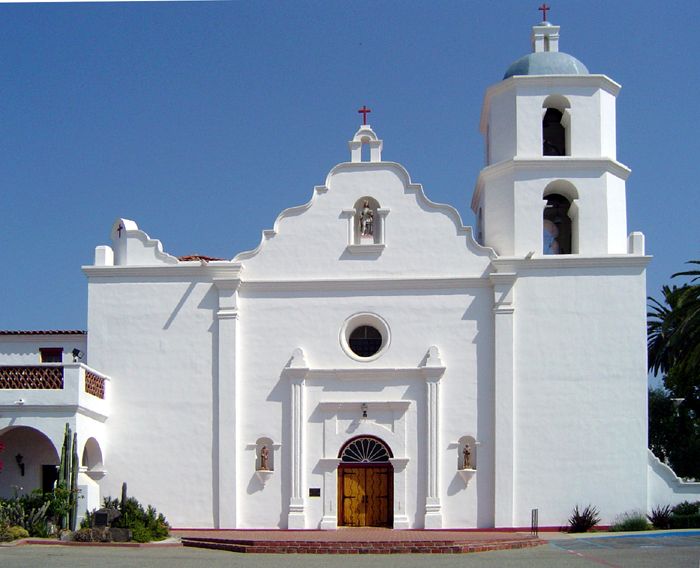
San Luis Rey Mission, Oceanside, California, courtesy of Wikipedia.
Compiled and edited by Kathy Alexander/Legends of America, updated September 2026.
Also See:
List of Missions & Presidios in the United States
Missions & Presidios of the United States
Spanish Missions & Presidios Photo Gallery
Sources: