
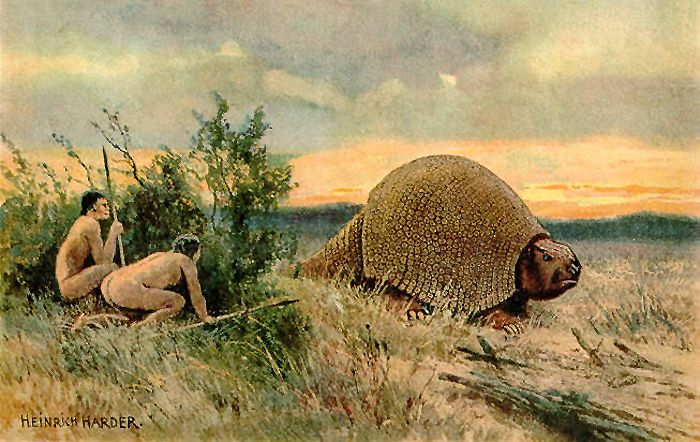
Paleo Indians by Heinrich Harder, 1919.
The Paleoindian Period, also known as the Lithic stage, spans approximately 8,000-16,000 BC and refers to a time at the end of the last ice age when humans first appeared in the archaeological record of North America.
Evidence suggests that groups of hunter-gatherers migrated across the Bering land bridge between Siberia and Alaska when sea levels were several hundred feet lower than they are today. Paleoindian campsites in central Alaska date back to approximately 11,800 BC, which is significantly older than sites in the lower 48 states. This route brought the first groups into present-day Montana, where the oldest known human burial associated with early Paleoindian tools was discovered in 1968.
The Bering Bridge existed from 45,000 to 12,000 BC when groups of hunter-gatherers migrated across the continent. These people were followed by animals, both of which migrated.
One of the original groups that entered Canada and the United States was the Clovis culture. They encountered and hunted many species of large, now-extinct mammals. They felled these “megafauna”, named such due to the large size compared to modern beasts, with spears tipped with stone points. These animals included the mastodon, mammoth, horse, tapir, ground sloth, great bison, giant beaver, giant tortoise, American lion, short-faced bear, and saber-toothed tiger.

Paleo Indian People.
Early Paleoindian stone tools have been found with the bones of many extinct mammals in many states.
Archaeologists divide the Paleoindian period into three subperiods: Early, Middle, and Late. The subperiods are well represented by stone tools found on the surface of farm fields and river gravel bars. Several cultures and traditions have been identified within this time frame, including the Clovis Culture, Folsom Tradition, and Dalton Tradition.
The fluted spear point is identified with the early part of the period, while a succession of fluted and non-fluted spear points represents the middle and late portions.
The Paleoindian period ended about 10,000 years ago as the culture evolved into what archaeologists term the Archaic Period.
©Kathy Alexander/Legends of America, updated October 2025.
Also See:
Ancient Cities of Native Americans
Native American Archaeological Periods
Native Americans – First Owners of America
See Sources.