
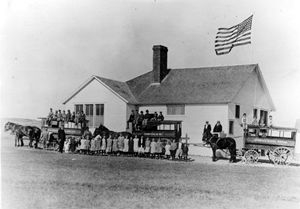
Atkinson School District in Griffin, North Dakota, about 1915.
Located in Bowman County, Griffin is situated about seven miles West of Bowman and six miles East of Rhame, North Dakota, on Highway 12. Griffin is an authentic ghost town with no residents.
Legends‘ reader Mark Griffin tells us that, according to North Dakota Place Names, the post office and Milwaukee Road railroad station were named Atkinson until February 10, 1908, when the name was changed to Griffin in honor of Henry T. Griffin, the railroad’s Assistant General Passenger Agent. According to the December 27, 1900, edition of The New York Times, “Henry T. Griffin has assumed the duties of Assistant General Passenger Agent of the Chicago, Milwaukee St. Paul Railway Company.”
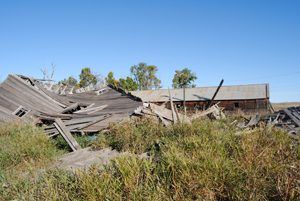
Collapsed building in Griffin, North Dakota, by Kathy Alexander.
Situated North of the railroad tracks that parallel the highway, this one-time community was primarily a business venture rather than a town, and it never had many residents. It had some of the county’s largest stockyards, along with several grain elevators, a depot, and a couple of section houses for railroad workers. In 1911, the North Dakota Magazine reported that Griffin had a general store, lumberyard, and elevators, and was experiencing rapid growth. It may have also had a gas station at one time.
It was also home to a school for area children. In the late 19th Century, school reformers urged rural school districts to reorganize their one-room schools into consolidated schools with multiple classrooms. Bowman County was one of the few in North Dakota to seriously test this idea, constructing four impressive rural consolidated schools in the early 1920s, including the one in Griffin, called the Atkinson School. Unfortunately, population loss from the countryside in the following years doomed these consolidated rural schools just as surely as the one-room schools.
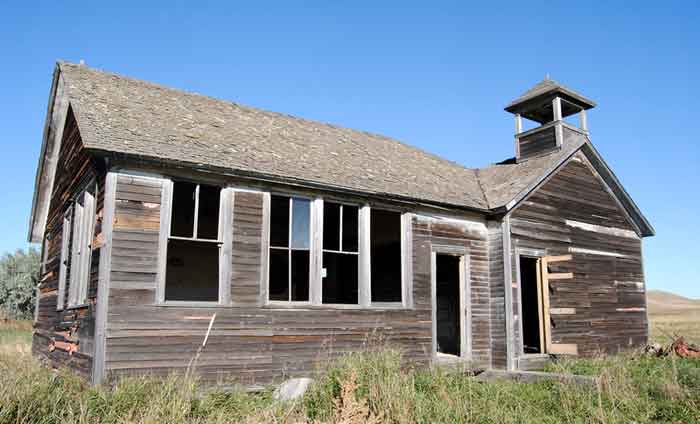
Abandoned school in Griffin, North Dakota.
Today, Griffin is home to only the quickly deteriorating old school building, a boxcar, a barn, and a few other deteriorating buildings. According to local lore, the stockyards attracted cowboys, who often frequented the town, and allegedly, a few gunfights took place within the community. About two miles North of the town ran the old Yellowstone Trail, the first transcontinental automobile highway through the upper-tier states. Established in 1912, the old highway ran from Plymouth, Massachusetts, through Yellowstone National Park, and on to Seattle, Washington. In some areas, this old road was marked with three-foot-tall stones painted yellow.
©Kathy Alexander/Legends of America, updated October 2026.
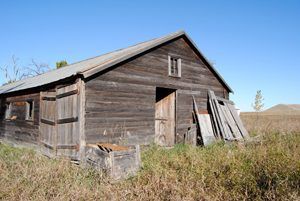
An old barn or workshop in Griffin, North Dakota, by Kathy Alexander.
Also See:
North Dakota Ghost Town Gallery
See Sources.