
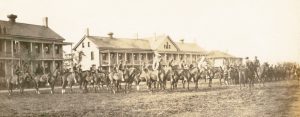
Cavalry soldiers at Fort Sam Houston, Texas.
Fort Sam Houston, just North of downtown San Antonio, Texas, is one of the oldest posts in the U.S. Army.
The U.S. Army has maintained a presence in the Alamo City since 1845. During that time, the installation performed five distinct and essential roles: headquarters, logistical base, mobilization and training site, garrison, and medical support provider.
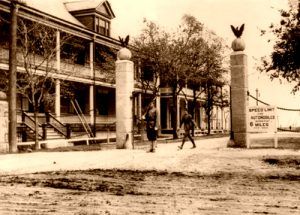
Fort Sam Houston Entrance, about 1912.
At first, the Army leased facilities in San Antonio, including the Alamo. The Army repaired the Alamo and added a roof to use it as a headquarters. However, in the 1870s, the military commander of the Department of Texas, Major General Edward Ord, a West Point-trained Army engineer, began construction of Fort Sam Houston.
By 1876, upon completing the Quadrangle, the Army began moving its facilities to the new site. The Army built additional facilities to meet its needs as it expanded. The headquarters and garrison have long been among the Army’s most important commands. Before the Civil War, the headquarters controlled 25 percent of the Army’s forces.
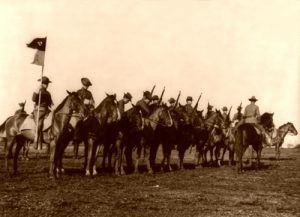
The 11th Cavalry at Fort Sam Houston, 1912.
From 1910 until World War II, Fort Sam Houston was the largest Army post in the continental United States. Many distinguished American soldiers, including 13 Army Chiefs of Staff and two United States presidents, served here.
The post’s prominence led to significant tactical and organizational innovations. Military aviation began here in 1910 and was revitalized during the 1940s and 1950s. The Army conducted large-scale troop maneuvers, including the first practical use of the Command Post Exercise in 1911. Field exercises in the 1930s developed the Triangular Division. This streamlined, mobile organization was the foundation of the Army’s combat power in World War II. The Army also tested delivering troops to the battlefield by air here in 1939-41. The Army first developed aeromedical evacuation of casualties here as early as 1917.
At the end of the Second World War, the Army made Fort Sam Houston the principal medical training facility. With this decision, Brooke General Hospital was designated as one of the Army’s premier medical centers. Today, Fort Sam Houston is the world’s largest and most important military medical training facility.
Throughout its existence, Fort Sam Houston and the City of San Antonio have had a close and harmonious relationship. The two have grown and matured together. The city is often called the “mother-in-law of the Army” because many soldiers, including Dwight D. Eisenhower, met their future spouses here.
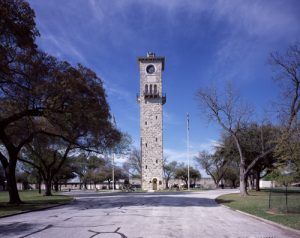
The quadrangle clock tower, Fort Sam Houston, Texas, by Carol Highsmith.
The post has since grown from its original 92 acres, donated to the Army by the city, to approximately 3,000 acres today. A continuously growing installation, the fort has taken on new missions, such as being home of the Army Medical Command headquarters, in addition to command headquarters such as Fifth U.S. Army, U.S. Army South, Fifth Recruiting Brigade, 12th ROTC Brigade, U.S. Navy Regional Recruiting, the San Antonio Military Entrance and Processing Station, and the U.S. Naval School of Health Sciences, Bethesda Detachment.
Fort Sam Houston also houses Brooke Army Medical Center, the Great Plains Regional Medical Command, Headquarters Dental Command, Headquarters Veterinary Command, the Institute for Surgical Research (trauma/burn center), the Defense Medical Readiness Training Institute, and the Army Medical Department NCO Academy.
More than 27,000 military and civilian personnel work at the post, with an annual payroll and operating budget of $1.9 billion. Local purchases made by installation activities total almost $105 million annually. Funding for construction projects on post averages $30 million annually.
Fort Sam Houston’s significant contributions to the United States were recognized in 1975 when the post was designated a National Historic Landmark. As one of the Army’s oldest installations, Fort Sam Houston boasts the most extensive collection of historic structures—more than 900 buildings.
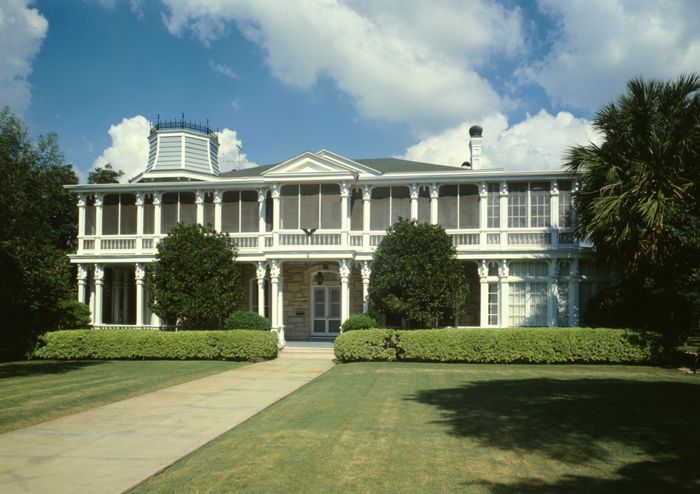
Fort Sam Houston Headquarters, San Antonio, Texas, by the Historic American Buildings Survey.
Even more consequential than the numbers is the historical integrity of the post’s different sections, which represent different eras of construction and reflect Army concepts in planning and design. Careful preservation of these areas allows the post to live with its history, surrounded by the traditions of excellence established when the first soldier arrived here in 1845.
Because Fort Sam Houston is still an extremely active base, most of its historic buildings
are still in use and thus off-limits; however, the historic fort still provides a wealth of information and photography opportunities. The oldest building on the base, the Quadrangle, is an impressive 1876 limestone structure centered on a brick clock tower and encloses a grassy square where peacocks and deer roam freely.
Apache Chief Geronimo was held captive here for 40 days in 1886. The building was originally a supply depot and housed Geronimo and his Apache when they were captured. Although the Quadrangle now serves as an office complex for the commanding general and staff of U.S. Army North, it remains open to the public.
The installation also provides two museums — the Fort Sam Houston Museum, which details the history of the armed forces in Texas, and the U.S. Army Medical Department Museum, which displays Army medical equipment and American prisoner-of-war memorabilia. The site also includes the Fort Sam Houston National Cemetery.
The complex is located at Grayson St. and New Braunfels Avenue, about 2 ½ miles northeast of downtown. Because it is an active military installation, visitors must enter through the Walters Gate (take the Walters St. exit off I-35) and present a driver’s license.
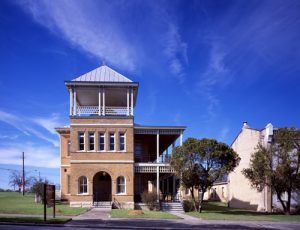
The Band Building is just one of Fort Sam Houston’s 900 historic buildings. Photo by Carol M. Highsmith.
More Information:
Fort Sam Houston
210-221-1151 (public affairs)
©Kathy Alexander/Legends of America, updated September 2026.
Also See:
Forts & Presidios Across America
San Antonio – A Mecca For History Buffs
Primary Source: Fort Sam Houston