
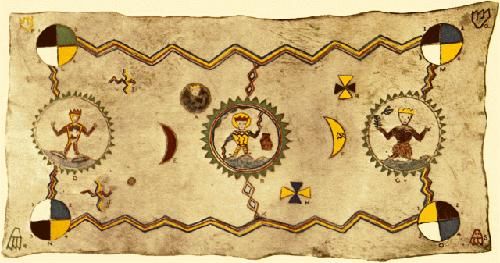
Sacred buckskin of the Apache.
The Yavapai are an Apache tribe of the Yuman Family, popularly known as Apache Mohave and Mohave Apache, meaning “hostile or warlike Mohave.” Before their removal to the Rio Verde Agency in May 1873, the Yavapai claimed as their range the Rio Verde Valley and the Black Mesa, from the Salt River to the Bill Williams Mountains in western Arizona. They then numbered about 1,000. Earlier, they ranged much farther west, as far west as the Colorado River, but they were chiefly an interior tribe, living south of Bill Williams Fork, as far as the Castle Dome Mountains above the Gila River. In the spring of 1875, they were placed under the San Carlos Apache Agency, where, in the following year, they numbered 618.
Writings of the time described the Yavapai men as tall, erect, muscular, and well-proportioned, and the women as stouter and more handsome than the Yuma. In 1900, most of the tribe drifted from the San Carlos Reservation. They settled at their old home on the Rio Verde, including the abandoned Camp McDowell Military Reservation, assigned to their use on November 27, 1901. By 1903, they were said to number between 500 and 600 (but this number probably included some Yuma and Apache), scattered in small bands from Camp McDowell to the head of the Rio Verde.
An executive order of September 15, 1903, set aside the old reservation for their use. However, in 1905, the ravages of tuberculosis were reported to be largely responsible for a great number of deaths, and by the following year, their numbers had been reduced. In 1906, 465 “Mohave Apache” were officially reported at Camp McDowell and in the Upper Verde Valley of Arizona, and 55 at San Carlos, for a total of 520.
Today, the Yavapai have three reservations in Arizona.
The Yavapai-Prescott Tribe is located near Prescott, Arizona, on a reservation of about 1,500 acres. Established solely for the Yavapai in 1935, it comprised only 75 acres of the former Fort Whipple Military Reserve in central Arizona. The modern Yavapai-Prescott Indian Tribe continues to preserve the ancient culture of its ancestors. It works diligently to achieve economic independence through numerous tribal enterprises, including a resort and two casinos. Tribal members today number about 160.
Contact Information:
Yavapai-Prescott Tribe
530 E. Merritt
Prescott, Arizona 86301
928-445-8790
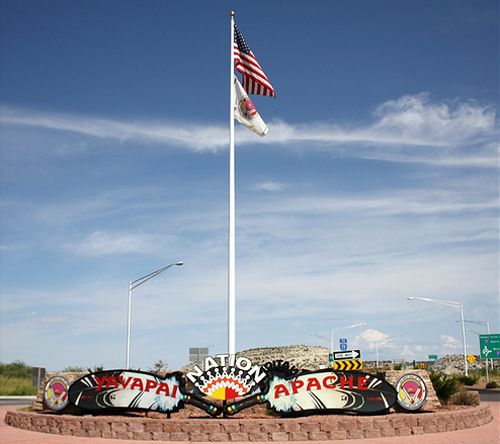
Yavapai Apache Reservation.
The Yavapai-Apache Nation comprises two distinct tribal peoples, the Yavapai and Apache, who refer to themselves as the Wipuhk’a’bah and Dil’zhe’e. Both tribes lived in the Verde Valley and the surrounding country for centuries. The Dil’zhe’e lived mostly east, and the Yavapai lived west of the Verde River. Revenues from tribally owned enterprises, including a casino, assist the Nation in providing much-needed economic, educational, and social programs for its tribal members.
The reservation encompasses four tribal communities, including Camp Verde, its tribal headquarters, Clarkdale, Middle Verde, and Rimrock, and more than 1,600 acres throughout the Verde Valley.
Contact Information:
Yavapai-Apache Nation
2400 W. Datsi St.
Camp Verde, Arizona 86322
928-567-3649
The Fort McDowell Yavapai Nation is located within Maricopa County, about 23 miles northeast of Phoenix. Created by an Executive Order on September 15, 1903, the 40-square-mile reservation is now home to 600 community members, while another 300 live off-reservation.
It sits amid the ancestral territory of the once-nomadic Yavapai people. Today, Fort McDowell Yavapai takes great pride in its community and has built a strong, stable community and economy, including a casino and resort, through perseverance and hard work.
Contact Information:
Fort McDowell Yavapai Nation
P.O. Box 17779
Fountain Hills, Arizona 85269
480-789-7000
©Kathy Alexander/Legends of America, updated February 2026.
Also see:
Arizona – The Grand Canyon State
Fort McDowell – Amid the Apache Wars
Apache – The Fiercest Warriors in the Southwest
See Sources.