
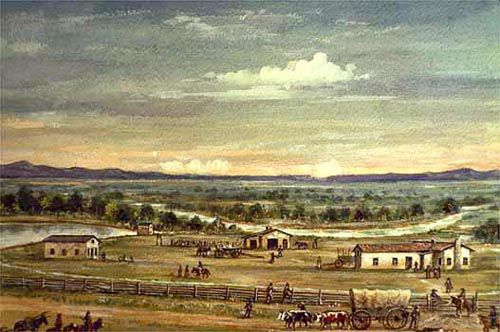
Whitman Mission, Washington.
The Whitman Massacre on November 29, 1847, instigated the Cayuse War, which would last for seven bloody years between the Cayuse people and the United States Government and local white settlers.
In 1836, missionary couple Marcus and Narcissa Whitman founded the Whitman or Waiilatpu Mission about seven miles west of present-day Walla Walla, Washington. Although the mission’s development was slow, it would eventually include a large adobe mission house, several residences, a shelter for emigrants, a gristmill, and a blacksmith shop. In addition to its primary role of attempting to convert the Cayuse to Christianity, the mission also served as a way station and landmark along the Oregon Trail.
Despite the Whitmans’ energy and devotion, progress in educating and converting the Cayuse was slow, as the vast majority rejected the idea of farming, continued their nomadic way of life, and remained indifferent to their preaching. Tensions between the white settlers and the Indians were also increased by quarreling among the various missions, the increasing number of white settlers, and numerous cultural misunderstandings. As tensions increased, the Whitmans began to devote more and more time to caring for emigrants and less to the Cayuse.
Worse, the new settlers brought diseases with them, and in 1847, a measles epidemic spread from the wagon trains to their villages and, within two months, killed about half of them. When Marcus Whitman, a practicing physician, was unable to check the epidemic, the Cayuse came to believe he was poisoning them to make way for settlers.
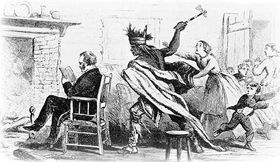
Whitman Massacre
Seeking revenge, Cayuse tribesmen attacked the Whitman Mission on November 29, 1847, killing fourteen settlers, including Marcus and Narcissa Whitman, and destroying most of the buildings. Afterward, the Indians held 53 women and children captive for ransom before eventually being released.
This event, known as the Whitman Massacre, sparked the Cayuse War. The following year, a force of over 500 militiamen, led by fundamentalist clergyman Cornelius Gilliam and supported by the United States Army, marched against the Cayuse and other native inhabitants of central Oregon, demanding the surrender of the warriors responsible for the Whitman Massacre.
However, the Cayuse refused to make peace and began to raid isolated settlements. US troops and militiamen were then called in to suppress the Cayuse. In 1850, five Cayuse warriors were captured by the military and tried for the murder of the Whitmans. All five were convicted by a military commission and hanged on June 3, 1850.

Cayuse Warrior, Edward S. Curtis, 1910.
However, this did not end the conflict, as bloodshed continued in the area until the Cayuse were finally defeated in 1855. With their numbers significantly reduced by the war, the Cayuse were placed on a reservation with the Umatilla Indians, and their tribal lands were confiscated.
The war had significant long-term consequences for the region, opening up the Cayuse territories to white settlement but wrecking relations between whites and the native tribes and setting the scene for a series of fresh wars over the following 40 years.
©Kathy Alexander/Legends of America, updated March 2026.
Also See:
Cayuse Tribe of Washington and Oregon
Frontier Skirmishes between the Pioneers & the Indians
Indian Campaigns by the US Army
Washington Indian Conflicts, Battles & Wars
Whitman Massacre National Historic Site
See Sources.